Physics · Glossary

What is Absolute temperature?

Also known as: kelvin

Definition 2.6 High School Physics · Chapter 2 — Light Spectra and the Message of Light

For radiation laws, the absolute temperature is counted not from the freezing point of water but from the coldest state possible, 273C-273{}^{\circ}\mathrm{C}. The unit is the kelvin (symbol K\mathrm{K}), with the same size of degree:

T (in K)=θ (in C)+273.T \text{ (in } \mathrm{K}) = \theta \text{ (in } {}^{\circ}\mathrm{C}) + 273 .

Thus a room at 20C20{}^{\circ}\mathrm{C} is at 293K293\,\mathrm{K}, and the surface of the Sun, near 5500C5500{}^{\circ}\mathrm{C}, is near 5800K5800\,\mathrm{K}.

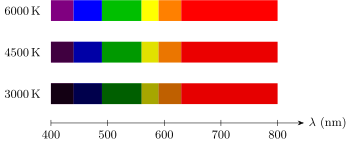
The visible band of a continuous spectrum at three temperatures: the cooler the source, the dimmer the band — and the blue end fades first.

Examples

Example 2.9 (Taking the Sun’s temperature)

The Sun’s continuous spectrum is most intense near λmax=500nm\lambda_{\max} = 500\,\mathrm{nm}. Wien’s law gives its surface temperature:

T=2.90×10³mK5.00×107m=5800K,T = \frac{2.90 \times 10^{-3}\,\mathrm{m}\,\mathrm{K}}{5.00 \times 10^{-7}\,\mathrm{m}} = 5800\,\mathrm{K},

about 5500C5500{}^{\circ}\mathrm{C} — measured from 150150 million kilometers away, with a prism and a division.

Read in context →