 Coach
CoachAn isolated conductor at potential carries a charge proportional to : , with its capacitance (farad, ); for a sphere . A capacitor is a pair of conductors (plates) carrying opposite charges and facing each other so that the field is confined between them; its capacitance is with the voltage between the plates. The symbol and the circuit law were used in Chapter 7.
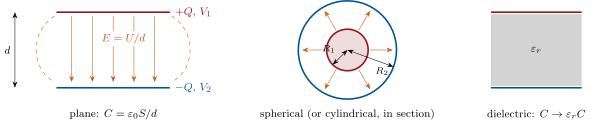
Examples
Example 27.15 (Three capacitors and their energies)
A square metre of foil pair apart: — the farad is a huge unit. A defibrillator’s at : , delivered in milliseconds. A supercapacitor of at : in a can the size of a soda bottle — its capacitance comes from a molecular gap and an enormous porous . The energy density of a field at the breakdown of air, , is why capacitors store so little compared with batteries.