Definition 10.1University Physics — Year 2 · Chapter 10 — Charges, Currents and Conduction
At the mesoscopic scale, matter carries a volume charge densityρ(M,t) (C/m3): the charge ρdτ in dτ. A surface may carry a surface densityσ (C/m2), a wire a linear density λ (C/m). If the carriers of species i (charge qi, number density ni) move at the mean velocity vi, the current density is
j=i∑niqivi(A/m2),
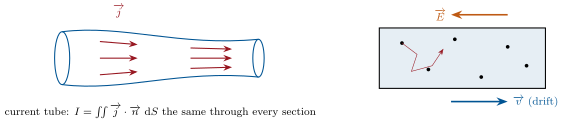
and the intensity through an oriented surface S is the flux I=∬Sj⋅ndS: the charge crossing S per unit time. For a single species, j=ρmv with ρm=nq the density of mobile charge.
Left: a tube of current — in a stationary regime the same intensity crosses every section. Right: an electron in a metal zigzags between collisions at about 106 m/s; the field adds a slow drift, opposite to E, of a fraction of a millimetre per second.
Examples
Example 10.2(How slowly electrons drift)
Copper has one conduction electron per atom: n=ρCuNA/M=8900×6.02×1023/0.0635=8.5×1028m−3. A current of 10A in a 1.5mm2 wire is j=6.7×10⁶A/m2, and the drift velocity is v=j/ne=6.7×106/(8.5×1028×1.6×10−19)=0.5mm/s — two hours per metre. The lamp lights at once because the field that pushes the electrons is set up along the whole wire within nanoseconds (it travels at nearly the speed of light, as the cable of Chapter 8 showed): all the electrons start together, like water in a full hose.
Example 10.3(Orders of magnitude)
Lightning, 30kA in a channel of 1cm radius: j≈1×10⁸A/m2. A household wire: 106–107. An electron beam in a cathode-ray tube, 1mA over 1mm2: 103. A nerve fibre, 1nA through 10µm2: 102. The beam of a particle accelerator, 1A in a 0.1mm2 spot: 107 — in vacuum, with no collisions at all.
 Coach
Coach