Drop a stone in a pond and watch the ring of ripples: new crests are born at its inner edge, run outward through the ring, and die at its outer edge — the ring as a whole moves slower than the crests in it. Sit on a beach after a distant storm and the long, slow swell arrives a day before the short chop: the sea sorts waves by wavelength. The first transatlantic telegraph cable, in 1858, turned crisp dots and dashes into a smear that took minutes to read. In all three cases the speed of a wave depends on its frequency: the medium is dispersive. This chapter introduces the dispersion relation, the complex wavenumber that carries both propagation and absorption, the group velocity at which a packet — and its energy, and its information — actually travels, and the line along which telegraphy, television and the internet have travelled: the coaxial cable.
A linear, homogeneous, time-invariant medium admits the plane monochromatic waves s=Aei(ωt−kx) (complex notation; the physical signal is the real part) provided ω and k satisfy the dispersion relation of the medium, D(ω,k)=0, solved as k(ω) or ω(k). For real k the wave travels without deforming at the phase velocity
vφ=kω.
The medium is non-dispersive when vφ does not depend on ω (then ω=ck and every signal propagates undeformed — the d’Alembert equation) and dispersive otherwise.
Proof. Inserting ei(ωt−kx) into a linear equation with constant coefficients turns each ∂t into iω and each ∂x into −ik, leaving an algebraic relation. The string, the sound wave and the rod gave ω2=c2k2. ∎
Example 8.2(Dispersive and non-dispersive)
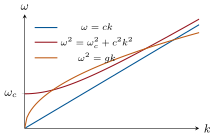
(i) A string on an elastic bed (restoring force −Ky per unit length, or a chain of pendulums), μ∂t2y=T∂x2y−Ky: ω2=ωc2+c2k2 with ωc=K/μ — the Klein–Gordon relation, the same as a plasma’s and a waveguide’s (Chapters 14 and 16): vφ=c/1−ωc2/ω2>c, and no real k below the cut-offωc. (ii) Deep-water gravity waves: ω2=gk (admitted), vφ=g/k=gλ/2π: long waves are faster — 12.5m/s for 100m, 40m/s for 1km. (iii) The chain of atoms, ω=2ω0∣sin(ka/2)∣ (Chapter 6). (iv) Light in glass, k=n(ω)ω/c, which is why a prism spreads a spectrum.
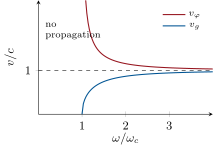
Left: three dispersion relations — a straight line for a non-dispersive medium, the Klein–Gordon hyperbola with its cut-off, the parabola of deep-water waves. Right: for the Klein–Gordon relation the phase velocity exceeds c and the group velocity stays below it, with vφvg=c2.
Definition 8.3(Complex wavenumber: propagation and attenuation)
When the dispersion relation gives, for real ω, a complex k=k′−ik′′, the wave is
s=Ae−k′′xei(ωt−k′x):
it propagates at vφ=ω/k′ and its amplitude decays as e−x/δ with the attenuation lengthδ=1/k′′ (it must decay in its direction of propagation: k′ and k′′ of the same sign). If k is purely imaginary, k=−iκ, the wave is evanescent: Ae−κxeiωt, a standing oscillation whose amplitude dies over the distance 1/κ without propagating anything — the case of the Klein–Gordon medium below its cut-off, κ=ωc2−ω2/c, and of a metal at optical frequencies.
Example 8.4(A damped string)
A string in a viscous fluid, μ∂t2y+α∂ty=T∂x2y: k2=(ω2−iαω/μ)/c2. For weak damping (α≪μω), k≈cω(1−i2μωα): the wave keeps its speed and loses amplitude over δ=2μc/α=2Z/α, independent of frequency — a dissipative, non-dispersive loss, 8.7dB per length δ.
8.2 Wave packets and group velocity
Proposition 8.5(Beats; group velocity)
Two waves of equal amplitude and neighbouring frequencies ω±δω, wavenumbers k±δk, superpose into
s=2Acos(δωt−δkx)cos(ωt−kx):
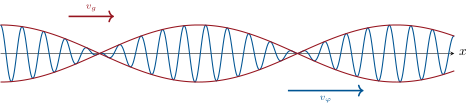
a carrier at (ω,k) moving at vφ=ω/k, modulated by a slow envelope moving at δω/δk. A wave packet — a superposition of monochromatic waves with wavenumbers in a narrow band around k0 — travels, as a whole, at the group velocity
vg=dkdωk0,
which is the velocity of its energy and of the information it carries. In a non-dispersive medium vg=vφ=c; otherwise the packet deforms as it goes (it spreads), the faster the larger d2ω/dk2 and the narrower its spectrum’s complement, its spatial width.
Proof. The sum-to-product formula gives the beats. For a packet, write s=∫a(k)ei(ω(k)t−kx)dk (a Fourier superposition — the Fourier integral is studied in the Year 3 mathematics volume; here only its interpretation as a continuous sum of sinusoids is used), with a(k) peaked at k0. Expand ω(k)≈ω0+vg(k−k0): then s≈ei(ω0t−k0x)∫a(k)ei(k−k0)(vgt−x)dk, a carrier times an envelope that is a function of x−vgt only — the envelope moves at vg. The next term, 21ω′′(k0)(k−k0)2t, dephases the components in time and spreads the envelope. The energy of a packet is located where its envelope is; so is any signal. ∎
Beats: two neighbouring frequencies produce a fast carrier (moving at the phase velocity) under a slow envelope (moving at the group velocity); in a dispersive medium the two speeds differ and the crests slide through the envelope.
Example 8.6(Deep water: the crests outrun the group)
ω=gk: vg=21g/k=21vφ. A group of swell moves at half the speed of its crests: watching a wave train, you see crests appear at the back of the group, travel through it and vanish at the front — exactly the pond’s ring. A storm 3000km away sends its 15s swell (λ=gT2/2π=350m, vg=gT/4π=11.7m/s) in three days, its 8s waves (vg=6.2m/s) in five and a half: from the arrival times of the different periods, oceanographers locate the storm.
The wake of a motorboat on a calm lake: the feathered pattern stays inside a wedge of fixed angle because the energy of each water wave travels at half the speed of its crests — dispersion made visible.
Example 8.7(Klein–Gordon: faster than light, and not)
For ω2=ωc2+c2k2: vφ=ω/k and vg=c2k/ω, so vφvg=c2: the phase velocity exceeds c (in the ionosphere, a 10MHz wave’s crests move faster than light) but the group velocity, which carries the signal, stays below it. A phase velocity transports no energy and no information — the crests are like the spot of a lighthouse beam sweeping a distant cloud.
Remark 8.8(Spreading)
A packet of spatial width Δx contains wavenumbers over Δk∼1/Δx (the Fourier reciprocity, admitted); its components’ group velocities differ by Δvg≈∣ω′′∣Δk, so after a time t it has spread by ∣ω′′∣Δkt: it doubles its width after tsp∼Δx2/∣ω′′∣. A packet of ten deep-water waves of 100m (Δx≈1km, ω′′=−41g/k3=−50m2/s) doubles in about six hours; a light pulse of 1ns in an optical fibre spreads by tens of picoseconds per kilometre — the limit of the bit rate of long links. The quantum wave packet of Chapter 30 spreads for the same reason.
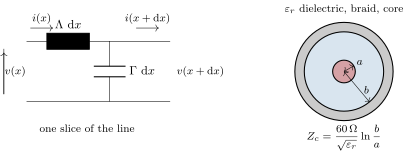
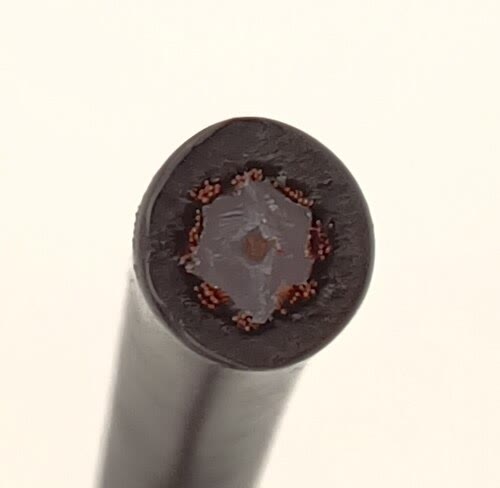
A coaxial cable (or any two-conductor line) has, per unit length, an inductance Λ and a capacitance Γ. The voltage v(x,t) between the conductors and the current i(x,t) in the inner one obey the telegrapher’s equations
Zc being the characteristic impedance of the line. For a coaxial cable of radii a<b filled with a dielectric of relative permittivity εr, Λ=2πμ0lnab, Γ=ln(b/a)2πε0εr, so c=c0/εr (about 2×10⁸m/s, two thirds of the speed of light) and Zc=εr60Ωlnab: 50Ω or 75Ω for the usual cables.
Proof. Model the slice [x,x+dx] as a series inductance Λdx and a shunt capacitance Γdx: the voltage drop along the slice is Λdx∂ti, and the current lost into the capacitance is Γdx∂tv. Cross-differentiate. For v=f(x−ct), the first equation gives i=f(x−ct)/Λc=v/Λ/Γ. The values of Λ and Γ are those of the cylindrical capacitor and of the coaxial inductor computed in the Year 1 volume. ∎
Left: the equivalent circuit of a slice dx of a lossless line — series inductance, shunt capacitance — from which the telegrapher’s equations follow. Right: a coaxial cable in section; its Λ and Γ depend only on the ratio of radii and on the dielectric.
Proposition 8.10(Lossy line; the distortionless condition)
With a series resistance R and a shunt conductance G per unit length, the equations become ∂xv=−Λ∂ti−Ri, ∂xi=−Γ∂tv−Gv, and the dispersion relationk2=(Λω−iR)(Γω−iG): the line is dispersive and attenuating. Two limits: (i) R/Λ=G/Γ (Heaviside’s condition, reached by adding inductance): k=ωΛΓ−iRG, every frequency travels at the same speed with the same attenuation — the line attenuates but does not distort. (ii) Λ≈0, G≈0 (the first submarine cables): ∂x2v=RΓ∂tv, a diffusion equation — a pulse does not propagate but smears, reaching a distance L after a time ∼RΓL2 (Kelvin’s law of squares), a hundred times longer for a cable ten times longer.
Proof. Insert ei(ωt−kx): −ikv=−(iωΛ+R)i, −iki=−(iωΓ+G)v; multiply. Under Heaviside’s condition the product is a perfect square. The diffusion limit drops the iωΛ and G terms. ∎
Example 8.11(Three cables)
The 1858 transatlantic cable: a single copper wire in gutta-percha, R≈3Ω/km, Γ≈0.3µF/km, L=3000km: RΓ=9×10⁻¹⁰s/m2 and RΓL2≈8s per dot: a word a minute, and the operators’ attempts to force the signal with 2kV destroyed the insulation within weeks. A telephone line loaded with coils every 2km to satisfy Heaviside’s condition (1900): clear speech over hundreds of kilometres. A modern 50Ωcoaxial cable: c=2×10⁸m/s, Λ=0.25µH/m, Γ=100pF/m, and an attenuation, due to the skin effect in the conductors (Chapter 14), growing as f: a few decibels per hundred metres at 100MHz.
Method 8.12(Reading a dispersion relation)
(1) Write the wave equation of the medium in complex notation and solve for k(ω). (2) Real k: compute vφ=ω/k and vg=dω/dk (or 1/(dk/dω)); compare: dispersive or not, normal (vg<vφ) or anomalous. (3) Complex k: split into propagation (k′) and attenuation (k′′, length 1/k′′); purely imaginary means evanescent, no transport. (4) A cut-off frequency separates a propagating band from an evanescent one. (5) For a signal, reason on the envelope at vg, never on the crests.
8.4 Exercises
Exercise 8.1★
Deep-water waves, ω2=gk. (a) Phase velocity, group velocity and period of a 100m swell. (b) A swell of period 14s: wavelength, vφ, vg; time for its energy to cross 5000km. (c) Why does the chop of a 2s period not get there at all?
Solution
Solution of Exercise 8.1.
(a) k=0.063rad/m, ω=gk=0.79rad/s, T=8.0s; vφ=12.5m/s, vg=6.3m/s. (b) ω=0.45rad/s, k=ω2/g=0.021rad/m, λ=310m; vφ=gT/2π=22m/s, vg=11m/s; 5×10⁶/11=4.6×105s=5.3 days. (c) λ=6m, vg=1.6m/s: it would need five weeks, and short waves are damped by viscosity and broken by the wind long before.
Exercise 8.2★
A medium obeys ω2=ωc2+c2k2 with ωc=2π×1×107rad/s and c=3×10⁸m/s. For f=20MHz: k, vφ, vg, and their product. For f=5MHz: κ and the penetration depth.
Two tuning forks at 440Hz and 444Hz: beat frequency, and the period of the loudness variations. Two water waves of wavelengths 100m and 110m: frequencies, wavelength and speed of the envelope; compare with vg at 105m.
Solution
Solution of Exercise 8.3.
Beat at 4Hz, loudness period 0.25s. Water: f=0.125 and 0.119Hz; envelope cos(δωt−δkx) with δk=2.9×10⁻³rad/m (beats 1.1km apart) and speed δω/δk=6.4m/s — the group velocity at 105m, 21gλ/2π=6.4m/s.
Exercise 8.4★
A coaxial cable: inner conductor 0.9mm in diameter, outer 3.0mm, polyethylene (εr=2.3). Λ, Γ, wave speed, characteristic impedance, delay per metre; length of cable equivalent to a 10ns delay. Same cable with air instead of polyethylene.
The stiff string. A real piano string obeys μ∂t2y=T∂x2y−EI∂x4y (EI the bending stiffness). (a) Dispersion relation, phase and group velocities. (b) For the A4 string of Chapter 6 (T=685N, μ=6.1g/m, EI=9.8×10⁻³Nm2), relative increase of vφ for the eighth harmonic (k=8π/L, L=0.38m); check against the inharmonicity found there. (c) Is the dispersion normal or anomalous? What does a sharp pluck look like after a few round trips?
Solution
Solution of Exercise 8.5.
(a) ω2=c2k2+(EI/μ)k4; vφ=c2+(EI/μ)k2; vg=(c2k+2(EI/μ)k3)/ω. (b) c2=1.12×10⁵m2/s2, k=66rad/m, (EI/μ)k2=7.0×103m2/s2: vφ/c=1.063=1.031, +3.1% — the 53 cents of Chapter 6. (c) vg>vφ: anomalous; the high harmonics run ahead and the attack of a pluck turns into a brief descending chirp.
Exercise 8.6★★
Damped string.μ∂t2y+α∂ty=T∂x2y. (a) Derive the dispersion relation. (b) For α≪μω, show k′≈ω/c and k′′≈α/2Z; attenuation in decibels per metre. (c) Numbers: μ=5g/m, T=50N, α=0.02kgm−1s−1, f=100Hz: check the approximation and give δ. (d) Is the damped string dispersive? In which regime of α would it become so?
Solution
Solution of Exercise 8.6.
(a) −μω2+iαω=−Tk2: k2=(ω2/c2)(1−iα/μω). (b) k≈(ω/c)(1−iα/2μω): k′=ω/c, k′′=α/2μc=α/2Z; 8.7k′′ dB/m. (c) c=100m/s, Z=0.5kg/s, μω=3.1≫0.02: k′′=0.02m−1, δ=50m, 0.17dB/m. (d) Not in this limit (k′=ω/c); when α≳μω the square root no longer linearizes and k′ depends non-linearly on ω: dispersive (the diffusive limit of the cable).
Exercise 8.7★★
Ripples. Short water waves are ruled by surface tension: ω2=γk3/ρ (γ=0.072N/m); the full relation is ω2=gk+γk3/ρ. (a) vφ and vg for pure capillary waves; which is larger? (b) Show that the phase velocity of the full relation is minimal at λm=2πγ/ρg and compute λm and vmin. (c) A boat slower than vmin makes no wake: why? (d) Raindrops on a pond make rings whose crests lag behind the ring: in which regime?
Solution
Solution of Exercise 8.7.
(a) vφ=γk/ρ, vg=23vφ: the group outruns the crests. (b) vφ2=g/k+γk/ρ is minimal at km=ρg/γ: λm=2πγ/ρg=1.7cm, vmin=(4gγ/ρ)1/4=23cm/s. (c) A wake is a pattern stationary with respect to the boat, made of waves whose phase velocity matches its speed; none is slower than 23cm/s. (d) Capillary regime, vg>vφ: crests are born at the front of the ring and die at its back.
Exercise 8.8★★
Spreading. A packet of initial width Δx0 doubles its width after tsp≈Δx02/∣ω′′(k0)∣. (a) A group of deep-water waves, λ=50m, Δx0=500m. (b) A pulse of light in a glass fibre: ω′′≈−0.16m2/s; a 10ps pulse (Δx0=2mm): spreading time and the distance travelled meanwhile; the same for a 1ns pulse. Why do long optical links use longer pulses or dispersion-compensating fibre?
Solution
Solution of Exercise 8.8.
(a) k=0.126rad/m, ω′′=−41g/k3=−18m2/s: tsp=2.5×10⁵/18=1.4×104s, four hours. (b) 10ps: tsp=4×10⁻⁶/0.16=25µs, 5km at 2×10⁸m/s; 1ns: 0.04/0.16=0.25s, 50000km. Short pulses (high bit rates) spread within kilometres: long links use compensating fibre or moderate rates.
Exercise 8.9★★
The submarine cable.R=3Ω/km, Γ=0.3µF/km, Λ and G negligible. (a) Show that v obeys a diffusion equation and give its diffusivity. (b) Dispersion relationk(ω); phase velocity and attenuation length at 1Hz and at 10Hz. (c) Time for a signal to "arrive" over 3000km (∼RΓL2); words per minute. (d) Heaviside’s cure: the inductance per kilometre needed for R/Λ=G/Γ if G=1×10⁻⁷S/km; why was it hard to add?
Solution
Solution of Exercise 8.9.
(a) ∂x2v=RΓ∂tv, D=1/RΓ=1.1×1012m2/s. (b) k2=−iRΓω: k′=k′′=RΓω/2; 1Hz: k=1.7×10⁻⁶m−1, vφ=3.7×10⁶m/s, δ=600km; 10Hz: vφ=1.2×10⁷m/s, δ=190km. (c) RΓL2=9×10−13×9×1012=8s per dot: about a word a minute. (d) Λ=RΓ/G=9H/km — an absurd inductance for a submarine cable; loading coils worked on land telephone lines, whose G and RΓ were different.
Exercise 8.10★★★
Energy travels at the group velocity. String on an elastic bed: μ∂t2y=T∂x2y−Ky, wave y=Acos(ωt−kx) with ω2=ωc2+c2k2. (a) Energy density e=21μ(∂ty)2+21T(∂xy)2+21Ky2 and flux P=−T∂xy∂ty: check ∂te+∂xP=0. (b) Time averages ⟨e⟩ and ⟨P⟩ for the wave. (c) Show that ⟨P⟩/⟨e⟩=c2k/ω=vg, not vφ. (d) What happens to the energy flux below the cut-off?
Solution
Solution of Exercise 8.10.
(a) ∂te=y˙(μy¨+Ky)+Ty′y˙′=y˙Ty′′+Ty′y˙′=∂x(Ty′y˙)=−∂xP. (b) ⟨e⟩=41A2(μω2+Tk2+K)=21μω2A2 (using μω2=Tk2+K); ⟨P⟩=21TkωA2. (c) Ratio Tk/μω=c2k/ω=vg. (d) y=Ae−κxcosωt: P∝sin2ωt, zero mean — no energy crosses the medium.
Exercise 8.11★★★
Swell and tsunami. Water waves of wavelength λ on a depth h obey ω2=gktanhkh (admitted). (a) Recover the deep-water and the shallow-water (kh≪1) limits; speed of shallow-water waves; are they dispersive? (b) A tsunami of λ=200km on 4km of ocean: which limit, speed, period; time to cross 8000km. (c) Its amplitude offshore is 0.5m: energy per unit length of crest (admit E=21ρgA2 per unit area) for a 1000km front; what happens when the depth falls to 10m, if the energy flux Evg is conserved (Green’s law, A∝h−1/4)? (d) A 100m swell arriving on a beach: at what depth does it start to feel the bottom, and why do its crests turn parallel to the shore?
Solution
Solution of Exercise 8.11.
(a) tanhkh→1: ω2=gk; kh≪1: ω=ghk, speed gh, non-dispersive. (b) kh=0.13: shallow; c=9.81×4000=198m/s, T=17min; 8000km in 11h. (c) 21ρgA2=1.2kJ/m2 over 200×1000 km2: 2.5×10¹⁴J. Green: A∝h−1/4, (4000/10)1/4=4.5: 2.2m, before steepening and run-up. (d) At h≈λ/2=50m; the part of a crest in shallower water slows down, so the crest swings round parallel to the depth contours — refraction.
Exercise 8.12★★★
A pulse on a line. A 50Ω cable of length ℓ=100m (c=2×10⁸m/s) is fed at x=0 by a generator of internal resistance 50Ω and ended at x=ℓ by a load RL. (a) Show that a wave arriving at the end is reflected with the voltage coefficient r=(RL−Zc)/(RL+Zc) (write v and i as incident plus reflected waves and impose Ohm’s law in the load). (b) Values for RL=50, 0, ∞, 150Ω. (c) A 1ns pulse of 1V is sent: what the oscilloscope at the generator shows, and when, for each load; why the generator’s 50Ω matter. (d) A fault in a buried cable returns an echo after 1.8µs: where is it? (Time-domain reflectometry.)
Solution
Solution of Exercise 8.12.
(a) At x=ℓ: v=vi+vr, i=(vi−vr)/Zc, v=RLi: r=(RL−Zc)/(RL+Zc). (b) 0, −1, +1, 0.5. (c) The line’s input looks like Zc, so the scope sees 0.5V at t=0, then the echo 0.5r V at 2ℓ/c=1µs: nothing, −0.5V, +0.5V, +0.25V; the matched generator absorbs the echo, so there is no second one. (d) 21×2×108×1.8×10−6=180m.
8.5 Problem: The cable and the sea
Problem 8.1
Weekend problem — dispersion at work: the telegraph cable that smeared the dots, the swell that announces a storm, the tsunami that crosses an ocean, and the packet that spreads
Part I — The telegraph cable. The 1866 transatlantic cable: R=2.0Ω/km, Γ=0.25µF/km, Λ=0.5mH/km, G negligible, length L=3500km.
At what frequency does Λω equal R? Conclude that for telegraph frequencies (a few hertz) the line is in the diffusive regime.
In that regime, k=−iRΓω: give k′ and k′′ (recall −i=(1−i)/2); phase velocity and attenuation length at 1Hz; at 4Hz.
Attenuation in decibels over the whole cable at 1Hz and at 4Hz. Which frequency survives? What does that do to a sharp dot?
Kelvin’s estimate of the transit time, RΓL2; the practical rate of the cable in words per minute if a word is about 10 dots and dashes and the dots must not overlap.
Heaviside proposed to raise Λ: what value makes Λω=R at 4Hz, and what would the speed and attenuation then be (take G=0, so the condition R/Λ=G/Γ cannot be met exactly — use the general relation at that frequency)?
A modern optical fibre carries 1×1010bit/s: compare with question 5, in powers of ten.
A storm 4000km from a coast generates waves of periods from 6s to 18s: arrival time of each extreme; duration of the swell event.
Show that at a coast at distance D the arriving period obeys 1/T=gt/4πD, t counted from the storm: 1/T grows linearly in time. A buoy records T=16s one day at noon and T=12s exactly 24h later: distance of the storm.
Energy per unit area of a swell of amplitude A is 21ρgA2; power crossing a line of 1m of crest, for A=1.5m, T=12s. (Use the group velocity — why?)
A wave-energy farm of 1km of front with 30% efficiency: electrical power; compare with a wind turbine (3MW).
A boat at 5m/s on deep water leaves a stationary wake behind it: which wavelength has a phase velocity equal to the boat’s speed and so follows it? Why does the pattern trail in a V, narrower than the crests’ own spreading would suggest (think of vg=vφ/2)?
Watching one group of swell from a cliff, describe what an individual crest does during the time the group passes a fixed buoy; how many crests does a group of duration 2min contain at T=12s, and how many crest "lifetimes" does that represent?
Part III — The tsunami.ω2=gktanhkh; Pacific depth h=4.0km.
An earthquake lifts a sea-floor patch of 100km by 2m; the wave has λ≈200km: check that it is a shallow-water wave and give its speed, period and the time to reach a coast 6000km away.
Is it dispersive? Compare with the swell of Part II: does it arrive before or after the swell would? Which arrives as a single pulse?
Its height offshore is 0.6m: energy per square metre; total energy of a 500km-long front spread over one wavelength; compare with a 1Mt explosion (4.2×10¹⁵J).
Green’s law: height when the depth falls to 20m near the shore (energy flux 21ρgA2vg conserved, vg=gh); speed and wavelength there; why the wave then steepens and breaks like a wall.
A ship at sea does not notice the tsunami passing: why?
Tide gauges 6000km apart record the wave: what the travel time gives, and why the measured speed is slightly less than gh over an ocean of varying depth.
Part IV — The spreading packet.
For deep water, compute ω′′(k)=d2ω/dk2 and its value for λ=100m.
A packet of 10 such waves (Δx0≈1km) is released: spreading time Δx02/∣ω′′∣; distance travelled by the packet meanwhile.
Explain in words why a packet with a narrower spectrum (longer train) spreads more slowly, and why the tsunami of Part III barely spreads at all.
The same estimate for an electron of wavelength 0.1nm localized within 1nm, with ω=ℏk2/2m (ℏ=1.05×10⁻³⁴Js, m=9.1×10⁻³¹kg): spreading time and the distance travelled — the first contact with the quantum wave packet of Chapter 30.
Sum up in a table: for the cable, the swell, the tsunami and the electron, the dispersion relation, vφ, vg and whether the medium spreads or merely attenuates.
Solution
Solution of Problem 8.1.
1.∂xv=−Λ∂ti−Ri, ∂xi=−Γ∂tv; with ei(ωt−kx): ikv=(iωΛ+R)i, iki=iωΓv, hence k2=ωΓ(ωΛ−iR).
2.ω=R/Λ=4000rad/s, 640Hz: at a few hertz Λω≪R, diffusive.
4.8.7L/δ: 38dB at 1Hz, 76dB at 4Hz: only the slowest components survive; a sharp dot arrives as a long, low hump.
5.RΓL2=5×10−13×1.2×1013=6s: a dot every six seconds, a word a minute (the real cable, with sensitive mirror galvanometers, managed a few).
6.Λ=R/ω=80mH/km. Then k2=ΓRω(1−i), k=ΓRω21/4e−iπ/8: k′=3.9×10⁻⁶m−1, k′′=1.6×10⁻⁶m−1: vφ=6.4×10⁶m/s, δ=620km, 49dB over the cable instead of 76dB.
7. A dot every 6s is about 0.2bit/s: the fibre is 1010 to 1011 times faster.
8.vφ=gT/2π, vg=gT/4π.
9.18s: vg=14.1m/s, 4×10⁶/14.1=3.3days; 6s: 4.7m/s, 9.9days: the swell lasts more than six days.
10.t=D/vg=4πD/gT, so 1/T=gt/4πD. Δ(1/T)=1/12−1/16=0.0208Hz in 86400s: g/4πD=2.4×10−7s−2, D=3200km.
11.21ρgA2=11kJ/m2; the energy moves at vg=gT/4π=9.4m/s: 103kW per metre of crest.
12.103×103×0.3=31MW: ten wind turbines.
13.λ=2πU2/g=16m. The energy of each wave component travels at half its phase speed, so the pattern is confined to a wedge behind the boat (half-angle 19.5∘, whatever its speed).
14. A crest is born at the rear of the group, overtakes it (crests move at 2vg relative to the water, vg relative to the group) and dies at the front. The group is 120×9.4=1.1km long, five wavelengths (λ=gT2/2π=225m); ten crests pass the buoy, each having lived about two minutes.
15.kh=0.13: shallow. c=198m/s, T=λ/c=17min, 8.4h.
16. Non-dispersive: all components at 198m/s, arriving together as one pulse (the swell, at ∼10m/s, sorted by period, would take a week).
17.21ρgA2=1.8kJ/m2 over 500×200 km2: 1.8×10¹⁴J, 4% of a megatonne.
18.A=0.6(4000/20)1/4=2.3m; c=gh=14m/s, λ=cT=14km. The crest, in deeper water than the trough ahead of it, travels faster and catches up: the front steepens into a bore.
19. A rise of 0.6m over a quarter of an hour, on a slope of 10−5: nothing to feel.
20. The mean speed, gh for the mean depth; since h is concave, shallow stretches slow the wave more than deep ones speed it up, and the path average is below ghˉ.
22.tsp=106/50=2×104s, 5.6h; the packet has moved vgt=6.25×2×104=125km.
23. A long train contains a narrow band of k, whose group velocities nearly coincide: the components stay together longer. The tsunami’s medium is non-dispersive: equal speeds, no spreading.