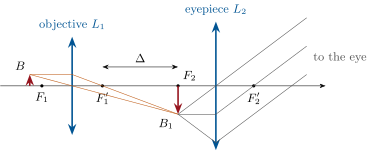
A microscope is an objective L1 of short focal length f1′ forming a real, enlarged intermediate image of a nearby object in the object focal plane of an eyepiece L2 (focal length f2′), which acts as a magnifier. The distance Δ=F1′F2 between the objective’s image focus and the eyepiece’s object focus is the optical interval, a standardized 160mm on classical instruments.
Examples
Example 4.12 (A student microscope)
Objective f1′=4.0mm, eyepiece f2′=25mm, Δ=160mm: γ1=−40, G2=10, G=400. The object sits at F1A=−f1′2/Δ=−16/160=−0.10mm from F1: 4.1mm from the objective. Focusing means moving the whole tube by fractions of a millimeter.
Example 4.9 (A watchmaker’s loupe)
f′=25mm: G=250/25=10, sold as “10×”. A 0.05mm detail then subtends 2×10⁻³rad, comfortably resolved. Pushing G higher means f′ of a few millimeters, a tiny lens held against the eye — the limit of the single lens, and the reason the microscope exists.
Example 4.16 (An amateur’s 150-millimeter refractor)
D=150mm, f1′=1200mm, eyepiece 25mm: G=−48; exit pupil 3.1mm; light gain (150/7)2≈460 against a dark-adapted pupil of 7mm; resolution 1.22×550nm/0.15m=4.5×10−6rad=0.9′′, so craters 1.7km wide on the Moon; Gr=3×10⁻⁴/4.5×10−6≈67 — the 6mm eyepiece (G=200) shows no more detail, only a dimmer, bigger disk. The weekend problem designs this instrument.
 Coach
Coach