
全部书籍

专业

应用 关于 Coach 登录 开始阅读

书籍暂未推出简体中文版——当前显示英文版。

Physics · 术语表

什么是 Contact force, normal and tangential?

Definition 1.14 University Physics — Year 2 · 第 1 章 — Rigid-Body Mechanics

The force exerted by a support on a solid at a contact point II splits into a normal reaction N→\vect N, perpendicular to the common tangent plane and directed toward the solid (N≥0N \ge 0: a support can only push), and a tangential component T→\vect T in the tangent plane, the friction force.
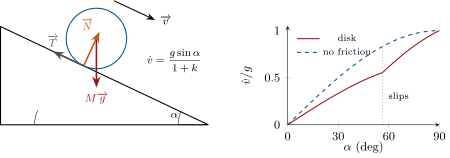
Left: forces on a solid rolling down an incline — weight at G, normal reaction and friction at the contact point. Right: the acceleration of a disk (k = 1/2) as a function of the slope for f = 0.5: it rolls without slipping while 3f, then slips and its acceleration follows g( - f ), always below the frictionless g.
Left: forces on a solid rolling down an incline — weight at GG, normal reaction and friction at the contact point. Right: the acceleration of a disk (k=12k = \tfrac12) as a function of the slope for f=0.5f = 0.5: it rolls without slipping while tan⁡α≤3f\tan\alpha \le 3f, then slips and its acceleration follows g(sin⁡α−fcos⁡α)g(\sin\alpha - f\cos\alpha), always below the frictionless gsin⁡αg\sin\alpha.

示例

Example 1.19 (Why a car needs friction to accelerate)

A front-wheel-drive car: the engine applies a torque to the front wheels; the only external horizontal force on the car is the friction of the road on the tyres, and it is this force that accelerates the car. With the whole weight on the driven wheels the maximum acceleration is fg≈8 m/s2fg \approx 8\,\mathrm{m}/\mathrm{s}^{2} on dry asphalt — and half of that if only half the weight rests on the driven axle; on ice, 1 m/s21\,\mathrm{m}/\mathrm{s}^{2}. The engine’s work is not done by the road (whose contact point is at rest): it is internal work, converted by the transmission into kinetic energy — the same way the internal forces of a walker’s muscles, not the ground, supply the walker’s energy.

在原文中阅读 →