University Physics — Year 2 · Bachelor Year 2
1Rigid-Body Mechanics
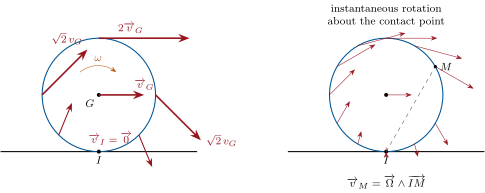
Watch a bicycle wheel from the kerb: the spokes near the road are almost still and sharp, the spokes at the top are a blur moving at twice the speed of the cyclist. Every point of the wheel has a different velocity, yet the wheel is one object — its points keep their distances, and that single constraint organizes all their motions into two vectors, a translation and a rotation. The Year 1 volume treated the special case of a solid turning about a fixed axis; this chapter gives the general kinematics of a rigid body, its kinetic energy and angular momentum, the laws of its motion, and the law that governs every wheel, tyre, brake and ladder: Coulomb’s law of dry friction.
1.1 Kinematics of a rigid body
Definition 1.1 (Rigid body)
A rigid body (or solid) is a system of points whose mutual distances stay constant: is independent of time for every pair , of its points. A frame in which every point of the solid is at rest is a frame attached to the solid.
Theorem 1.2 (Velocity field of a rigid body)
At every instant there is a vector , the rotation vector of the solid (unit ), such that the velocities of any two of its points and in a frame satisfy
does not depend on the choice of ; a vector fixed in the solid evolves as .
Proof. Let be an orthonormal basis attached to the solid. From , the coefficients satisfy : the matrix of the map (for fixed in the solid, with constant ) is antisymmetric, and an antisymmetric matrix is the matrix of with , , . Apply it to : . If did the same job, for every , so . ∎
Remark 1.3 (Three motions)
Translation: , all points share one velocity (not necessarily a straight-line motion: a Ferris-wheel cabin translates on a circle). Rotation about a fixed axis : the points of are at rest, , and a point at distance from the axis moves on a circle at speed — the case of the Year 1 volume. The general motion combines both: , a translation at the velocity of the centre of mass plus a rotation about .
Definition 1.4 (Rolling without slipping)
Two solids and touch at a point . The slip velocity of on is , the difference of the velocities of the two material points that coincide at at this instant. rolls without slipping on when . For a wheel of radius rolling without slipping on a fixed ground, with centre velocity and angular velocity , the condition reads (signs chosen so that a wheel rolling to the right turns clockwise).
Proof. Apply Theorem 1.2 to the wheel between and the contact point : ; with , and , this is , which must vanish. ∎
Example 1.5 (Velocity field of a rolling wheel)
For the rolling wheel, : at each instant the wheel rotates about its contact point. The contact point is at rest, the centre moves at , the top at , and a point of the rim at height moves at , perpendicular to . A spoke valve traces a cycloid; a stone flung from the tread leaves at the speed of the rim point, up to — which is why a lorry’s mudflaps matter.

1.2 Kinetic quantities of a solid
Proposition 1.6 (Momentum, angular momentum, kinetic energy)
For a solid of mass , centre of mass , in a frame :
- its momentum is ;
if it rotates about an axis (fixed in , or passing through and fixed in direction) at angular velocity , its angular momentum along that axis is , where
is its moment of inertia about ( the distance to the axis; unit );
- its kinetic energy is (Koenig) , where the kinetic energy in the barycentric frame is for a rotation at about an axis through — and for a rotation about a fixed axis .
Proof. The momentum and Koenig’s theorems were proved in the Year 1 volume for any system. For the rotation about through , a point at distance from the axis has speed on a circle around the axis; its angular momentum about projected on is (the other components, which cancel for a symmetric solid, are not needed here); sum. Kinetic energy: . ∎
Remark 1.7 (What is admitted)
For an arbitrary rotation the full vector is not parallel to in general: with the inertia tensor, a symmetric matrix whose eigenvectors are the principal axes. Every solid of this chapter rotates about a fixed axis or about a symmetry axis through , for which exactly; the general case is the Year 3 volume’s.
Proposition 1.8 (Moments of inertia)
For homogeneous solids of mass , about an axis through : thin rod of length (axis perpendicular), ; thin hoop or cylindrical shell of radius (own axis), ; disk or full cylinder, ; full sphere, ; spherical shell, . Huygens’ theorem (parallel axes): about an axis parallel to an axis through at distance ,
Proof. Rod: . Disk: rings of mass , . Sphere: by symmetry ( the distance to the centre, since on average over the three axes) and . Huygens: with the vector from to perpendicular to the axis and , , and the middle sum vanishes by definition of . ∎
Example 1.9 (A flywheel)
A steel disk of and radius : ; at () it stores , the kinetic energy of a small car at . Energy-storage flywheels spin carbon-fibre rotors at in vacuum on magnetic bearings: the energy grows as , the limit is the tensile strength of the rim.
1.3 Dynamics of a solid
Theorem 1.10 (Laws of motion of a solid)
In a Galilean frame, for a solid subject to external forces applied at points :
- (momentum) ;
- (angular momentum about , or about a fixed point ) ; projected on a fixed axis or on an axis through of fixed direction along which the solid rotates at : , the sum of the moments of the external forces about the axis;
- (power) the power of a set of forces on a solid is for any point of the solid, with the sum of the forces and their total moment about ; the internal forces of a solid have zero power, and .
Proof. (1) and (2) are the theorems of the Year 1 volume for systems of points (the angular momentum theorem about holds even when accelerates, because the inertial forces of the barycentric frame have zero moment about ). (3) With : (mixed product). Internal forces: their sum and their total moment vanish (action–reaction, same line), hence zero power on a solid — not on a deformable system. The kinetic energy theorem then keeps only the external power. ∎
Definition 1.11 (Perfect pivot)
A solid rotates about a fixed axis in a perfect pivot (an ideal bearing) when the contact forces of the bearing have zero moment about ; they then develop no power ( on the axis, ). A real bearing adds a friction torque , or a viscous one .
Proposition 1.12 (The physical pendulum)
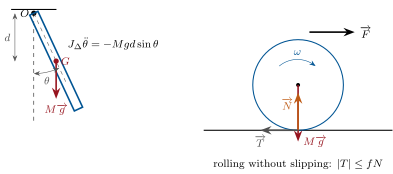
A solid of mass swings about a horizontal fixed axis in a perfect pivot, its centre of mass at distance from the axis. With the angle of from the downward vertical,
so that small oscillations have the period — that of a simple pendulum of length .
Proof. Angular momentum theorem about : the weight’s moment is , the pivot’s is zero. Linearize. ∎
Example 1.13 (The metre rule)
A metre rule pivoted at one end: (Huygens from ), , and — a whole-rule pendulum beats slower than a point mass hung at its centre () and faster than one at its end ().
1.4 Contact forces and Coulomb friction
Definition 1.14 (Contact force, normal and tangential)
The force exerted by a support on a solid at a contact point splits into a normal reaction , perpendicular to the common tangent plane and directed toward the solid (: a support can only push), and a tangential component in the tangent plane, the friction force.
Theorem 1.15 (Coulomb’s laws of dry friction)
For two dry solids in contact, with a coefficient of friction depending on the materials and their state of surface, but not on the area of contact nor (to a good approximation) on the speed:
- if the solids slip on each other (), the friction force is opposite to the slip velocity and of magnitude (kinetic friction);
- if they do not slip, (static friction): the friction force is then whatever the other laws of motion require, within that bound, and its direction is not known in advance.
A perfect contact is the idealization : .
Proof. Admitted at this level. ∎
Remark 1.16 (Reading Coulomb’s laws)
The first law is an equation, the second an inequality — and that is the whole difficulty of friction problems. The method is to assume no slipping, solve for and , and check ; if the check fails, the solid slips, opposite to the slip, and the problem is solved again. Geometrically, the contact force must stay inside the friction cone of half-angle with . Typical values: rubber on dry asphalt –, on wet asphalt –, on ice ; steel on steel dry, greased; the static coefficient is in reality slightly larger than the kinetic one, which is why a skid is hard to stop once started.
Proposition 1.17 (Power of the contact forces; rolling without slipping)
The power of the contact forces on a solid moving on a fixed support is (the normal force is perpendicular to the velocity of the contact point, which is in the tangent plane). In rolling without slipping this power is zero: friction then does no work, though it may be essential to the motion. In sliding it is : heat.
Proof. and lies in the tangent plane, so only contributes; it is zero when the slip velocity is zero, and when the solids slip ( opposite to ). Real rolling dissipates a little through the deformation of tyre and ground (rolling friction, modelled by a small torque or an equivalent force , with for a tyre on a road): a different, much smaller effect. ∎
Method 1.18 (A solid rolling down an incline)
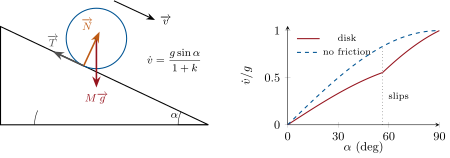
A homogeneous solid of radius , mass and moment of inertia about its axis ( hoop, disk, sphere) is released on an incline of angle with friction coefficient . Assume rolling without slipping:
- momentum along the slope: ; normal: ;
- angular momentum about : ;
no slip: , hence and
- check: . Beyond that slope the solid slips, , and .
Energy check (no slip, friction powerless): gives — a sphere beats a disk, which beats a hoop, independently of mass and radius.
Example 1.19 (Why a car needs friction to accelerate)
A front-wheel-drive car: the engine applies a torque to the front wheels; the only external horizontal force on the car is the friction of the road on the tyres, and it is this force that accelerates the car. With the whole weight on the driven wheels the maximum acceleration is on dry asphalt — and half of that if only half the weight rests on the driven axle; on ice, . The engine’s work is not done by the road (whose contact point is at rest): it is internal work, converted by the transmission into kinetic energy — the same way the internal forces of a walker’s muscles, not the ground, supply the walker’s energy.
Example 1.20 (The sliding-to-rolling transition)
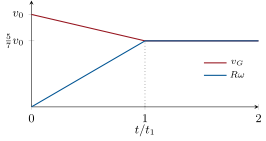
A bowling ball is released sliding at without spin. Kinetic friction slows the centre () and spins the ball up (, ) until : at , with . From then on it rolls without slipping at constant speed. Two sevenths of the speed, and of the kinetic energy, are lost to heat in the slide — whatever is; only sets how fast.
1.5 Exercises
Exercise 1.1 ★
Moments of inertia: (a) a , rod about a perpendicular axis through its centre, then through one end; (b) a disk of radius about its axis, then about a parallel axis through its rim; (c) a billiard ball of diameter . (d) A thin hoop and a full disk of the same mass and radius: which resists spin-up more, and by what factor?
Solution
Solution of Exercise 1.1.
(a) ; through one end (Huygens, ): . (b) ; at the rim . (c) . (d) The hoop, against : twice.
Exercise 1.2 ★
A bicycle rides at on wheels of diameter . Angular velocity of the wheels; speed, in the ground frame, of the valve when it is at the top, at the bottom, at the front of the wheel (height of the axle); speed of the tread relative to the frame of the bicycle. A stone stuck in the tread comes loose at the top: at what speed does it leave?
Solution
Solution of Exercise 1.2.
, . Top: forward; bottom: ; front: , i.e. at downward. Relative to the bicycle the tread moves at everywhere. The stone leaves at , horizontally forward.
Exercise 1.3 ★
A flywheel is a steel disk of radius . (a) Energy stored at . (b) Constant torque needed to spin it up from rest in ; power at the end of the spin-up. (c) In a bus, it must deliver for : to what speed does it slow down? (d) Why are high-speed flywheels run in vacuum?
Solution
Solution of Exercise 1.3.
; . (a) . (b) ; at the end. (c) taken out leave : . (d) Air drag on the rim grows as (power as ) and would heat and slow the rotor; in vacuum on magnetic bearings the losses fall to a few watts.
Exercise 1.4 ★
A uniform disk of radius swings in a vertical plane about a horizontal axis through a point of its rim. Moment of inertia about the axis; period of small oscillations for ; length of the equivalent simple pendulum. Same questions for the axis at a distance from the centre. Where should the axis be for the shortest period?
Solution
Solution of Exercise 1.4.
, : , . At : , , again, same period. In general , minimal at : , .
Exercise 1.5 ★★
A hoop, a disk and a sphere of the same radius are released together at the top of a high incline of slope , . (a) Check that all three roll without slipping. (b) Speed at the bottom for each; order of arrival. (c) Time taken by each. (d) Show that the friction force on the sphere is and that it does no work. (e) At what slope would the hoop start to slip? The sphere?
Solution
Solution of Exercise 1.5.
(a) , i.e. (hoop), (disk), (sphere): all roll. (b) : hoop , disk , sphere ; sphere first, hoop last. (c) Length , , , , , , . (d) ; the contact point is at rest, so . (e) Hoop: , ; sphere: , .
Exercise 1.6 ★★
Disk brake. A wheel and its brake disk have and spin at ; two pads press on the disk at a mean radius of , each with a normal force of , . Braking torque; angular deceleration; time and number of turns to stop; heat released, and temperature rise of the steel disk () if it keeps it all.
Solution
Solution of Exercise 1.6.
; ; , ; turns; heat , .
Exercise 1.7 ★★
Atwood’s machine with a real pulley. Masses and hang on a rope over a pulley of radius and moment of inertia on a perfect pivot; the rope does not slip on the pulley. (a) Why are the two rope tensions different? (b) Equations for the two masses and the pulley; acceleration. (c) The two tensions. (d) Compare with the massless pulley; by energy, recover the acceleration.
Solution
Solution of Exercise 1.7.
(a) The rope must exert a net torque to spin the pulley up: . (b) , , with : . (c) , . (d) Massless: . Energy: ; differentiate.
Exercise 1.8 ★★
The ladder. A uniform ladder of length and mass leans at angle from the horizontal against a smooth vertical wall; the ground has friction coefficient . (a) Forces and their moments about the foot; equilibrium equations. (b) Show that equilibrium requires . (c) Minimum angle for . (d) A person of mass climbs the ladder set at : how far up (fraction of ) can they go?
Solution
Solution of Exercise 1.8.
(a) Weight at the middle; wall: horizontal at the top; ground: vertical and horizontal friction . Moments about the foot: . (b) . (c) , . (d) Person at : , : .
Exercise 1.9 ★★
Back-spin. A billiard ball is struck so that it leaves with centre speed and back-spin (rotation opposite to rolling). Friction coefficient . (a) Equations for and while sliding. (b) Time at which it starts rolling without slipping and its speed then, as functions of , . (c) Condition on for the ball to come back toward the player. (d) Numbers: , , , .
Solution
Solution of Exercise 1.9.
(a) The contact point moves forward at ( for back-spin): friction on the centre, ; torque on the spin: . (b) Slip vanishes at , then . (c) . (d) ; : it comes back.
Exercise 1.10 ★★★
The spool. A spool (mass , moment of inertia about its axis, outer radius ) rests on a horizontal table; a thread wound on its inner hub of radius is pulled horizontally with a force , the thread coming off the bottom of the hub. (a) Assuming rolling without slipping, write the momentum and angular-momentum equations and find the acceleration of the centre; which way does the spool roll? (b) Friction force required, and the condition on for no slipping. (c) Same questions if the thread is pulled at an angle above the horizontal; show that the spool stays still when , and explain geometrically (instantaneous axis through the contact point). (d) What happens for ?
Solution
Solution of Exercise 1.10.
(a) With toward the pull, friction along : ; moments about (counterclockwise): (rolling, ). Hence : the spool rolls toward the pull, winding the thread up. (b) (backward); no slip if . (c) The thread’s line of action is tangent to the hub; its moment about the contact point is , clockwise (forward roll) when , zero when the line passes through — the instantaneous axis — and then , , . (d) For the moment about is counterclockwise: the spool rolls away from the puller.
Exercise 1.11 ★★★
Where to hit a billiard ball. A cue delivers a horizontal impulse (very short force) to a ball of radius at rest, at height above the table. (a) Momentum and angular momentum just after the hit (friction negligible during the hit). (b) Show that the ball rolls without slipping at once if , has top-spin above, back-spin below. (c) For (centre hit), how far does the ball slide before rolling, with and ? (d) Why is the cushion of a billiard table built at height ?
Solution
Solution of Exercise 1.11.
(a) ; about : (top-spin sense for ). (b) ; above it (top-spin), below it back-spin or under-spin. (c) : slides for , distance . (d) A cushion at returns the ball rolling without slipping: no sliding phase, no speed lost to the cloth, a predictable rebound.
Exercise 1.12 ★★★
Cylinder in a bowl. A full cylinder of radius rolls without slipping inside a fixed cylindrical surface of radius , axes horizontal and parallel. Let be the angle of the line of centres from the vertical. (a) Express the angular velocity of the cylinder about its own axis in terms of (hint: the contact point is at rest). (b) Kinetic energy and potential energy; show the period of small oscillations is . (c) Compare with a point sliding without friction in the bowl. (d) Minimum friction coefficient for rolling without slipping at amplitude (small angles).
Solution
Solution of Exercise 1.12.
(a) ; the contact point is at rest, so the cylinder spins at about its axis. (b) , ; gives , . (c) A sliding point: — rolling is slower by , a third of the energy being rotation. (d) Tangential: , so ; at the turning point : .
1.6 Problem: A vehicle on wheels
Problem 1.1
Weekend problem — what a car asks of its tyres: rolling, accelerating, braking, and the one force that does it all
A car of mass has a wheelbase ; its centre of mass is at height and at horizontal distances from the front axle and from the rear axle. Each of the four wheels has radius , mass and moment of inertia about its axle. Tyre–road friction coefficient (dry); rolling-friction coefficient . .
Part I — Rolling.
- The car drives at . Angular velocity of the wheels; velocity, in the road frame, of the top, bottom and front points of a tyre.
- Total kinetic energy of the car, separating the translation of the whole and the rotation of the four wheels; what fraction do the wheels’ rotations represent?
- At rest on level ground, normal forces (both front wheels together) and (both rear) by the momentum and angular-momentum equations — which axle carries more?
- The rolling-friction torque on each wheel is . Power dissipated by rolling friction at ; compare with the aerodynamic drag with , .
- The engine is cut and the car coasts on level ground: write the equation for (include the wheels’ inertia as an effective mass) and estimate the distance to slow from to , neglecting drag; then including only drag.
Part II — Accelerating. The car is front-wheel drive; the engine applies a torque to the two front wheels together. Neglect drag and rolling friction here.
- Draw the external forces on the whole car. Which force accelerates it? What is the power of the road on the car, and where does the kinetic energy come from?
- Write the momentum equation of the car, the angular-momentum equation of the front wheels about their axle, and the no-slip condition; show that the acceleration is and compute the effective mass.
- Angular momentum about the centre of mass for the whole car (treat the wheels’ angular momenta as negligible): show that the load transfer under acceleration is — the front axle is unloaded, the rear loaded.
- Maximum acceleration without the driven (front) wheels spinning: show that and compute it; the same for a rear-wheel-drive car, . Which layout accelerates harder, and why do dragsters put the weight at the back?
- Engine torque at the wheels needed for ; the corresponding power at .
- The same car on ice (): maximum acceleration and the time to reach .
- What does the friction force on the front tyres do to the tyre — sliding or not — and why does a spinning wheel on ice accelerate the car less than a gripping one?
Part III — Braking.
- The brakes apply a torque to each wheel. Show that, for a wheel that keeps rolling, the braking force on the car is the road’s friction on the tyre, and that the brake torque is limited by per wheel.
- Load transfer under deceleration : front axle load ; numbers at .
- Maximum deceleration with all four wheels at the limit of slipping; stopping distance from on dry road, and on wet road ().
- If the brakes are set so that front and rear torques are equal, which axle locks first at hard braking? Why is a locked rear axle dangerous (think of the direction of the friction force on a sliding tyre)?
- A wheel locks and slides: deceleration from the road, and what fraction of the peak braking is lost with vs . Explain what an anti-lock system does and why it pulses the brakes.
- Heat released in the brakes from ; temperature rise of four steel disks (); why do mountain roads have runaway-truck ramps?
- An electric car recovers braking energy through its motor at efficiency: energy recovered per stop from ; number of such stops a battery is worth.
Part IV — Cornering and a wheel off the ground.
- The car turns on a flat road on a circle of radius at : the friction forces must supply . Maximum cornering speed on dry and on wet road.
- Angular-momentum about the centre of mass along the direction of motion: show that the outer wheels are loaded by where is the track; speed at which the inner wheels lift (), and compare with the skidding speed: does this car roll over or skid first?
- The bend is banked at an angle . Show that at the speed no friction is needed at all; value for .
- A wheel is jacked off the ground and spun by hand to ; its bearing exerts a friction torque of . How long does it spin? Kinetic energy lost.
- The spinning wheel is dropped onto the road (car at rest, wheel at , ): sliding time before it stops, and the distance the car would be pushed if it were free to roll (treat the car as a mass on free wheels, neglect the other wheels’ inertia).
- Sum up in one table: the four regimes (rolling, accelerating, braking, cornering), the force that acts in each and the Coulomb bound it must respect.
Solution
Solution of Problem 1.1.
1. , ; top , bottom , front : at downward.
2. ; ; total , wheels .
3. , : , — the front (engine) axle.
4. ; drag , .
5. , . Rolling only: , . Drag only: , , (both together: ).
6. Weight, normal reactions, friction of the road on the tyres. The forward friction on the front tyres is the only horizontal external force, so it accelerates the car; its power is zero (contact point at rest); the kinetic energy comes from the engine — internal work.
7. ; front wheels ; rear wheels . Adding: ; .
8. Moments about (horizontal ground forces at depth , total ): with , so : the rear gains , the front loses it.
9. Front drive: , so . Rear drive: , . Load transfer helps the rear axle: rear drive, and weight at the back, accelerate harder.
10. ; .
11. ; to .
12. Gripping: static friction, no slip, no dissipation at the contact. Spinning: kinetic friction (slightly smaller coefficient), its work heats the tyre and polishes or melts the ice, and the engine’s power goes into spinning the wheel, not moving the car.
13. The brake torque is internal (wheel–body); the car is slowed only by the road’s backward friction on the tyre. For the wheel (negligible ): .
14. Same balance with : ; at : , .
15. ; ; wet : , .
16. Equal torques give equal forces, but the rear axle carries only : it locks first. A sliding tyre’s friction is opposite to its slip velocity and can no longer supply a lateral force: a locked rear axle loses directional stability and the car spins.
17. Locked: , less, stopping distance instead of — and no steering. An anti-lock system senses a wheel decelerating toward lock, releases and reapplies the brake many times a second, keeping the tyre near the static peak and rolling.
18. into : per stop. A truck descending must dissipate : brakes overheat and fade; a gravel ramp stops the truck by the friction of the gravel.
19. ; a battery is about such stops.
20. : ; wet .
21. Lateral friction at depth , normal forces at : , so . Inner wheels lift at : : it skids first (since ).
22. On a bank of angle with no friction, and : for .
23. , : ; lost.
24. Kinetic friction pushes the car forward: ; on the wheel , . The slip starts at and falls at : it vanishes in , the car having gained and moved — a jolt, not a push.
25. Rolling: friction , rolling resistance , trivially. Accelerating: forward friction on the driven tyres, , . Braking: backward friction on all tyres, , . Cornering: lateral friction . In every case one force — the road’s friction, bounded by Coulomb’s law — does the whole job.