 Coach
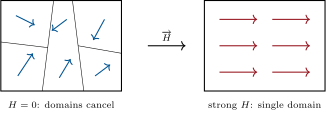
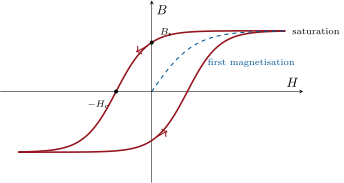
CoachA raw lump of iron is not magnetised: it shatters into domains, micron-scale regions each fully magnetised but pointing differently, so the exterior field (and its energy cost) nearly cancels. An applied moves the domain walls — favourable domains grow — and then rotates whole domains into line. Walls snag on defects, so the process is irreversible: sweep up and down and traces a loop, the hysteresis cycle. Switch the current off and a remanent field survives; cancelling it needs the reverse coercive field . The loop’s enclosed area is energy dissipated per cycle and per unit volume. Soft materials (silicon steel, ferrites: thin loop, small ) make transformer and motor cores; hard ones (alnico, NdFeB: fat loop, huge ) make permanent magnets — and magnetic memory: the refrigerator magnet and the hard disk are hysteresis loops that refuse to forget.
Examples
Example 22.9 (The iron-core electromagnet)
Wind turns carrying around an iron ring () with a small air gap . Ampère’s law for around the loop: , and flux continuity makes common, so
With and , the gap term is fifty times the iron term: nearly all the coil’s effort is spent pushing field across one centimetre of air. That is the magnetic circuit in one line — iron is a near-perfect conductor of flux, air the resistor — and it is why motors, relays and scrapyard lifters keep their air gaps ruthlessly thin (Problem 22.1).