
Physics · Glossary

What is Electric dipole?

Definition 27.6 University Physics — Year 1 · Chapter 27 — Electric Potential; Conductors and Capacitors

Two opposite charges q-q at NN and +q+q at PP, a distance a=NPa = NP apart, form an electric dipole of dipole moment p=qNP\vect p = q\,\vect{NP} (Cm\mathrm{C}\,\mathrm{m}), pointing from - to ++. The dipole approximation is the study of its field at distances rar \gg a. A molecule whose centres of positive and negative charge do not coincide (water, p=6.2×1030Cmp = 6.2 \times 10^{-30}\,\mathrm{C}\,\mathrm{m}) is a dipole; a neutral atom in a field becomes one (induced dipole).
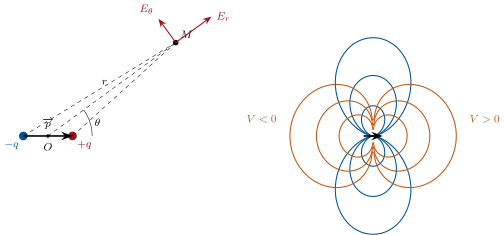
Left: the geometry of the dipole approximation — M seen from the centre O at distance r and angle  from p, with the radial and orthoradial field components. Right: field lines (blue, r 2) and equipotentials (orange, r √| |) of a dipole pointing right; the plane through O perpendicular to p is the equipotential V = 0.
Left: the geometry of the dipole approximation — MM seen from the centre OO at distance rr and angle θ\theta from p\vect p, with the radial and orthoradial field components. Right: field lines (blue, rsin2θr \propto \sin^2\theta) and equipotentials (orange, rcosθr \propto \sqrt{|\cos\theta|}) of a dipole pointing right; the plane through OO perpendicular to p\vect p is the equipotential V=0V = 0.

Examples

Example 27.9 (Why the comb attracts the paper)

A charged comb creates a field that falls off with distance; a scrap of paper, neutral, is polarized by it (induced dipole along E\vect E), and the force p ⁣dE/ ⁣dxp\,\dd E/\dd x on an aligned dipole pulls it toward the strong-field region: the comb. Sign of the comb’s charge irrelevant; the same mechanism holds the balloon on the wall and makes the water stream bend. For water molecules, pEpE in a 1MV/m1\,\mathrm{MV}/\mathrm{m} field is 6×1024J6 \times 10^{-24}\,\mathrm{J}, 600600 times less than kBTk_BT at room temperature: only a slight net alignment survives the thermal tumbling (Exercise 27.7).

Read in context →