
Physics · Glossary

What is Ideal operational amplifier?

Definition 10.2 University Physics — Year 1 · Chapter 10 — The Operational Amplifier

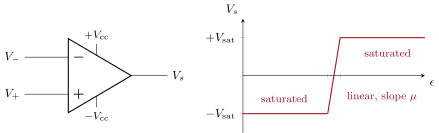
The ideal model assumes: (i) no current enters either input, i+=i=0i_+ = i_- = 0 (infinite input impedance); (ii) the output imposes its voltage whatever the current drawn (zero output impedance); (iii) infinite gain, μ\mu \to \infty. In the linear regime (Vs<Vsat\abs{V_s} < V_{\mathrm{sat}}) the third assumption forces

ϵ=V+V=0:\epsilon = V_+ - V_- = 0 :

the two inputs sit at the same potential (a “virtual short circuit”) although no current flows between them.
The operational amplifier: symbol with its two inputs, and its transfer characteristic V_s( ) — a steep linear segment of slope 105 (drawn far too shallow), then saturation at ± V_ sat. In the ideal model the linear segment is vertical: = 0.
The operational amplifier: symbol with its two inputs, and its transfer characteristic Vs(ϵ)V_s(\epsilon) — a steep linear segment of slope μ105\mu \sim 10^5 (drawn far too shallow), then saturation at ±Vsat\pm V_{\mathrm{sat}}. In the ideal model the linear segment is vertical: ϵ=0\epsilon = 0.
Read in context →