সব বই

পেশাদার

1 Markets I: The Ecosystem and Exchange-Traded Marketsবাজার অনলাইন 2 Markets II: Rates, FX and Creditবাজার অনলাইন 3 Markets III: Commodities, Energy and Cryptoবাজার অনলাইন 4 Quantitative Methodsপদ্ধতি অনলাইন 5 Derivatives and Volatilityডেরিভেটিভস অনলাইন 6 Rates, Credit, XVA and Riskসুদহার, ঋণ ও ঝুঁকি অনলাইন 7 Research Craft: Predictors, Backtests, Measurement, Portfoliosগবেষণা অনলাইন 8 Strategies I: Equities and Futuresকৌশল অনলাইন 9 Strategies II: Volatility, Relative Value, Macro and the Bank Desksকৌশল অনলাইন 10 Microstructure and Executionএক্সিকিউশন অনলাইন 11 Market Making and High-Frequency Tradingমার্কেট মেকিং অনলাইন 12 Machine Learning for Marketsমেশিন লার্নিং অনলাইন 13 Low-Latency Softwareপ্রযুক্তি অনলাইন 14 Networks, Hardware and Trading Infrastructureপ্রযুক্তি অনলাইন 15 Research, Data and Risk Platformsপ্রযুক্তি অনলাইন 16 The Desk and the Firmপ্রতিষ্ঠান অনলাইন 17 The Industry: Firms, Roles and Careersক্যারিয়ার অনলাইন 18 Interviews I: Maths, Probability and Speedক্যারিয়ার অনলাইন 19 Interviews II: Markets, Trading Games and the Final Roundক্যারিয়ার অনলাইন 20 Interviews III: Codeক্যারিয়ার অনলাইন
অ্যাপ পরিচিতি Coach সাইন ইন পড়া শুরু করো

বইগুলো এখনো বাংলা ভাষায় পাওয়া যায় না — ইংরেজি সংস্করণ দেখানো হচ্ছে।

Physics · পরিভাষা

Magnetic flux through a circuit কী?

Definition 29.1 University Physics — Year 1 · অধ্যায় 29 — Electromagnetic Induction and Applications

Orient a closed circuit Γ\Gamma (a sense of travel); its surface gets the normal n→\vect n given by the right-hand rule. The magnetic flux through the circuit is Φ=∑B→⋅n→  ⁣dS\Phi = \sum\vect B\cdot\vect n\,\dd S over any surface bounded by Γ\Gamma (weber, 1 Wb=1 T m21\,\mathrm{Wb} = 1\,\mathrm{T}\,\mathrm{m}^{2}) — “any”, because the flux of B→\vect B through a closed surface is zero. For a uniform field and a plane coil of NN turns and area SS, Φ=NBScos⁡α\Phi = NBS\cos\alpha, α\alpha the angle between B→\vect B and n→\vect n.

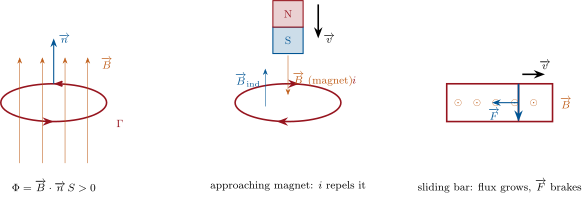
Orientation and Lenz’s law. Left: the circuit’s orientation fixes n and the sign of . Middle: a magnet approaching a ring increases the flux; the induced current creates a field opposing the magnet’s and the ring repels it. Right: a bar sliding on rails in a field pointing toward the reader; the flux of the circuit grows, the induced current flows so that the Laplace force on the bar opposes its motion.
Orientation and Lenz’s law. Left: the circuit’s orientation fixes n→\vect n and the sign of Φ\Phi. Middle: a magnet approaching a ring increases the flux; the induced current creates a field opposing the magnet’s and the ring repels it. Right: a bar sliding on rails in a field pointing toward the reader; the flux of the circuit grows, the induced current flows so that the Laplace force on the bar opposes its motion.

উদাহরণ

Example 29.4 (Orders of magnitude)

A coil of 100100 turns and 10 cm210\,\mathrm{cm}^{2} in the Earth’s field, flipped in 0.1 s0.1\,\mathrm{s}: ΔΦ=2×100×10−3×5×10−5=1×10⁻⁵ Wb\Delta\Phi = 2 \times 100 \times 10^{-3} \times 5 \times 10^{-5} = 1 \times 10^{-5}\,\mathrm{Wb}, e∼0.1 mVe \sim 0.1\,\mathrm{mV} — measurable with a sensitive galvanometer, the way the Earth’s field was once mapped. The same coil in the 1 T1\,\mathrm{T} gap of a magnet, pulled out in 0.1 s0.1\,\mathrm{s}: 1 V1\,\mathrm{V}. A transformer coil of 10001000 turns with 1 T1\,\mathrm{T} at 50 Hz50\,\mathrm{Hz} over 10 cm210\,\mathrm{cm}^{2}: emax⁡=1000×10−3×314=314 Ve_{\max} = 1000 \times 10^{-3} \times 314 = 314\,\mathrm{V} — the mains.

প্রসঙ্গসহ পড়ো →