Physics · Glossary

What is Motor, resistive, zero work?

Also known as: motor work · resistive work

Definition 17.4 High School Physics · Chapter 17 — Work of a Force

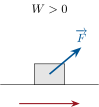
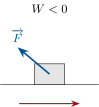
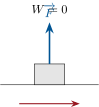
The sign of cosθ\cos\theta sorts every force into three regimes:
  • θ<90\theta < 90{}^{\circ}: W>0W > 0, the work is motor — the force feeds energy into the motion;
  • θ=90\theta = 90{}^{\circ}: W=0W = 0, the force works not at all, however large;
  • θ>90\theta > 90{}^{\circ}: W<0W < 0, the work is resistive — the force drains energy. The pure case is a brake at 180180{}^{\circ}: 800N800\,\mathrm{N} over 45m45\,\mathrm{m} takes 800×45×(1)=36kJ800 \times 45 \times (-1) = -36\,\mathrm{kJ} out of a car, into hot discs.
The three regimes — motor, zero, resistive — by the angle between force and displacement (red arrow). The three regimes — motor, zero, resistive — by the angle between force and displacement (red arrow). The three regimes — motor, zero, resistive — by the angle between force and displacement (red arrow).
The three regimes — motor, zero, resistive — by the angle between force and displacement (red arrow).
Read in context →