High School Physics · Grades 10–12
17Work of a Force
Push a wardrobe across the room and you have worked; push against a wall all afternoon and, whatever your muscles report, physics counts zero. Work is what a force delivers along a motion — energy in transit (Chapter 9), paid in joules. This chapter prices the forces of Chapter 16 — pulls at an angle, weight, friction — and clocks the payment rate: power.
17.1 Work of a constant force
Definition 17.1 (Work of a constant force)
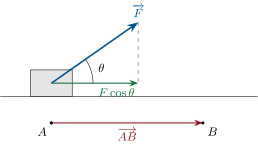
A constant force applied to an object moving along a straight segment from to does the work
where is the magnitude of the force (in ), the length of the displacement (in ) and the angle between and . Work is measured in joules (): one joule is the work of a one-newton force along one metre of its own direction.
Remark 17.2
is exactly the scalar product of this year’s mathematics volume. Only the component along the motion earns anything.
Example 17.3 (Suitcase on a leash)
A traveller drags a suitcase across a terminal, the strap pulled with at to the floor: . Pulled flat () the same force would deliver : a third of the pull lifts nothing.
Definition 17.4 (Motor, resistive, zero work)
The sign of sorts every force into three regimes:
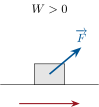
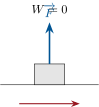
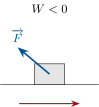
17.2 The work of the weight
Proposition 17.5 (Work of the weight)
When an object of mass moves from (altitude ) to (altitude ) along any path made of straight segments, its weight does the work
where is the height drop: going down, going up — the drop alone matters, not the route.
Proof. On one straight segment , the weight (magnitude , straight down) makes an angle with , and is precisely the projection of the displacement on the downward vertical: . Hence . Along a chain of segments the works add and the drops telescope: . ∎
Proposition 17.6 (Any path)
The same formula holds along any curved path from to .
Proof. Admitted at this level. ∎
Remark 17.7
Plausible — a curve is as close as we like to a broken line of many short segments — but making “as close as we like” honest is calculus, done in Chapter 29.
Example 17.8 (Hiker)
A hiker (pack included) climbs , by whichever trail: , and exactly back down, whatever the detours.
17.3 The work of friction
Proposition 17.9 (Work of sliding friction)
A friction force of constant magnitude , at every instant opposite the motion, does the work along a path of total length : always resistive, and proportional to the length of the path travelled — not to the displacement.
Proof. Each short straight piece has the force at to the motion, contributing ; the pieces add up to . A curved path is chopped into short pieces likewise, the limit admitted as for the weight (Remark 17.7). ∎
Remark 17.10 (Friction against weight: the great divide)
The weight’s work forgets the path; friction’s is a toll per metre. On a round trip the weight nets zero — what it takes uphill it refunds downhill — while friction charges on every leg and refunds nothing: the weight’s work can be stored and recovered (potential energy, Chapter 18), friction’s is lost as heat.
Example 17.11 (There and back)
A crate slides across a floor and back, against : friction does even though the crate ends where it started. Weight and normal force, perpendicular to the motion: zero throughout.
Remark 17.12 (What about a spring?)
A spring pulls harder the further it is stretched: its force is not constant and Definition 17.1 does not apply. Its work means cutting the stretch into infinitesimal steps and summing — calculus, delivered in Chapter 29.
17.4 Power
Definition 17.13 (Power)
The power of a force is the rate at which it works, , in watts () — the same watt as in Chapter 12. A pre-SI unit survives on engine badges: the horsepower, .
Proposition 17.14 (Power at constant velocity)
If the object moves at constant speed , a constant force at angle to the motion delivers the power — in particular for a force along the motion.
Proof. In a time the object covers , so ; divide by . ∎
Example 17.15 (Crane)
A crane hoists a pallet at a steady : the cable’s force equals the weight, , so — a seven-horse team in a steel box.
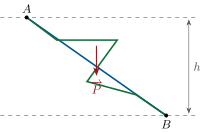
Method 17.16 (Climbing with less force: the zigzag)
To raise a load a height with a limited force:
- The bill is fixed: by Proposition 17.5, any route to the top costs the work .
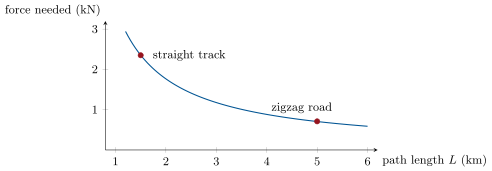
- Stretch the path: on a slope of length the force needed (constant speed, friction aside) is — double the length, halve the force.
- Pay the surcharge: friction charges by the metre (Proposition 17.9), adding .
Mountain roads zigzag for step 2: same height, less force, same work.
17.5 Exercises
Exercise 17.1 ★
A constant force acts over a straight displacement: compute its work for , , and .
Solution
Solution of Exercise 17.1.
: ; ; ; .
Exercise 17.2 ★
A toolbox is lowered from a van, then later raised back. Work of its weight in each case?
Exercise 17.3 ★
Motor, resistive or zero? (a) the weight of a falling apple; (b) the weight of a rising ball; (c) the normal force on a sliding box; (d) friction on a braking bicycle; (e) the string’s tension on a swinging pendulum bob.
Exercise 17.4 ★
A crane lifts by at constant speed. Work of the lifting force and of the weight? What is their sum, and why?
Solution
Solution of Exercise 17.4.
Constant speed: lifting force , so and . Sum zero: at constant velocity the forces balance (Chapter 16), so their works cancel.
Exercise 17.5 ★
An escalator motor does of work every minute. Its power in watts? In horsepower?
Solution
Solution of Exercise 17.5.
; .
Exercise 17.6 ★★
A sled is towed by a rope of tension at above the snow; friction is . Work of each of the four forces (rope, friction, weight, normal) and total?
Exercise 17.7 ★★
A cyclist rides at a constant against a total drag of . Power delivered? Work done in one hour?
Solution
Solution of Exercise 17.7.
; . In one hour, (equivalently ).
Exercise 17.8 ★★
A skier descends of height, by a steep slope or a gentle track; friction on the skis is on both. Work of the weight and of friction on each route? Which work cares about the route?
Exercise 17.9 ★★
A box is pushed up a ramp at constant speed, against of friction. Compute the works of the weight and of friction, then (from the constant speed) the work and magnitude of the push, parallel to the ramp.
Exercise 17.10 ★★
A car cruises at with its engine delivering to the wheels. What total resistive force does it fight?
Solution
Solution of Exercise 17.10.
; constant speed, so .
Exercise 17.11 ★★
A canal horse tows a barge at , the rope of tension making with the towpath. Compute the horse’s power, in watts and in horsepower. Comment.
Solution
Solution of Exercise 17.11.
; in horsepower, — almost exactly what a strong horse sustains, the comparison Watt built his unit on.
Exercise 17.12 ★★★
A car climbs to a pass, by a straight track of grade or a zigzag road of grade (grade ). Neglecting friction, at constant speed, compute for each route the length, the force needed along the slope, and its work. Conclude in one sentence.
Exercise 17.13 ★★★
A winch raises of tiles up scaffolding at a steady . Compute the work of the cable’s force, the duration, the mechanical power (twice: and ), and the electrical power drawn at motor efficiency.
Solution
Solution of Exercise 17.13.
; ; ; ( agrees); electrical: .
Exercise 17.14 ★★★
A wardrobe is slid against of friction from one corner of a room to the opposite one: straight along the diagonal, or then along the walls. Friction work on each route, then on a diagonal round trip? What does the weight do on that round trip, and what deep difference between the two forces does this expose?
Solution
Solution of Exercise 17.14.
Diagonal: ; walls: ; round trip: . The weight does zero on the round trip (no net drop). Friction’s work depends on the path and never refunds; the weight’s depends only on the endpoints (Remark 17.10).
Exercise 17.15 ★★★
A cyclist ( with bike) climbs a pass: of height over of road, at a constant , against of drag and rolling resistance. Compute the work supplied against gravity, against friction, and in total; the duration of the climb; the average power, in watts and horsepower.
Solution
Solution of Exercise 17.15.
Gravity: ; friction: ; total . , so and — a strong amateur, a third of a horse.
17.6 Problem: The mover’s day
Problem 17.1
Weekend problem — physics pays by the joule: a day of sliding, hoisting and hairpin bends, ending with the humbling discovery of what a kettle thinks of honest labour
A mover’s crew empties a warehouse, hauls the load up to a third-floor flat, then drives the van to a hilltop village. Every task is priced in joules; the kitchen kettle will audit the day. Boxes: .
Part I — Across the warehouse floor. A box is pushed with a horizontal force over ; sliding friction is .
- Compute the work of the push.
- Compute the work of friction, of the weight, and of the normal force (justify the zeros).
- Total work on the box, and its sign’s meaning (the box started at rest)? What push keeps the speed constant (Chapter 16)?
- The far corner can be reached along the diagonal or along two walls ( then ). Friction work on each route?
- On a diagonal round trip (out and back), compute the work of friction and the work of the weight. Which force refunds?
Part II — Up to the third floor ().
- Compute the work of the weight on a box raised to the flat. What work must the crew supply at least?
- Carried up the stairs by a mover, gravity charges for mover and box: total work against gravity, and the fraction actually spent on the box?
- A trolley ramp is long for the same rise, with of rolling friction. At constant speed, compute the push needed along the ramp and its work.
- Compare the ramp with a straight vertical hoist: force needed, work done. What does the ramp buy, and at what price?
- A rope-and-pulley hoist raises the box at . Duration and mechanical power?
- Recover that power as . The hoist’s motor is efficient: electrical power drawn?
Part III — The zigzag road. The loaded van () must reach a village above the valley: straight lane, at grade, or paved road, at grade (grade ).
- Check that both routes climb the same .
- At constant speed and neglecting friction, compute the driving force needed along each route.
- Work of the driving force on each route? Compare with .
- Rolling resistance is on both: compute the extra work on each route. What does the zigzag’s comfort cost?
- At , compute the engine power needed on each route (in and ). Why do roads zigzag?
Part IV — The day’s ledger.
- The crew slides boxes across the floor (the push of question 1) and hoists all up the (question 6). Total mechanical work delivered to the boxes?
- Add the stair carrier’s own body: trips up at (downhill refunds go to hot knees, not to the ledger). Day’s total?
- The crew worked hours: average mechanical power? How long would the kettle take to expend the same energy?
- Finale: in two sentences, say what the joule pays for — and does not (the wall pushed all afternoon, the box held motionless) — and why movers own winches, ramps and zigzag roads rather than bigger muscles.
Solution
Solution of Problem 17.1.
1. .
2. Friction: . Weight and normal force are perpendicular to the motion: zero each.
3. Total : net motor work, the box speeds up. A push balances friction — zero net force, constant speed, zero total work.
4. Diagonal: ; walls: : friction charges by the metre.
5. Friction: ; weight: (no net drop). Only the weight refunds.
6. ; the crew must supply at least .
7. ; the box’s share is — carrying is mostly self-transport.
8. : ; ().
9. Vertical hoist: , . The ramp buys a smaller force ( against ) at the price of more work: friction’s toll.
10. ; .
11. — same. Electrical: .
12. and : same summit.
13. : lane ; road .
14. and — both .
15. Rolling resistance: against : the gentle road’s comfort costs of extra friction.
16. . Road: ; lane: — beyond a loaded van. Roads zigzag so that modest engines (and tyres) can climb: same work, spread thin.
17. Per box: ; for boxes, .
18. Stairs: . Day’s total .
19. . The kettle: — under three minutes for the whole day’s labour.
20. The joule pays for force delivered along a motion — nothing for the wall pushed or the box held, however exhausting (muscles burn chemical energy even doing zero mechanical work). Since human power output is a few dozen watts, movers let machines reshape the force — winch, ramp, zigzag — while the bill never changes.