
Physics · Glossary

What is Work of a constant force?

Also known as: work (of a force) · joule

Definition 17.1 High School Physics · Chapter 17 — Work of a Force

A constant force F\vect F applied to an object moving along a straight segment from AA to BB does the work

WAB(F)=F×AB×cosθ,W_{AB}(\vect F) = F \times AB \times \cos\theta ,

where FF is the magnitude of the force (in N\mathrm{N}), ABAB the length of the displacement (in m\mathrm{m}) and θ\theta the angle between F\vect F and AB\vect{AB}. Work is measured in joules (J\mathrm{J}): one joule is the work of a one-newton force along one metre of its own direction.
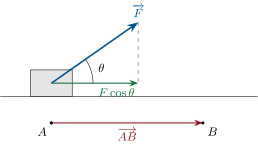
Only the projection F of the force on the displacement works: W_AB( F) = F × AB ×.
Only the projection FcosθF\cos\theta of the force on the displacement works: WAB(F)=F×AB×cosθW_{AB}(\vect F) = F \times AB \times \cos\theta.

Examples

Example 17.3 (Suitcase on a leash)

A traveller drags a suitcase 300m300\,\mathrm{m} across a terminal, the strap pulled with F=40NF = 40\,\mathrm{N} at θ=50\theta = 50{}^{\circ} to the floor: W=40×300×cos507.7kJW = 40 \times 300 \times \cos50{}^{\circ} \approx 7.7\,\mathrm{kJ}. Pulled flat (θ=0\theta = 0) the same force would deliver 12kJ12\,\mathrm{kJ}: a third of the pull lifts nothing.

Read in context →