 Coach
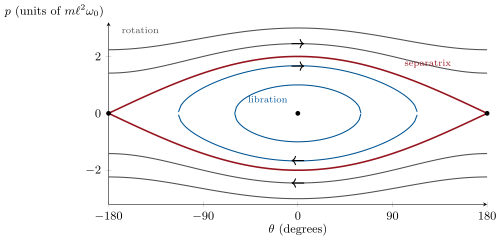
CoachThe phase portrait of a system is the family of its trajectories in phase space. A fixed point is a state where both canonical equations vanish — an equilibrium: a minimum of the potential appears as a centre surrounded by closed curves, a maximum as a saddle through which passes a separatrix, the trajectory that divides phase space into regions of qualitatively different motion.
Examples
Example 2.7 (The pendulum’s phase portrait)
For : closed ovals around — librations, the ordinary swings; wavy curves at large — rotations, the pendulum turning over the top; and through the saddles at the separatrix, of energy , on which the pendulum takes an infinite time to reach the top. A state on the separatrix is the swing launched exactly hard enough to arrive at the inverted position with nothing to spare.