
সব বই

পেশাদার

1 Markets I: The Ecosystem and Exchange-Traded Marketsবাজার অনলাইন 2 Markets II: Rates, FX and Creditবাজার অনলাইন 3 Markets III: Commodities, Energy and Cryptoবাজার অনলাইন 4 Quantitative Methodsপদ্ধতি অনলাইন 5 Derivatives and Volatilityডেরিভেটিভস অনলাইন 6 Rates, Credit, XVA and Riskসুদহার, ঋণ ও ঝুঁকি অনলাইন 7 Research Craft: Predictors, Backtests, Measurement, Portfoliosগবেষণা অনলাইন 8 Strategies I: Equities and Futuresকৌশল অনলাইন 9 Strategies II: Volatility, Relative Value, Macro and the Bank Desksকৌশল অনলাইন 10 Microstructure and Executionএক্সিকিউশন অনলাইন 11 Market Making and High-Frequency Tradingমার্কেট মেকিং অনলাইন 12 Machine Learning for Marketsমেশিন লার্নিং অনলাইন 13 Low-Latency Softwareপ্রযুক্তি অনলাইন 14 Networks, Hardware and Trading Infrastructureপ্রযুক্তি অনলাইন 15 Research, Data and Risk Platformsপ্রযুক্তি অনলাইন 16 The Desk and the Firmপ্রতিষ্ঠান অনলাইন 17 The Industry: Firms, Roles and Careersক্যারিয়ার অনলাইন 18 Interviews I: Maths, Probability and Speedক্যারিয়ার অনলাইন 19 Interviews II: Markets, Trading Games and the Final Roundক্যারিয়ার অনলাইন 20 Interviews III: Codeক্যারিয়ার অনলাইন
অ্যাপ পরিচিতি Coach সাইন ইন পড়া শুরু করো

বইগুলো এখনো বাংলা ভাষায় পাওয়া যায় না — ইংরেজি সংস্করণ দেখানো হচ্ছে।

Physics · পরিভাষা

Pure substance, phase, phase change কী?

Definition 25.1 University Physics — Year 1 · অধ্যায় 25 — Phase Changes of a Pure Substance

A pure substance is a body of a single chemical species. A phase is a part of it that is homogeneous in its physical properties: solid, liquid, gas (vapour when it coexists with its liquid). A phase change (melting/solidification, vaporization/ condensation, sublimation/deposition) is the passage from one phase to another; at fixed pressure it occurs at a fixed temperature, with heat exchanged but no temperature change: the latent heat.
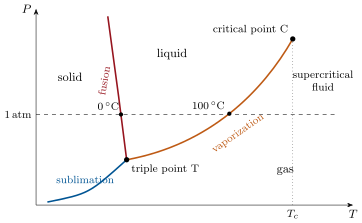
The phase diagram of water (not to scale). Heating at atmospheric pressure follows the dashed isobar: ice melts where it crosses the fusion curve, water boils where it crosses the vaporization curve. The fusion curve of water leans left: pressure lowers its melting point.

উদাহরণ

Example 25.8 (Where the heat of vaporization goes)

For water at 100∘C100{}^{\circ}\mathrm{C}: Ps(vv−vl)=1.013×105×1.67=169 kJ/kgP_s(v_v - v_l) = 1.013 \times 10^5 \times 1.67 = 169\,\mathrm{kJ}/\mathrm{kg}, so uv−ul=2257−169=2088 kJ/kgu_v - u_l = 2257 - 169 = 2088\,\mathrm{kJ}/\mathrm{kg}: 93%93\% of the latent heat goes into tearing the molecules apart, 7%7\% into pushing the atmosphere back. The entropy of vaporization, 2257/373=6.05 kJ/(kg K)2257/373 = 6.05\,\mathrm{kJ}/(\mathrm{kg}\,\mathrm{K}), dwarfs that of fusion, 334/273=1.22 kJ/(kg K)334/273 = 1.22\,\mathrm{kJ}/(\mathrm{kg}\,\mathrm{K}): melting loosens the molecules, boiling frees them.

প্রসঙ্গসহ পড়ো →