 Coach
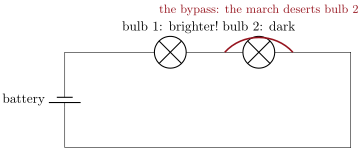
CoachThe gravest case: a conducting road joins the battery’s two terminals with no device anywhere on it. Nothing opposes the march at all, and it becomes a stampede — the wild rush heats the wire and the battery itself, ruining cells, melting insulation, and, on the mains, setting houses on fire.
Examples
Example 48.5 (Why the wires heat)
A marching current always warms its road a little — the lamp’s glow is that warming, put to work on purpose in a thread built to run white-hot. In a stampede, the warming turns menace: the short circuit’s rush can heat a copper wire past the melting point of its plastic sleeve within seconds. The pocket-scale preview: a battery shorted by a wire grows warm in your hand — the same physics that, at mains scale, chars walls. (How warming grows with the rush is measured honestly in two years, with the electric power chapter.)