Primary & Middle School Physics · Grades 1–9
48Short Circuits and Electrical Safety
Every safety rule you have learned traces back to one villain met briefly last year: the short circuit. This chapter studies it properly — how it starts, why it burns, how a humble sacrificial wire defeats it — and turns the family fuse box from a mystery cupboard into an ally you understand.
48.1 The villain’s method
Proposition 48.1 (The current prefers the effortless road)
Between two roads joining the same two points, the marching current crowds onto the one that opposes it less. Devices — lamps, motors, buzzers — all oppose the march as they work; a plain thick wire opposes it almost not at all. Offer the march a bare-wire bypass, and it deserts the working road almost entirely for the effortless one.
Definition 48.2 (Short circuit of a device)
A device is short-circuited when a conducting road joins its two terminals directly, bypassing it. The march deserts the device — a short-circuited lamp goes dark, a motor stops — while the rest of the loop carries on, now with one worker fewer opposing the march.
Definition 48.3 (Short circuit of the battery)
The gravest case: a conducting road joins the battery’s two terminals with no device anywhere on it. Nothing opposes the march at all, and it becomes a stampede — the wild rush heats the wire and the battery itself, ruining cells, melting insulation, and, on the mains, setting houses on fire.
Method 48.4 (The villain, demonstrated safely)
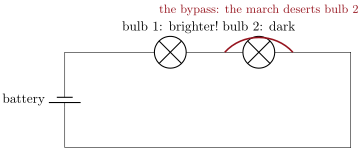
With one battery and two bulbs in series (safe: the battery’s push is tiny):
- light both bulbs — equally dim, as the series law promises;
- now touch a plain wire across bulb 2’s two terminals, bypassing it;
- watch: bulb 2 dies instantly — deserted — while bulb 1 jumps brighter: with one opposer bypassed, the whole loop’s march strengthens;
- remove the wire: the march re-enters bulb 2, and the equal dimness returns.
One experiment, three lessons: the bypass rule, the deserted device, and the strengthened rush.
Example 48.5 (Why the wires heat)
A marching current always warms its road a little — the lamp’s glow is that warming, put to work on purpose in a thread built to run white-hot. In a stampede, the warming turns menace: the short circuit’s rush can heat a copper wire past the melting point of its plastic sleeve within seconds. The pocket-scale preview: a battery shorted by a wire grows warm in your hand — the same physics that, at mains scale, chars walls. (How warming grows with the rush is measured honestly in two years, with the electric power chapter.)
48.2 The bodyguards
Definition 48.6 (Fuse)
A fuse is a bodyguard that dies for you: a deliberately thin wire, in series with the circuit it guards, chosen to melt — and so cut the loop — when the current exceeds its rating. The stampede that would char metres of house wiring instead destroys three centimetres of sacrificial wire in its fireproof cartridge. A blown fuse is replaced — after the fault is found — by a fresh one of the same rating.
Example 48.7 (Breaker and fuse, two guards one duty)
The modern circuit breaker does the fuse’s duty without dying: a spring-loaded switch that snaps open at the rush and is reset by a flick — after the fault is cured. Fuse or breaker, the guard’s post is the same: in series, on the branch it protects, so the stampede must pass through its checkpoint. A guard in parallel would watch the rush thunder past on the other road — pure decoration.
Example 48.8 (Overload: the polite stampede)
Not every dangerous rush is a short circuit. A multi-socket feeding a heater, a kettle and a toaster at once asks its one branch to carry three full marches together — each appliance innocent, their sum an overload that warms the wall wiring like a slow toaster. The breaker trips on the sum, and rightly so. House rule: one hungry heat-making appliance per socket; the multi-socket is for lamps and chargers, not for a private kitchen.
Remark 48.9 (The forbidden repair)
The old story is true and still kills: a household’s fuse keeps blowing, and someone “repairs” it with a nail or a coin — a stout conductor that will never melt. The symptom is silenced; the disease rages on. The next stampede meets no checkpoint, and the house’s own wires become the fuse — inside the walls. Never bypass a guard: a fuse that keeps blowing is a guard that keeps telling the truth.
Remark 48.10 (The rules, final form)
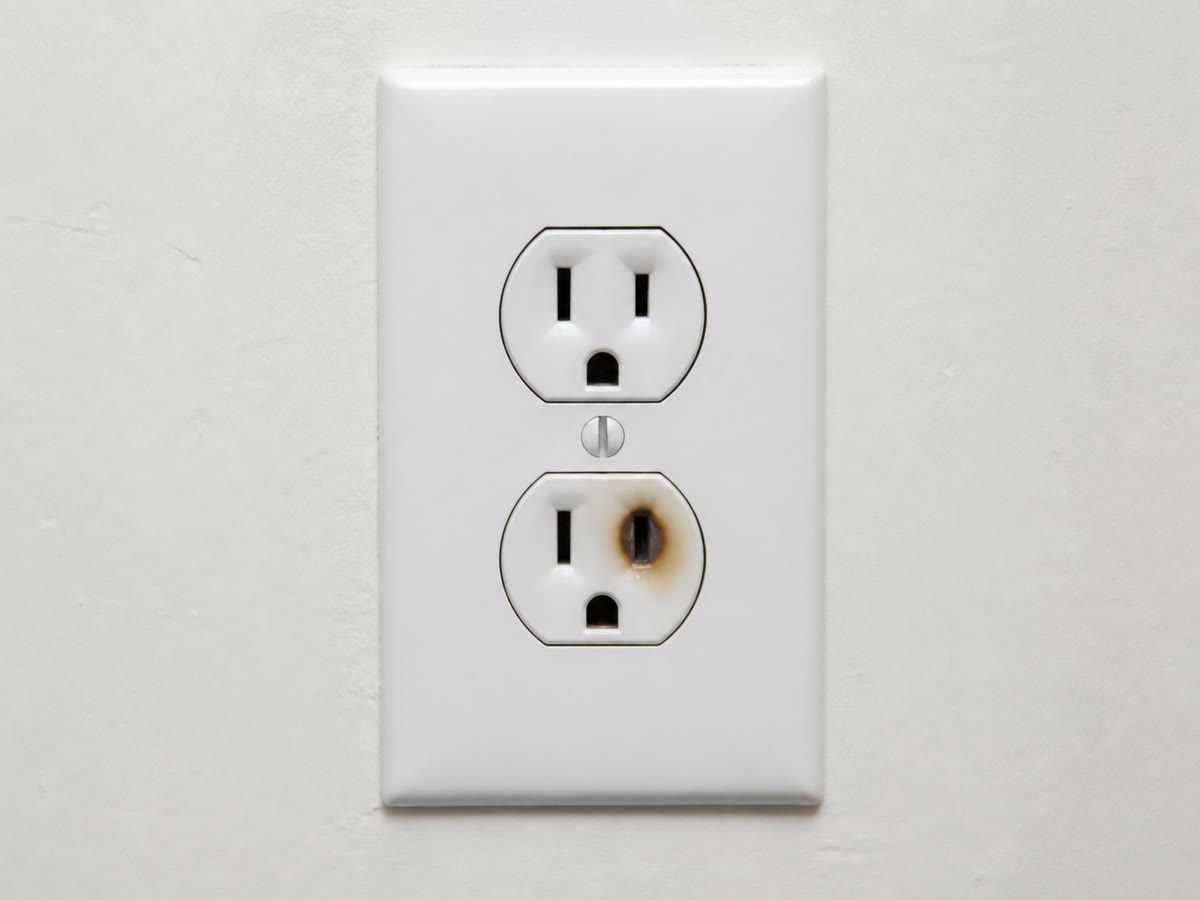
The family’s electrical law-book, with its reasons now complete: never bridge a battery’s terminals, and keep spanners off car batteries (a battery short in metal is a welding arc); one heat-hungry appliance per socket (overload); damaged cords retired (a fraying sleeve is a short circuit rehearsing); water and mains apart, dry hands always (your body must never be the bypass); guards respected — matching fuses only, faults found before resetting; and the socket itself, forever, not for fingers or experiments.
48.3 Exercises
Exercise 48.1 ★
State the effortless-road proposition. Why does a bare wire win the march away from a lamp?
Solution
Solution of Exercise 48.1.
Between two roads joining the same points, the current crowds onto the one opposing it less. A working lamp opposes the march; a bare thick wire barely does — so the march deserts the lamp for the wire.
Exercise 48.2 ★
Distinguish the short circuit of a device from the short circuit of the battery. Which is the graver, and why?
Solution
Solution of Exercise 48.2.
Device short: a bypass across one device — it stops working while the loop continues. Battery short: a bare road joining the battery’s own terminals with no device at all — the graver case: nothing opposes the march, and the stampede heats wire and battery toward ruin and fire.
Exercise 48.3 ★
In the safe demonstration, why does bulb 2 die — and why does bulb 1 brighten at the same moment?
Exercise 48.4 ★
Why does a short circuit heat its wire? What everyday device uses the same warming on purpose?
Solution
Solution of Exercise 48.4.
A marching current always warms its road, and a stampede warms it furiously. The lamp uses the warming on purpose: its thread is built to run white-hot and shine.
Exercise 48.5 ★
What is a fuse, and what does it sacrifice? Why must it sit in series with what it guards?
Exercise 48.6 ★
How does a circuit breaker improve on the fuse? What must happen before either guard is reset or replaced?
Solution
Solution of Exercise 48.6.
The breaker snaps open instead of melting, and is reset by a flick — no spare parts. Before any reset or replacement, the fault must be found and cured: the guard tripped for a reason.
Exercise 48.7 ★
A heater, kettle and toaster share one multi-socket. No wire is bare, no device faulty — yet the breaker trips. Name the event and explain the branch’s complaint.
Solution
Solution of Exercise 48.7.
An overload: three innocent appliances asked one branch to carry their three full marches at once, and the summed rush warms the wiring. The breaker trips on the sum — correctly.
Exercise 48.8 ★
Why is “repairing” a fuse with a nail among the most dangerous acts in a house? What becomes the fuse afterward?
Exercise 48.9 ★★
A cord’s two inner wires, their sleeves frayed, touch each other inside the cable — upstream of the lamp they feed. Diagnose: which kind of short circuit, what happens to the lamp, and what does the branch’s guard do?
Solution
Solution of Exercise 48.9.
A short circuit upstream of the device — effectively a short across the supply as seen from that cord. The lamp dies (deserted), the stampede rushes through the frayed contact and heats the cable — and the branch’s guard, fuse or breaker, cuts the branch. That cut is the system working.
Exercise 48.10 ★★
In the two-bulb demonstration, predict what happens if the bypass wire is instead laid across both bulbs together — from before bulb 1 to after bulb 2. Which definition now applies, and why must the experimenter not try it?
Solution
Solution of Exercise 48.10.
Laid across both bulbs, the wire joins — through plain wire and the battery’s leads — the battery’s own two terminals with no device on the bypass road: a short circuit of the battery. Both bulbs die and the stampede heats wire and battery; even at toy scale it ruins cells and warms fingers, so it is demonstrated in words, not deeds.
Exercise 48.11 ★★
Christmas morning mystery: grandmother’s string of series fairy-lights has one bulb whose inner support wires have fused together in dying — short-circuiting itself. Contrary to the usual tragedy, the rest of the string keeps shining, a little brighter. Explain — and say what is now slowly being prepared for the remaining bulbs.
Solution
Solution of Exercise 48.11.
The dying bulb’s fused support wires became a built-in bypass: the loop stays closed through the dead bulb’s short, so the string survives its loss — one opposer fewer, so slightly brighter. But each such death strengthens the march through the survivors, hurrying the next failure: the string is politely preparing its own cascade.
Exercise 48.12 ★★★
Design the protection plan of a small workshop: three parallel branches (lights; power tools; a battery charger), one supply. Place guards and switches; choose which branches deserve their own guard and why; and write the two-line notice above the fuse drawer that summarizes Remark 48.9.
Solution
Solution of Exercise 48.12.
One main guard and master switch on the common road; then each branch — lights, tools, charger — with its own switch and its own guard sized to its branch (the tools’ branch carries the heaviest marches and earns the stoutest breaker; the charger’s thin branch wants the most delicate fuse, for it would char at currents the main guard ignores). Notice above the drawer, for example: “A fuse that blows is telling the truth — find the fault. Replace like with like; foil and nails guard nothing but the fire’s path.”
48.4 Problem: The Fire Investigator’s Report
Problem 48.1
Weekend problem — after the apartment fire; the investigator reads the wiring’s confession; three faults, one lesson
Nobody was hurt — the family was away — but the kitchen wall is charred, and the investigator must reconstruct the night from the evidence. You carry her notebook.
Part I — Reading the ruins.
- Exhibit one: a multi-socket that fed a heater, a kettle and a deep-fryer, its plastic half-melted. No bare wires anywhere in it. Name the fault this exhibit suggests, and why no “villainous wire” is needed for it.
- Exhibit two: a cord behind the cupboard, chewed by a pet, its two conductors touching at the bite. Name this fault, and state where the march went from the moment of contact.
- Exhibit three, the damning one: in the fuse box, the kitchen branch’s fuse cartridge contains — a rolled strip of kitchen foil. State what this “repair” did to the branch’s protection.
- Put the three exhibits in a likely story: which fault came first, what did the true fuse do about it (before exhibit three), and why did the final night end in fire rather than in a dark kitchen?
Part II — The physics deposition.
- The court asks: why does a shorted or overloaded wire heat? Give the everyday device that proves current-warming can be tamed — and what was missing here.
- Why is a fuse thin on purpose? Explain the phrase “a bodyguard that dies for you”.
- The foil strip conducted magnificently. Precisely because of that, it failed as a guard. Resolve the little paradox for the jury.
- The heater alone was rated safe, the kettle alone safe, the fryer alone safe. Write one sentence on how three safeties summed to one danger.
Part III — The verdict and the lessons.
- The investigator must rank the three faults by moral weight: the overload, the chewed cord, the foil. Which one turned mishap into catastrophe, and why?
- The family asks what would have happened on the fire night had a proper fuse been in place. Walk them through it, minute by minute.
- Recommend the rewiring: how should heater, kettle and fryer be fed now, and what standing rule governs the multi-socket’s future?
- Close the report with the investigator’s three-sentence summary: the villain’s method, the guard’s duty, and the one repair that must never be improvised.
Solution
Solution of Problem 48.1.
1. An overload: three heat-hungry appliances summed their honest marches on one branch — no bare wire needed; the sum alone warms wiring past safety. 2. A short circuit at the bite: from that moment the march deserted the lamp beyond and stampeded through the touching conductors, heating the cord. 3. It abolished it: foil conducts any stampede without melting — the branch stood guardless. 4. Likely story: the overload came first, and the true fuse blew — honestly — perhaps more than once; someone “cured” the nuisance with foil (exhibit three); when the chewed cord’s short finally struck, no guard remained, and the stampede heated the wall wiring into fire instead of dying at a blown fuse in the dark. 5. A current warms its road always; rush harder, warm fiercer. The lamp proves warming can be tamed — its thread is designed for white heat in a safe bulb. Missing here: any designed place for the heat to live, and any guard to stop it. 6. Thin on purpose so that it, of all the circuit’s wires, melts first: the guard takes the fatal heating in its own three centimetres — dying so the metres in the walls do not. 7. A guard must fail at the right moment: its virtue is a designed weakness. The foil’s excellence as a conductor was precisely the corruption of the checkpoint — perfect passage, no protection. 8. Safety does not add like courtesy: three lawful marches on one road sum to one unlawful rush — the branch obeys arithmetic, not intentions. 9. The foil. Overloads and chewed cords are mishaps the system is built to survive — guards exist for exactly them; silencing the guard converted survivable faults into catastrophe. 10. With a true fuse: the cord’s short strikes, the rush leaps, the fuse melts within moments — the kitchen goes dark, the family returns to a blown fuse and a chewed cord, grumbles, repairs both, and never learns how bad the night nearly was. 11. Each heat-maker to its own wall socket on its own adequately-guarded branch; the multi-socket restored to lamps and chargers only, under the standing rule: one hungry appliance per socket, and no strip ever feeds a heater. 12. For example: “The villain’s method is the effortless road: offer the march a bypass and it will take it, heating as it rushes. The guard’s duty is to stand in series and fail first, honestly and cheaply. And no household may ever improvise a guard: a fuse is replaced by a fuse — like for like — or the walls themselves will one day do the melting.”