Biology · Glossary

What is Cardiac output?

Definition 8.4 High School Biology · Chapter 8 — Heart and Lungs During Effort

The heart is a double pump of four chambers. The right side receives the blood returning from the organs and sends it to the lungs (pulmonary circulation); the left side receives it back from the lungs and sends it to the organs (systemic circulation). Valves between the chambers and at the exits make the flow one-way. The cardiac output QQ is the volume of blood each side pumps per minute: the volume ejected per beat, the stroke volume VsV_s, multiplied by the heart rate ff,

Q=f×Vs.Q = f \times V_s .

At rest, 7070 beats per minute of 70mL70\,\mathrm{mL}: about 5L/min5\,\mathrm{L}/\mathrm{min} — the whole blood volume once a minute.
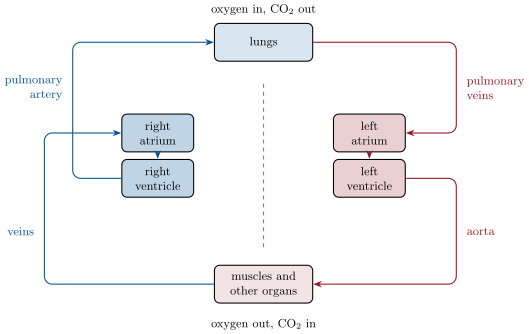
The double circulation. Blue: blood poor in oxygen, pumped by the right heart to the lungs. Red: blood rich in oxygen, pumped by the left heart to the organs. The two sides beat together and pump the same volume per minute.
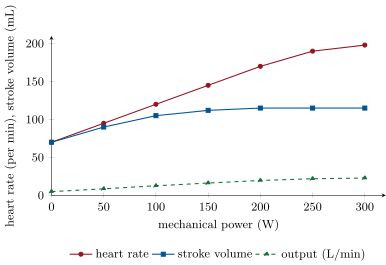
Heart rate, stroke volume and cardiac output of a twenty-year-old at increasing power. The stroke volume levels off at moderate effort; above that the output rises through the rate alone, and the rate itself levels off near 220 - 20 = 200.
Heart rate, stroke volume and cardiac output of a twenty-year-old at increasing power. The stroke volume levels off at moderate effort; above that the output rises through the rate alone, and the rate itself levels off near 22020=200220 - 20 = 200.

Examples

Example 8.6 (Output at 200W200\,\mathrm{W})

From the figure: f=170f = 170 per minute, Vs=115mLV_s = 115\,\mathrm{mL}, so Q=170×0.11519.6L/minQ = 170 \times 0.115 \approx 19.6\,\mathrm{L}/\mathrm{min}: four times the resting output. The heart is moving the body’s entire blood volume four times a minute.

Read in context →