High School Biology · Grades 10–12
8Heart and Lungs During Effort
Run up four flights of stairs and stop at the top. Your chest is heaving — forty breaths a minute instead of twelve, each one three times deeper — and your heart is hammering at a hundred and seventy. Nothing about the stairs required you to decide this; the body arranged it, in seconds, because the muscles of Chapter 7 were demanding ten times more oxygen than a minute earlier. This chapter is about the delivery system — lungs, heart, blood vessels — and about how its output is multiplied when effort begins.
8.1 Ventilation
Definition 8.1 (Ventilation)
Pulmonary ventilation is the volume of air moved into and out of the lungs per minute: the volume of one breath (the tidal volume) multiplied by the number of breaths per minute (the respiratory rate). At rest, about twelve to fifteen times a minute: . In the lungs the air reaches some 300 million alveoli, thin-walled sacs wrapped in capillaries, where oxygen passes into the blood and carbon dioxide out of it.
Proposition 8.2 (Ventilation during exercise)
During exercise both the tidal volume and the rate rise: a fit adult can breathe forty times a minute, or more, fifteen times the resting value. The rise begins within the first seconds of effort, before any change in the blood, and settles at a level proportional to the oxygen being consumed.
Proof. Admitted at this level. ∎
Example 8.3 (Reading a spirogram)
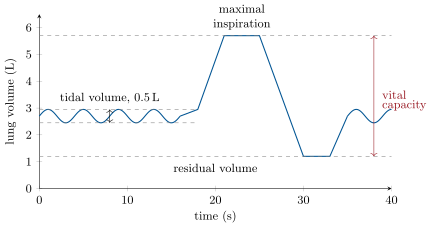
In the figure, four breaths take : 15 breaths per minute of , hence . The maximal sweep runs from down to : a vital capacity of . A tidal volume of during exercise uses more than half of that capacity, which is why breathing hard feels like it.
8.2 The heart and the two circulations
Definition 8.4 (Cardiac output)
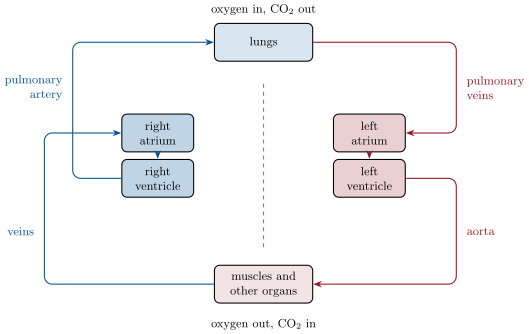
The heart is a double pump of four chambers. The right side receives the blood returning from the organs and sends it to the lungs (pulmonary circulation); the left side receives it back from the lungs and sends it to the organs (systemic circulation). Valves between the chambers and at the exits make the flow one-way. The cardiac output is the volume of blood each side pumps per minute: the volume ejected per beat, the stroke volume , multiplied by the heart rate ,
At rest, beats per minute of : about — the whole blood volume once a minute.
Proposition 8.5 (Cardiac output during exercise)
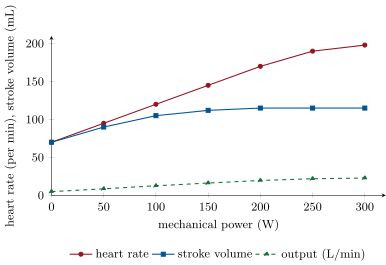
During exercise the heart rate rises with the power delivered, up to a maximum of roughly minus the age in years, and the stroke volume rises too, by about half in an untrained person and more in a trained one. The cardiac output of a young adult goes from at rest to at maximal effort, and to or more in an endurance champion, whose stroke volume can exceed .
Proof. Admitted at this level. ∎
Example 8.6 (Output at )
From the figure: per minute, , so : four times the resting output. The heart is moving the body’s entire blood volume four times a minute.
8.3 Getting the blood where it is needed
Proposition 8.7 (Redistribution of the blood flow)
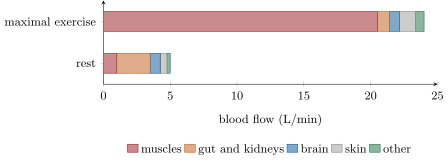
At rest the muscles receive about a fifth of the cardiac output; the gut, liver and kidneys take half. During heavy exercise the small arteries of the working muscles widen and those of the gut and kidneys narrow: the muscles then receive more than four fifths of an output that has itself quadrupled — some instead of , twenty times more. The brain’s share is kept constant in absolute terms, and the skin’s rises to carry the heat away.
Proof. Admitted at this level. ∎
Proposition 8.8 (Oxygen delivery and extraction)
Each litre of arterial blood carries about of oxygen, almost all of it bound to the haemoglobin of the red blood cells. At rest the organs remove about from each litre; during exercise the working muscles remove up to , three times more. The oxygen consumed per minute is the cardiac output multiplied by the amount removed per litre — so the fivefold rise in output and the threefold rise in extraction together give the fifteenfold rise in oxygen consumption of Chapter 7.
Proof. Admitted at this level. ∎
Example 8.9 (The oxygen budget checked)
Rest: , the resting consumption. Maximal effort of a trained student: — a max of per kilogram for , exactly the figure of the previous chapter.
8.4 How the response is controlled
Proposition 8.10 (Nervous and hormonal control)
Heart and breathing muscles are driven by nerve centres in the base of the brain. Two sets of nerves reach the heart: one slows it, active at rest; one accelerates it and strengthens each beat. At the start of exercise the brain’s command to the muscles is copied to these centres — the heart speeds up within one or two beats — and sensors in the muscles and joints report the movement. Then, as the exercise continues, sensors in the arteries measure the carbon dioxide and acidity of the blood and adjust ventilation and heart rate to keep them near their resting values. The adrenal glands add the hormone adrenaline, which reinforces the acceleration and widens the muscles’ arteries.
Evidence. Cutting the slowing nerve of an animal raises its resting heart rate from 70 to about 100; stimulating it stops the heart. Stimulating the accelerating nerve doubles the rate. A person told to expect an effort shows a rising heart rate before moving; a subject breathing air enriched in carbon dioxide increases ventilation within a minute, and one whose blood carbon dioxide is kept constant artificially during exercise still increases it at the start of movement — the two mechanisms, anticipation and correction, are both real. ∎
Method 8.11 (Computing the delivery of oxygen)
- Ventilation: tidal volume rate. Only about 70% of each breath reaches the alveoli; the rest fills the airways.
- Cardiac output: , in litres per minute if is in litres.
- Oxygen consumed per minute: (oxygen removed per litre of blood).
- Flow to an organ: its share of . Compare absolute flows, not shares — a smaller share of a larger output can be more blood.
- Check: consumption cannot exceed the max, and cannot exceed about age.
Remark 8.12 (Where the limit lies)
Ventilation can exceed and the blood leaving the lungs is still nearly saturated at maximal effort: the lungs are not the bottleneck. The stroke volume is: it sets how much blood, hence how much oxygen, each beat delivers. Endurance training enlarges the heart and its stroke volume — which is why a trained resting heart beats at 45 instead of 70 for the same , and why max rises with training.
8.5 Exercises
Exercise 8.1 ★
Compute the ventilation of a person breathing fourteen times a minute; then of the same person breathing thirty-five times a minute.
Solution
Solution of Exercise 8.1.
; .
Exercise 8.2 ★
Define cardiac output and give its formula. Compute it for a heart rate of 65 per minute and a stroke volume of .
Solution
Solution of Exercise 8.2.
The volume of blood pumped by one side of the heart per minute: . .
Exercise 8.3 ★
Trace the path of a red blood cell from the right atrium back to the right atrium, naming the chambers and the two circulations.
Solution
Solution of Exercise 8.3.
Right atrium, right ventricle, pulmonary artery, lungs (pulmonary circulation), pulmonary veins, left atrium, left ventricle, aorta, organs (systemic circulation), veins, right atrium.
Exercise 8.4 ★
From the spirogram figure, give the tidal volume, the vital capacity and the residual volume.
Solution
Solution of Exercise 8.4.
Tidal volume ; vital capacity ; residual volume .
Exercise 8.5 ★
What is the maximal heart rate of a 16-year-old? Of a 60-year-old?
Solution
Solution of Exercise 8.5.
About and beats per minute.
Exercise 8.6 ★★
From the heart-rate figure, compute the cardiac output at and at , and the factor between them.
Solution
Solution of Exercise 8.6.
: ; : ; a factor of 1.8.
Exercise 8.7 ★★
At rest the gut and kidneys receive 50% of ; at maximal exercise, 4% of . Compute both flows. Which changes more, the share or the absolute flow?
Solution
Solution of Exercise 8.7.
Rest: ; exercise: . The share falls twelvefold, the absolute flow only by a factor of 2.6, because the output itself has grown.
Exercise 8.8 ★★
A subject has a cardiac output of and her muscles remove of oxygen per litre. Compute her oxygen consumption. Is she near the ceiling of a trained student?
Solution
Solution of Exercise 8.8.
: about three quarters of the of a trained student — close to it for a smaller person.
Exercise 8.9 ★★
Why does the brain’s blood flow stay at while the gut’s is cut by two thirds during exercise? Think of what each organ can tolerate.
Solution
Solution of Exercise 8.9.
The brain cannot tolerate even seconds without oxygen and glucose, so its supply is protected. The gut and kidneys can suspend digestion and filtration for an hour without harm, and their share is lent to the muscles.
Exercise 8.10 ★★
A trained cyclist has a resting heart rate of 42 and a resting output of . Compute her stroke volume and compare with an untrained person’s.
Solution
Solution of Exercise 8.10.
, against about : her enlarged heart delivers the resting output in far fewer beats.
Exercise 8.11 ★★
Explain why the heart rate starts rising before the first step of a race, and what would happen to a runner whose control worked only by sensing blood carbon dioxide.
Solution
Solution of Exercise 8.11.
The brain’s command to move, and its anticipation of the effort, are sent to the cardiac centres and the adrenal glands before the muscles act. A runner relying only on carbon dioxide sensing would start with a resting output, run the first minute on fermentation, and be forced to slow by lactic acid before the delivery caught up.
Exercise 8.12 ★★★
Two subjects reach the same maximal heart rate of 195. One has a maximal stroke volume of , the other . With the same oxygen extraction of , compute their maximal oxygen consumptions, and say what Remark 8.12 predicts about their training histories.
Solution
Solution of Exercise 8.12.
and . The stroke volume is what training enlarges: the second subject is the endurance trained one.
Exercise 8.13 ★★★
Air is 21% oxygen. A subject ventilates at maximal effort and consumes of oxygen. What fraction of the oxygen she breathes in does she actually use? What does the rest do?
Solution
Solution of Exercise 8.13.
Oxygen breathed in: ; used: , i.e. 17%. The rest is breathed out again — expired air still holds about 16% oxygen, which is why mouth-to-mouth resuscitation works.
Exercise 8.14 ★★★
A drug blocks the accelerating nerves and adrenaline’s effect on the heart, limiting the heart rate to 110. Predict its effect on the cardiac output at maximal effort, on the max, and on what the patient can do.
Solution
Solution of Exercise 8.14.
Output at most about instead of 24: the max falls by nearly half, to about . The patient can walk and cycle gently but not sustain any hard effort.
Exercise 8.15 ★★★
A person at high altitude has arterial blood carrying of oxygen per litre instead of . With the same maximal cardiac output and the same extraction of 75% of the oxygen delivered, compute the loss of max in per cent. Propose one adaptation the body makes in the following weeks.
Solution
Solution of Exercise 8.15.
Delivery per litre down by a quarter, extraction unchanged in proportion: max falls by 25%. Over the following weeks the body makes more red blood cells, raising the oxygen carried per litre back towards .
8.6 Problem: The Stress Test
Problem 8.1
Weekend problem — a cardiologist’s exercise test: heart rate, stroke volume, ventilation and oxygen extraction measured at rising power, and the multiplication they achieve together
Tom, 17, mass , pedals on a laboratory bicycle while his heart rate, ventilation and expired air are recorded. Results:
| power (W) | 0 | 75 | 150 | 225 | 300 |
|---|---|---|---|---|---|
| heart rate (per min) | 62 | 105 | 140 | 175 | 198 |
| stroke volume (mL) | 72 | 100 | 116 | 120 | 120 |
| tidal volume (L) | 0.5 | 1.2 | 1.8 | 2.3 | 2.6 |
| breaths per min | 13 | 18 | 24 | 32 | 44 |
| removed per litre of blood (mL) | 52 | 90 | 120 | 145 | 155 |
Part I — The heart.
- Compute Tom’s cardiac output at each power.
- By what factor has the output risen at ? What part of that factor comes from the rate and what part from the stroke volume?
- Above what power does the stroke volume stop rising? What alone increases the output beyond that?
- Compare Tom’s maximal heart rate with the rule of thumb.
- His resting output is about . If his blood volume is , how long does one full circuit take at rest, and at ?
Part II — The lungs.
- Compute the ventilation at each power.
- By what factor has it risen at ? Which of the two factors, volume or rate, contributes more?
- Tom’s vital capacity is . What fraction of it does each breath use at ?
- Ventilation rose by a larger factor than cardiac output. Does this mean the lungs limit performance? Use Remark 8.12.
- Only 70% of each breath reaches the alveoli. Compute the alveolar ventilation at rest and at .
Part III — The oxygen.
- Compute Tom’s oxygen consumption at each power, from the cardiac output and the oxygen removed per litre.
- Express the value at in millilitres per minute per kilogram. Is it a max, and of what kind of subject?
- By what factor has consumption risen from rest to ? Split it into the factor from the heart and the factor from extraction.
- Using per litre of oxygen, compute the metabolic power at and the efficiency of the muscles (mechanical power divided by the metabolic power above rest).
- Plot, or describe, oxygen consumption against mechanical power. Is it linear? Where is the ceiling?
Part IV — The control and the verdict.
- Tom’s heart rate reached 75 while he sat waiting for the test to start. Explain.
- At his arterial blood is still 95% saturated with oxygen. What does this tell you about the alveoli’s exchange, and about where the limit to his max lies?
- The cardiologist notes that the muscles now receive about of blood. What fraction of the output is that, and where did the rest of the resting distribution go?
- After six months of training, Tom’s maximal stroke volume is at the same maximal rate and extraction. Compute his new max.
- State the result: the three numbers (heart, extraction, ventilation) by which Tom’s body multiplied its resting oxygen supply, and the one of them that training changed.
Solution
Solution of Problem 8.1.
1. ; ; ; ; .
2. : the rate contributes , the stroke volume , and .
3. Above about the stroke volume stays at ; only the heart rate raises the output further.
4. : his 198 is within the rule’s precision.
5. , about ; at , , about .
6. ; ; ; ; .
7. : the tidal volume rose 5.2 times, the rate 3.4 times; the volume contributes more.
8. of the vital capacity per breath.
9. No: ventilation has a large reserve and the blood leaving the lungs stays saturated. The limit is the heart’s stroke volume, which sets how much oxygen each beat delivers.
10. and .
11. ; ; ; ; .
12. per kilogram. The rate has reached its maximum and the increase from 225 to is small: this is his max, that of a fit, trained student.
13. : the heart’s factor 5.3 multiplied by the extraction’s .
14. per minute, about ; at rest ; above rest about , so the efficiency is .
15. Roughly a straight line from to between 0 and , then bending: the last add only . The ceiling is about .
16. Anticipation: the brain’s expectation of the effort is relayed to the cardiac centres and the adrenal glands, raising the rate before any movement.
17. The alveoli oxygenate the blood fully even at maximal ventilation and output; the lungs are not the limit. The limit is the amount of blood the heart can send per minute.
18. . The gut and kidneys, which took half of the resting output, now receive about ; their arteries have narrowed and the flow has been redirected to the muscles.
19. , about per kilogram.
20. Cardiac output multiplied by 5.3, oxygen extraction by 3, ventilation by 18; training changed the heart’s stroke volume, and with it the ceiling.