 Coach
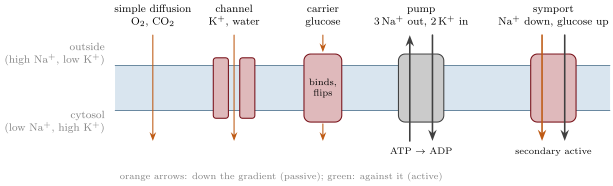
CoachChannels are integral proteins with a water-filled pore through which a specific ion or small molecule diffuses down its gradient at up to per second; many are gated, opening in response to a voltage, a ligand or a mechanical force. Aquaporins are water channels. Carriers bind their solute on one face, change conformation, and release it on the other, a thousand times a second at most; the glucose transporter of the red cell is one. Channels and carriers working down a gradient perform facilitated diffusion, passive but selective and saturable. Pumps are carriers that couple the transport of a solute against its gradient to the hydrolysis of ATP: primary active transport. The sodium–potassium pump of animal cells exports three and imports two per ATP; the proton pump of plant, fungal and bacterial membranes exports .
Examples
Example 7.11 (Kinetics tell the mechanism)
The flux of glucose into a red cell rises with the outside concentration, then levels off at a maximum, like an enzyme (Chapter 13): a carrier, saturable, with a of about ; a similar sugar, mannose, competes for it. The flux of urea rises in proportion to its concentration without limit: simple diffusion. The flux of glucose into an intestinal cell stops when sodium is removed from the lumen, or when the pump is poisoned with ouabain: secondary active transport.