 Coach
CoachThe chemical composition of a sample of living matter is the list of the chemical elements it contains, with the fraction of the sample’s mass that each one represents. It is measured by taking the sample apart chemically — burning it, weighing what evaporates and what remains, analysing the gases released — not by looking at it.
Examples
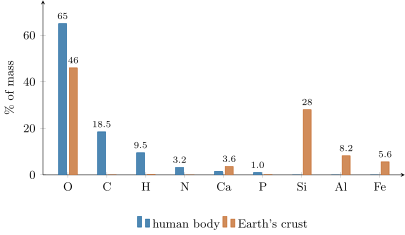
Example 1.3 (Living matter versus rock)
The Earth’s crust is 46% oxygen too, but its next elements are silicon (28%), aluminium (8%) and iron (5.6%). Carbon makes up 0.02% of the crust and nitrogen 0.002%, against 18.5% and 3.2% of a body. A living thing is therefore not a sample of its surroundings: it concentrates a few elements by a factor of a thousand or more. That selection is the first chemical signature of life.