High School Biology · Grades 10–12
1The Chemical Makeup of Living Things
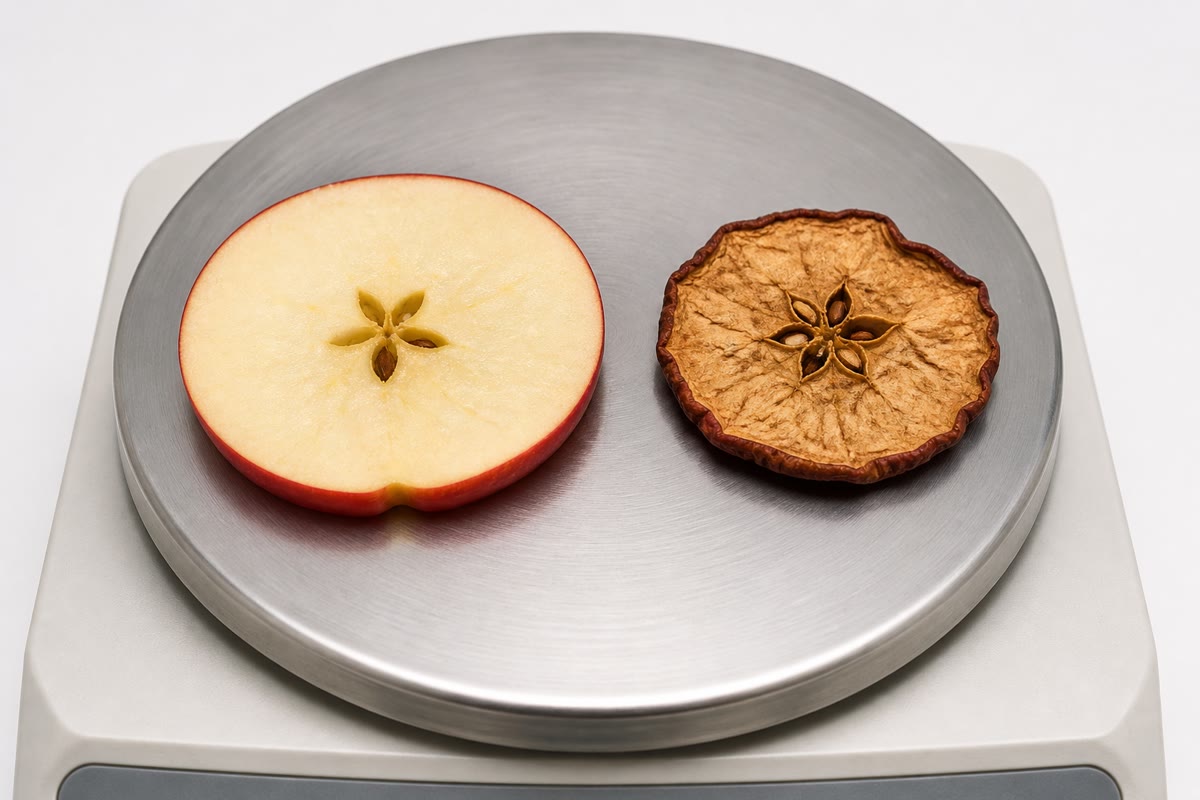
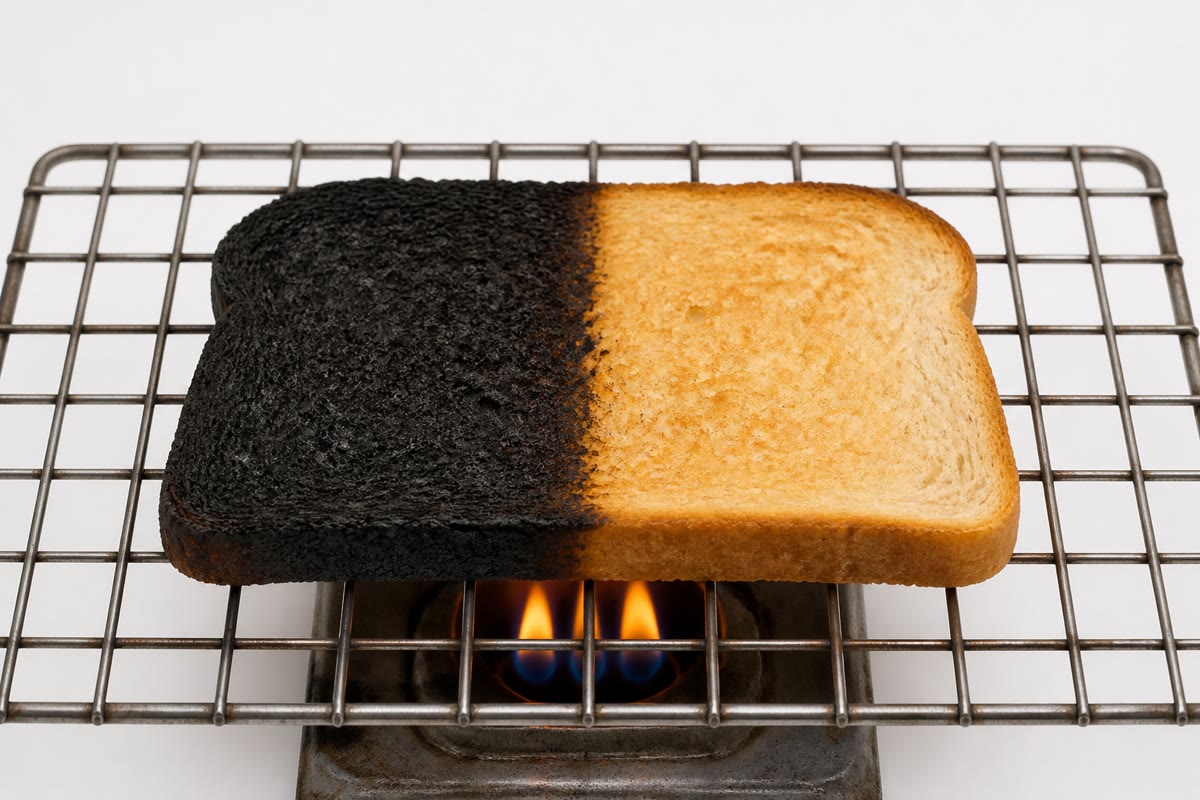
Leave a slice of bread too long on the grill and it turns black: what is left is mostly carbon. Weigh a fresh apple slice, dry it for a day in a warm oven, weigh it again: five sixths of its mass has left as water vapour. Bread, apple, oak, jellyfish, you — every living thing is built, at the bottom, from the same short list of chemical ingredients, and that list is not the list the rocks are made of. This chapter takes living matter apart, ingredient by ingredient, and asks what makes it distinctive.
1.1 Elements: the same atoms as the rocks, in different proportions
Definition 1.1 (Chemical composition of living matter)
The chemical composition of a sample of living matter is the list of the chemical elements it contains, with the fraction of the sample’s mass that each one represents. It is measured by taking the sample apart chemically — burning it, weighing what evaporates and what remains, analysing the gases released — not by looking at it.
Proposition 1.2 (Four elements make up 96% of a living body)
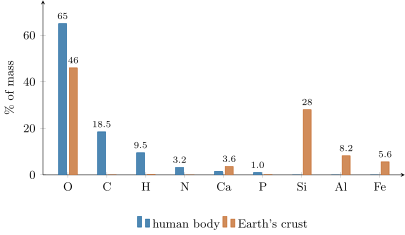
By mass, living matter is made almost entirely of four elements: oxygen (O), carbon (C), hydrogen (H) and nitrogen (N). In the human body they account for about 65%, 18.5%, 9.5% and 3.2% of the mass — 96% together. Calcium, phosphorus, potassium, sulfur, sodium, chlorine and magnesium share most of the remaining 4%, and a dozen trace elements (iron, zinc, iodine, copper…) are present at far below 0.1% yet are indispensable. The same four elements dominate in a bacterium, a wheat plant or a whale, in similar proportions.
Proof. Admitted at this level. ∎
Example 1.3 (Living matter versus rock)
The Earth’s crust is 46% oxygen too, but its next elements are silicon (28%), aluminium (8%) and iron (5.6%). Carbon makes up 0.02% of the crust and nitrogen 0.002%, against 18.5% and 3.2% of a body. A living thing is therefore not a sample of its surroundings: it concentrates a few elements by a factor of a thousand or more. That selection is the first chemical signature of life.
Remark 1.4 (Where the atoms come from)
Every one of those atoms is ordinary: the carbon of your muscles was carbon dioxide of the air before a plant fixed it, the nitrogen of your proteins was nitrogen of the air before soil bacteria captured it. What is special about life is not the atoms but the way they are assembled and the proportions in which they are gathered.
1.2 Water and mineral salts
Definition 1.5 (Mineral matter and organic matter)
The molecules of a living thing fall into two groups. Mineral matter is made of molecules that also exist outside living things: water and the dissolved mineral salts (ions such as , , , , phosphate and bicarbonate). Organic matter is made of molecules built on a skeleton of carbon atoms bonded to hydrogen, and usually to oxygen and nitrogen — molecules that, on Earth, are made only by living things or from their remains.
Proposition 1.6 (Water is the main constituent)
Water is the most abundant molecule of every living thing: about 60% to 65% of an adult human’s mass, 75% of a newborn’s, 85% of an apple’s, 95% of a jellyfish’s, but only 13% of a dormant wheat grain. The water content of a sample is measured by weighing it, drying it at about until its mass stops falling, and weighing it again: the lost mass is the water.
Proof. Admitted at this level. ∎
Example 1.7 (Drying an apple slice)
A slice of fresh apple of mass is dried until its mass settles at . Water lost: , i.e. , or 85% of the fresh mass. The that remain are the dry matter: organic molecules plus mineral salts. Burn that dry matter and about of pale ash — the mineral salts — survives; the rest, the organic part, has left as carbon dioxide and water vapour.
Proposition 1.8 (What water does)
Water is where the chemistry of a cell happens: it dissolves salts, sugars and most small organic molecules, so that they can meet and react; it carries them from one place to another (blood plasma is 90% water, sap much more); and because it takes a lot of energy to heat, it buffers the temperature of the organism against sudden change. A loss of 10% of the body’s water is a medical emergency; a dormant seed, at 13%, has simply switched its chemistry off until water returns.
Proof. Admitted at this level. ∎
Example 1.9 (Mineral salts you can name)
Calcium phosphate stiffens bone and teeth (calcium is 1.5% of body mass, almost all in the skeleton). Sodium and chloride ions set the salinity of blood, close to ; potassium ions are concentrated inside cells; iron sits at the heart of haemoglobin; iodine is needed to make the hormone of the thyroid gland. A mineral salt is never a source of energy, but a body deprived of one of them fails at a precise task.
1.3 The organic molecules: four families
Definition 1.10 (Carbohydrates, lipids, proteins, nucleic acids)
Organic molecules belong to four families.
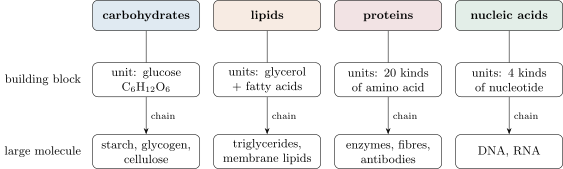
- Carbohydrates (sugars) contain carbon, hydrogen and oxygen only. The simple sugars are single units, such as glucose ; the complex carbohydrates are chains of hundreds or thousands of glucose units — starch and cellulose in plants, glycogen in animals.
- Lipids (fats and oils) also contain only C, H and O, but with much less oxygen, and they do not dissolve in water. The commonest are the triglycerides, each made of one glycerol molecule joined to three long fatty-acid chains.
- Proteins are chains of amino acids: twenty kinds of amino acid, all containing nitrogen, linked in a precise order into chains of fifty to several thousand units that fold into a definite shape.
- Nucleic acids (DNA and RNA) are chains of nucleotides, containing phosphorus as well as C, H, O and N; they store and transmit genetic information, and are the subject of Chapter 3.
Example 1.11 (Reading a food label)
A label on wholemeal bread reads, per : carbohydrates (of which sugars ), fat , protein , fibre , salt . The rest — about — is water. "Carbohydrates" here is mostly starch, "sugars" the simple ones, "fibre" is cellulose (a carbohydrate we cannot digest), "fat" the lipids, "salt" a mineral salt. A label is a chemical analysis, rounded.
Proposition 1.12 (What each family is for)
The families divide the work of a cell, with overlaps:
- carbohydrates are the everyday fuel (glucose) and its short-term store (starch, glycogen), and cellulose is the building material of plant cell walls;
- lipids are the compact long-term energy store ( per gram, against per gram for carbohydrates and proteins), and membrane lipids form the envelope of every cell;
- proteins are the machines: the enzymes that run every reaction, the fibres that contract muscle, the carriers, the antibodies, the receptors;
- nucleic acids hold the instructions for building the proteins.
Proof. Admitted at this level. ∎
Remark 1.13 (Large molecules and the shape of life)
The molecules of rock are small and repetitive (a crystal of quartz is repeated without end). The characteristic molecules of life are huge — a single protein can contain ten thousand atoms, a DNA molecule billions — and informative: the order of their building blocks carries a message. Nothing in the mineral world resembles a molecule whose sequence means something.
1.4 Identifying the constituents
Method 1.14 (Standard tests for the families)
Each family has a simple test that gives a visible result.
- Water: a strip of blue cobalt chloride paper turns pink; or dry the sample and measure the mass lost.
- Starch: a drop of iodine solution turns from yellow-brown to blue-black.
- Simple sugars (glucose, fructose…): heat with Fehling’s or Benedict’s reagent; the blue solution gives a brick-red precipitate.
- Proteins: the biuret test — a few drops of copper sulfate in alkaline solution turn violet.
- Lipids: the sample leaves a translucent, non-drying spot on paper; the red dye Sudan III stains it.
- Mineral salts: burn the dry matter completely; the ash that survives is mineral. Specific ions are identified by precipitation (silver nitrate for chloride, for instance).
Always run a control with pure water, and one with a known positive sample, to be sure the reagent works and that a colour change means what you think.
Example 1.15 (Analysing a potato)
A raw potato slice: cobalt chloride paper turns pink (water); iodine turns blue-black at once (starch, abundant); Fehling’s gives only a faint orange tinge (little free sugar); biuret gives a pale violet (some protein, about 2% of the fresh mass); no translucent spot (almost no lipid). Drying leaves 22% of the mass; burning that leaves 1% of ash. The potato is a starch store wrapped in water — exactly what a plant needs to survive the winter underground.
Proposition 1.16 (Unity of composition)
Whatever the organism — bacterium, mushroom, plant, animal — the same tests find the same four families, made of the same building blocks: the same twenty amino acids, the same glucose, the same four nucleotides. A living thing is distinctive not by owning special atoms or special building blocks, but by the proportions it maintains, the very large molecules it assembles, and the information those molecules carry. This chemical unity is one of the strongest arguments that all living things share a common origin, an argument Chapter 6 will take up.
Proof. Admitted at this level. ∎
1.5 Exercises
Exercise 1.1 ★
Name the four elements that make up 96% of the mass of a living body, with their approximate percentages in a human.
Solution
Solution of Exercise 1.1.
Oxygen (about 65%), carbon (18.5%), hydrogen (9.5%) and nitrogen (3.2%): 96% of body mass together.
Exercise 1.2 ★
Sort into mineral matter and organic matter: water, glucose, sodium chloride, a triglyceride, calcium phosphate, an amino acid, carbon dioxide.
Solution
Solution of Exercise 1.2.
Mineral: water, sodium chloride, calcium phosphate, carbon dioxide (a carbon compound, but made outside life and without a carbon–hydrogen skeleton). Organic: glucose, the triglyceride, the amino acid.
Exercise 1.3 ★
A fresh lettuce leaf of mass is dried to constant mass: . What is its water content, in per cent?
Solution
Solution of Exercise 1.3.
Water lost ; : the leaf is 95% water.
Exercise 1.4 ★
Which test would you use to show that a bean seed contains (a) starch, (b) protein, (c) lipids? Give the expected result in each case.
Solution
Solution of Exercise 1.4.
(a) Iodine solution on the crushed seed: blue-black. (b) Biuret reagent: violet. (c) Crush the seed on paper: a translucent spot that does not dry; Sudan III stains it red.
Exercise 1.5 ★
Give the building block of each family: carbohydrates, lipids, proteins, nucleic acids.
Solution
Solution of Exercise 1.5.
Carbohydrates: simple sugars such as glucose. Lipids: glycerol and fatty acids. Proteins: amino acids (twenty kinds). Nucleic acids: nucleotides (four kinds).
Exercise 1.6 ★★
Using the first figure of the chapter, by what factor is carbon more concentrated in a human body than in the Earth’s crust? And nitrogen? Comment.
Solution
Solution of Exercise 1.6.
Carbon: times more concentrated. Nitrogen: times. Living matter is not a sample of its surroundings: it gathers a few rare elements by factors of a thousand, which is a chemical signature of life.
Exercise 1.7 ★★
An adult of mass is 62% water. Compute the mass of water in the body, then the mass of the dry matter. If proteins are 17% of body mass, what is the mass of protein?
Exercise 1.8 ★★
A cereal bar contains, per , of carbohydrates, of lipids and of proteins. Using the energy values of Proposition 1.12, compute the energy supplied by of the bar, and the fraction coming from lipids.
Solution
Solution of Exercise 1.8.
Carbohydrates ; lipids ; proteins ; total , about . Lipids supply of the energy with only 12% of the mass.
Exercise 1.9 ★★
Iodine solution is added to a slice of bread, to a slice of cheese and to a piece of sugar. Predict the result in each case and explain.
Exercise 1.10 ★★
Why does the dry matter of a plant burn, while the ash it leaves does not? Which family of matter is each?
Solution
Solution of Exercise 1.10.
The dry matter is mostly organic: carbon–hydrogen molecules that combine with oxygen, releasing energy, carbon dioxide and water. The ash is the mineral salts, already fully combined with oxygen; nothing in them can burn.
Exercise 1.11 ★★
Two solutions are given: one of glucose, one of starch. Fehling’s test is positive only for the first, iodine only for the second. Yet starch is made of glucose. Propose an explanation.
Solution
Solution of Exercise 1.11.
Fehling’s reagent reacts with a free chemical group carried by single glucose molecules; in starch the glucose units are joined to one another and those groups are locked inside the chain, so the reagent finds nothing. Iodine, conversely, lodges in the long coiled starch chain, which single glucose molecules do not form. Each test detects a structure, not an element.
Exercise 1.12 ★★★
A wheat grain contains 13% water; a wheat seedling three days after germination contains 88%. Explain the change, and what it tells you about the role of water in the grain’s chemistry.
Solution
Solution of Exercise 1.12.
The grain has absorbed water massively. At 13% the reserves are solid and the enzymes cannot work: the grain’s chemistry is switched off and it survives dormant. Water dissolves the stores, lets the enzymes act and carries the products to the growing embryo: chemistry restarts only once water is abundant.
Exercise 1.13 ★★★
Blood plasma contains about of sodium chloride and about of glucose. A patient receives of an intravenous solution. What masses of salt and glucose must it contain to match plasma? Why would pure water be dangerous?
Solution
Solution of Exercise 1.13.
Salt: ; glucose: . Pure water would dilute the plasma; water would then enter the red blood cells, which would swell and burst.
Exercise 1.14 ★★★
Lipids store , glycogen ; moreover each gram of glycogen in the body is stored with about of water. A person carries of glycogen and of lipid. Compute the energy of each store, and the mass a body would need to carry to hold the lipid store’s energy as hydrated glycogen. Conclude on why animals store fat.
Exercise 1.15 ★★★
"Living things are made of the same atoms as rocks, so there is nothing chemically special about life." Discuss this statement in a short paragraph, using three precise arguments from the chapter.
Solution
Solution of Exercise 1.15.
The atoms are indeed ordinary, but (1) the proportions are not: living matter concentrates carbon a thousandfold and nitrogen far more, against an oxygen–silicon crust; (2) the molecules are not: only living things assemble carbon into giant chains — proteins, starch, DNA — whose size has no mineral counterpart; (3) those molecules carry information in the order of their units, and no crystal does. Life is chemically special in its organisation, not in its atoms.
1.6 Problem: The Carbon in a Human Being
Problem 1.1
Weekend problem — from a wheat field to a body: an audit of matter, from the water in a grain to the number of kilograms of carbon a person carries
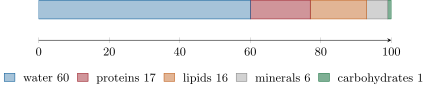
A class follows matter from a field of wheat to the body of one of its students. Data: a wheat grain is 13% water, and its dry matter is about 70% starch, 12% protein, 2% lipid, 2% mineral, the rest cellulose. Bread flour keeps roughly the composition of the grain’s inner part. The student, Lea, has a mass of ; use the adult composition of the second figure (water 60%, proteins 17%, lipids 16%, minerals 6%, carbohydrates 1%). Element mass fractions inside each family: take carbohydrates as 40% carbon, lipids as 77% carbon, proteins as 53% carbon and 16% nitrogen.
Part I — The grain.
- A grain of mass is dried. What mass of water does it lose, and what is its dry mass?
- Compute the masses of starch, protein and lipid in the dry matter of one grain.
- Which tests of Method 1.14 would confirm each of these three constituents on a crushed grain?
- The grain is planted and watered; three days later the seedling is 88% water. Explain why germination cannot start at 13%.
- A hectare yields of grain. What mass of water is harvested with it, and what mass of dry matter?
Part II — The bread.
- A loaf is baked from of flour, of water and of salt; it loses of water in the oven. What is the mass of the baked loaf, and its water content in per cent?
- Using the grain’s dry composition for the flour, estimate the masses of starch and protein in the loaf.
- Using for carbohydrates and proteins and for lipids, estimate the energy content of the loaf.
- Lea eats of this bread. What fraction of a daily need of about does it cover?
- Why is the salt in the loaf not a source of energy, and what is it for in the body?
Part III — The body: water and families.
- Compute the mass of water in Lea’s body.
- Compute the masses of protein, lipid, mineral and carbohydrate.
- Lea loses by sweating during a long run. What fraction of her body water is that? Why must it be replaced quickly?
- Her blood, about , is 55% plasma, and plasma is 90% water. Estimate the mass of water in her blood (take per litre). What fraction of her body water is that? Where is the rest?
- A newborn is 75% water. Explain in one sentence why an infant is more vulnerable to dehydration than an adult.
Part IV — The body: elements.
- Using the carbon fractions of each family, compute the mass of carbon in Lea’s carbohydrates, lipids and proteins, then the total mass of carbon.
- What fraction of her body mass is carbon? Compare with the 18.5% of Proposition 1.2 and comment on the agreement.
- Compute the mass of nitrogen in her proteins. Where did that nitrogen ultimately come from?
- Water is 89% oxygen by mass. Compute the mass of oxygen carried by her body water alone, and compare with the 65% of Proposition 1.2. Which molecule explains most of the body’s oxygen?
- State the result in one sentence: how many kilograms of carbon does a person carry, and through which two biological processes did that carbon leave the air and enter the body?
Solution
Solution of Problem 1.1.
1. Water ; dry mass .
3. Iodine (blue-black) for starch; biuret (violet) for protein; a translucent spot on paper or Sudan III for lipid.
4. At 13% the stores are solid and the enzymes inactive; water must dissolve the reserves and let the reactions run before the embryo can grow. Germination starts by absorbing water, and the seedling’s 88% is the sign that its chemistry is on.
5. Water ; dry matter , about .
6. Mass . Water in the loaf: from the flour , plus , minus : , i.e. .
7. Flour dry matter ; starch ; protein (lipid about ).
8. .
9. of the loaf: about , i.e. 11% of .
10. Salt is mineral: it is already fully oxidised and has no carbon–hydrogen bonds to burn. In the body its ions set the salinity of blood and are needed for nerve and muscle signals.
11. of water.
12. Protein ; lipid ; minerals ; carbohydrates .
13. of her water. Blood volume and temperature control both depend on it; a loss of 10% is dangerous, so drinking must restore it within hours.
14. Plasma ; water , about 6% of body water. The rest is inside the cells (about two thirds of all body water) and in the fluid between cells.
15. An infant exchanges a far larger fraction of its water each day (drinking, urine, skin) than an adult, so a few hours of loss without intake removes a dangerous fraction of its total.
16. Carbohydrates ; lipids ; proteins . Total about of carbon.
17. , against 18.5%. The agreement is good given rounded family fractions and the variation of lipid content between individuals; a leaner body gives a lower figure.
18. of nitrogen. It came from the nitrogen of the air, captured by soil bacteria, taken up by plants and eaten along the food chain.
19. of oxygen, i.e. of body mass. Water alone accounts for most of the 65%; the remainder is the oxygen inside the organic molecules.
20. A person carries about of carbon. It left the air as carbon dioxide through photosynthesis in plants, and entered the body through feeding and digestion along the food chain.