 Coach
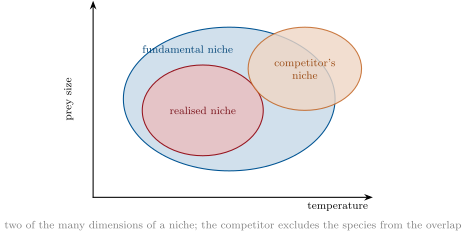
CoachA species’ habitat is where it lives; its niche is how it lives: the full set of conditions it tolerates and resources it uses — temperature, moisture, light, food, time of activity, nesting sites — each of them a dimension along which the species occupies a range. The fundamental niche is the range it could occupy alone; the realised niche the part it actually occupies in the presence of competitors and predators (Chapter 27). Two species with the same niche cannot coexist in one place for long; the niches of coexisting species differ, and the community is a set of niches fitted together.
Examples
Example 26.3 (Five warblers in one spruce)
Five species of small insect-eating warbler nest in the same spruce forests and eat the same insects; watched closely, each forages in a different part of the tree — the treetop, the outer new needles, the middle branches, the trunk and lower branches, the ground beneath — and at different heights and times. Their habitat is one; their niches are five, and the forest holds five species where the food alone would suggest one.
Example 26.10 (Why the top is thin)
A square kilometre of savanna makes some of grass a year; the grazers turn it into of antelope and buffalo; the lions into of lion — one or two animals. To feed a tiger, a forest must be large enough that its tenth of a tenth of a tenth of the sunlight is a whole deer every week: a hundred square kilometres a tiger, which is why large carnivores are rare, roam far, and vanish first when a habitat shrinks.