Coach
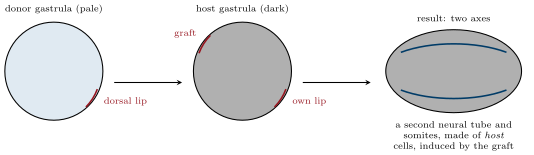
CoachInduction is the process by which one group of cells changes the fate of a neighbouring group by a signal; the responding cells must be competent — able to answer, which they are only for a limited time. Development is a chain of inductions: the vegetal cells induce mesoderm in the cells above them; the dorsal mesoderm — the organiser at the blastopore lip — induces the neural plate in the ectoderm above it and patterns the mesoderm on either side; the notochord induces the floor of the neural tube; the optic vesicle, a bud of the brain, induces a lens in the skin it touches; the lens induces the cornea. Each induced tissue becomes an inducer of the next. The signals are a handful of secreted protein families used over and over — and the same ones that pattern a limb (Chapter 11) and, in the adult, run the signalling of Chapter 19.