Biology · Glossary

What is Metabolic rate, allometry?

Also known as: metabolic rate · basal metabolic rate · allometry

Definition 1.13 University Biology — Year 1 · Chapter 1 — The Organism: A System in Interaction with Its Environment

The metabolic rate BB of an organism is the rate at which it converts chemical energy, measured in watts as heat production or as oxygen consumption (1L1\,\mathrm{L} of O2\mathrm{O_2} consumed 20kJ\approx 20\,\mathrm{kJ}). The basal metabolic rate is that of a resting, fasting endotherm in its thermoneutral zone. A quantity YY is said to scale allometrically with body mass MM when Y=aMbY = a\,M^{b} with an exponent b1b \neq 1; on a log–log plot the relation is a straight line of slope bb.

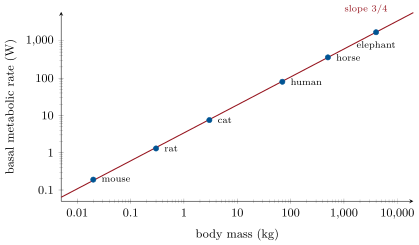
Kleiber’s law. Basal metabolic rate against body mass for six mammals on logarithmic axes: the points fall on a line of slope 3/4 over five orders of magnitude of mass.
Kleiber’s law. Basal metabolic rate against body mass for six mammals on logarithmic axes: the points fall on a line of slope 3/43/4 over five orders of magnitude of mass.

Examples

Example 1.16 (Mouse and elephant)

A 20g20\,\mathrm{g} mouse: B=3.4×0.020.75=0.18WB = 3.4\times 0.02^{0.75} = 0.18\,\mathrm{W}, or 9W/kg9\,\mathrm{W}/\mathrm{kg}. A 4t4\,\mathrm{t} elephant: B=3.4×40000.75=1700WB = 3.4\times 4000^{0.75} = 1700\,\mathrm{W}, or 0.43W/kg0.43\,\mathrm{W}/\mathrm{kg}. The elephant burns ten thousand times more than the mouse, but each of its grams burns twenty-one times less: (4000/0.02)1/4=1/21(4000/0.02)^{-1/4} = 1/21. The mouse must eat a tenth of its mass every day; the elephant, a fiftieth. The mouse’s heart beats 600600\, times a minute, the elephant’s 3030\,: heart rate, like B/MB/M, scales as M1/4M^{-1/4}, and both animals’ hearts beat about a billion times in a lifetime.

Read in context →