 Coach
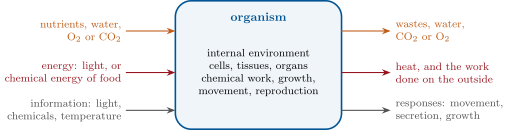
CoachAn organism is a living individual: a bounded, self-maintaining, self-reproducing system, made of one cell or of many cells that share a common origin and a common functioning. It is an open system: matter and energy cross its boundary continuously, and it stays alive only as long as they do. The environment of an organism is everything outside that boundary that exchanges with it — the physical medium (air, water, soil, light, temperature) and the other organisms.
Examples
Example 1.19 (The same hour, two budgets)
In the hour of the opening, the rabbit turned of grass into heat, motion and a little growth, keeping its blood at and its glucose near ; it did so by moving to the food. The oak turned a few hundred kilojoules of the sunlight on its crown into sugar, lost of water through its leaves to do so, and grew a few micrometres of new wood; it did so by being where the light and water were. Both are open systems; both keep themselves going by exchanging; the shapes of their exchanges are the shapes of their lives.