 Coach
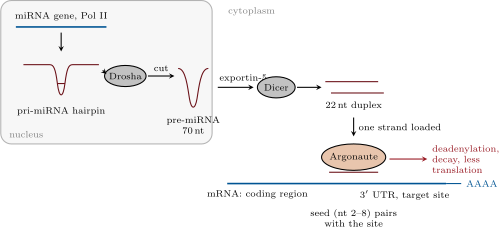
CoachA microRNA is encoded in the genome — in its own gene or in an intron of a protein-coding gene — and transcribed by RNA polymerase II as a long primary transcript (pri-miRNA) containing a hairpin of about . In the nucleus the RNase III Drosha, with its partner DGCR8, cuts the hairpin out (the pre-miRNA); exportin-5 carries it to the cytoplasm, where Dicer removes the loop, leaving a duplex. One strand is loaded into Argonaute. The mature miRNA recognises its targets chiefly through its seed, nucleotides 2 to 8, pairing with sites usually in the 3 untranslated region of a messenger; the rest of the miRNA pairs imperfectly, so the target is not cleaved but repressed: the RISC recruits proteins that shorten the poly(A) tail, remove the cap and inhibit translation, and the messenger is degraded faster. Because a seed is only seven nucleotides, one miRNA has hundreds of targets, and more than half of human protein-coding genes carry conserved sites for at least one of the several hundred confidently identified human miRNAs.
Examples
Example 2.6 (A four-fold repression)
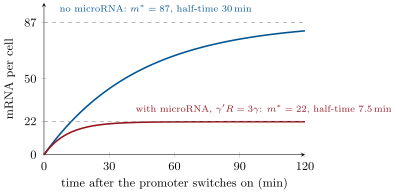
A messenger with a natural half-life of (), transcribed at molecules per minute, sits at copies per cell and takes to move half-way to a new level after its promoter changes. A microRNA that triples its decay rate () brings it to copies and cuts the half-time to . The same numbers, read backwards, show why miRNA knockouts often have mild phenotypes: a four-fold change in a messenger that is itself buffered downstream can leave the organism nearly normal, and the effect shows under stress or in timing.