
Biology · Glossary

What is RNA interference?

Definition 2.3 University Biology — Year 3 · Chapter 2 — Non-coding RNAs and Post-transcriptional Regulation

RNA interference (RNAi) is the sequence-specific silencing of a gene by a small RNA derived from double-stranded RNA. The enzyme Dicer, an RNase III, cuts long double-stranded RNA into 21 to 2321\text{ to }23-nucleotide duplexes with two-nucleotide 3' overhangs; one strand of each duplex, the guide, is loaded into an Argonaute protein to form the RNA-induced silencing complex (RISC). The guide pairs with a complementary target RNA, and Argonaute’s endonuclease domain cuts the target opposite nucleotides 10 and 11 of the guide; the cut RNA is then degraded and the RISC is released to find another. In plants, worms and fungi an RNA-dependent RNA polymerase copies the target into new double-stranded RNA, so the signal is amplified and spreads; mammals lack this step.

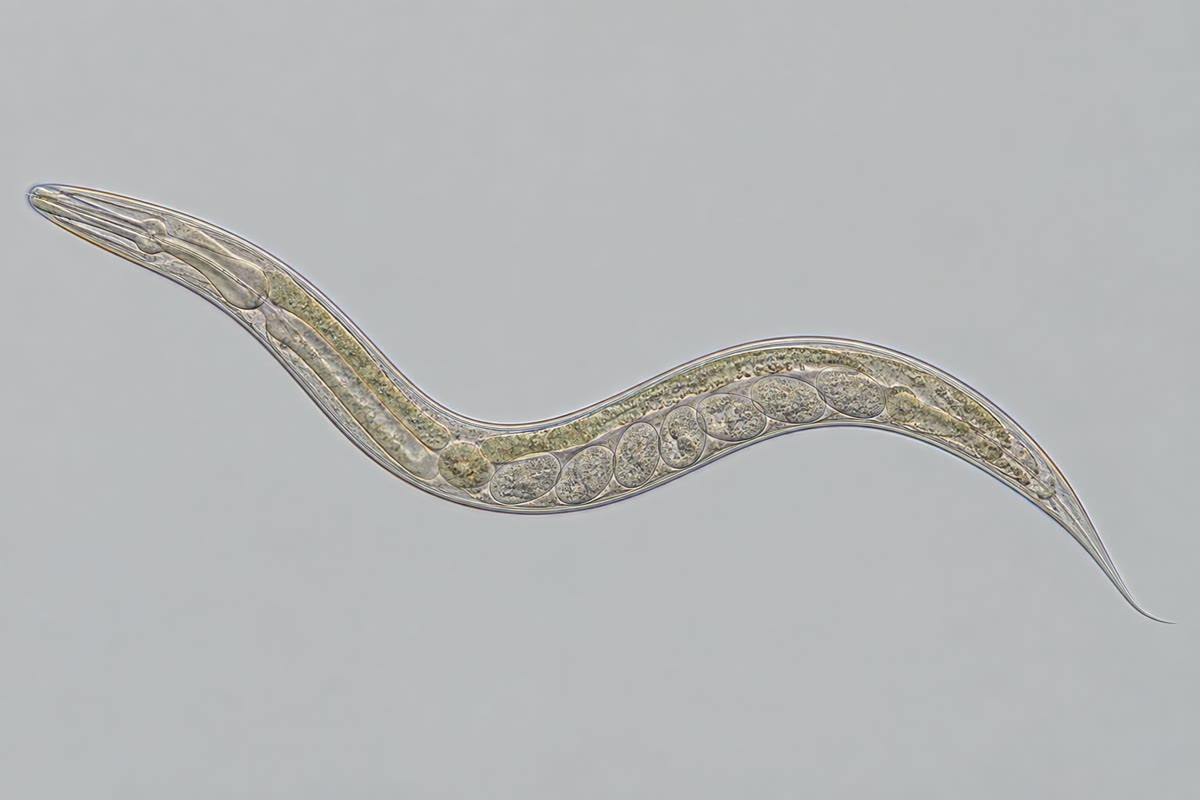
Left: petunias carrying an extra pigment gene, with the white sectors of cosuppression. Right: the nematode Caenorhabditis elegans, about a millimetre long and transparent, in which injected double-stranded RNA silenced the matching gene in the whole animal and its offspring. Left: petunias carrying an extra pigment gene, with the white sectors of cosuppression. Right: the nematode Caenorhabditis elegans, about a millimetre long and transparent, in which injected double-stranded RNA silenced the matching gene in the whole animal and its offspring.
Left: petunias carrying an extra pigment gene, with the white sectors of cosuppression. Right: the nematode Caenorhabditis elegans, about a millimetre long and transparent, in which injected double-stranded RNA silenced the matching gene in the whole animal and its offspring.
Read in context →