Coach
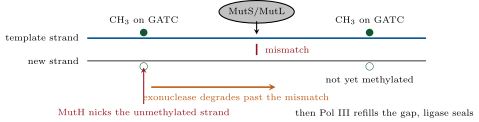
CoachMismatch repair (MMR) corrects the mispairs and small insertion–deletion loops that escape proofreading. The MutS protein (MSH2–MSH6 in humans) recognises the distortion of a mismatch and, with MutL (MLH1–PMS2), licenses an exonuclease to degrade the newly synthesised strand from a nearby nick back past the mismatch; the gap is refilled by polymerase. The difficulty is strand discrimination: a mismatch has two bases and only one is wrong. In Escherichia coli the new strand is identified because it is not yet methylated at GATC sites, which the Dam methylase marks a few minutes after synthesis; MutH nicks the unmethylated strand. In eukaryotes the new strand is identified by the nicks between Okazaki fragments and the free 3 end of the leading strand. Loss of MMR raises the mutation rate a hundred- to a thousand-fold, most visibly at microsatellites — runs of a short repeat where the polymerase slips — whose lengths change from cell to cell: microsatellite instability. Inherited loss of one MMR allele is Lynch syndrome, with colorectal cancer in some of carriers, often before fifty.