
Biology · Glossary

What is Neuron?

Definition 35.4 High School Biology · Chapter 35 — The Stretch Reflex and the Nerve Message

A neuron is a cell specialised for signalling: a cell body with its nucleus, branching dendrites that receive signals, and a single long fibre, the axon, that carries the neuron’s own signal to its endings — for a motor neuron of the leg, a metre away. Many axons are wrapped in a fatty sheath, myelin, laid down by companion cells, which speeds conduction. A nerve is a bundle of hundreds or thousands of axons.
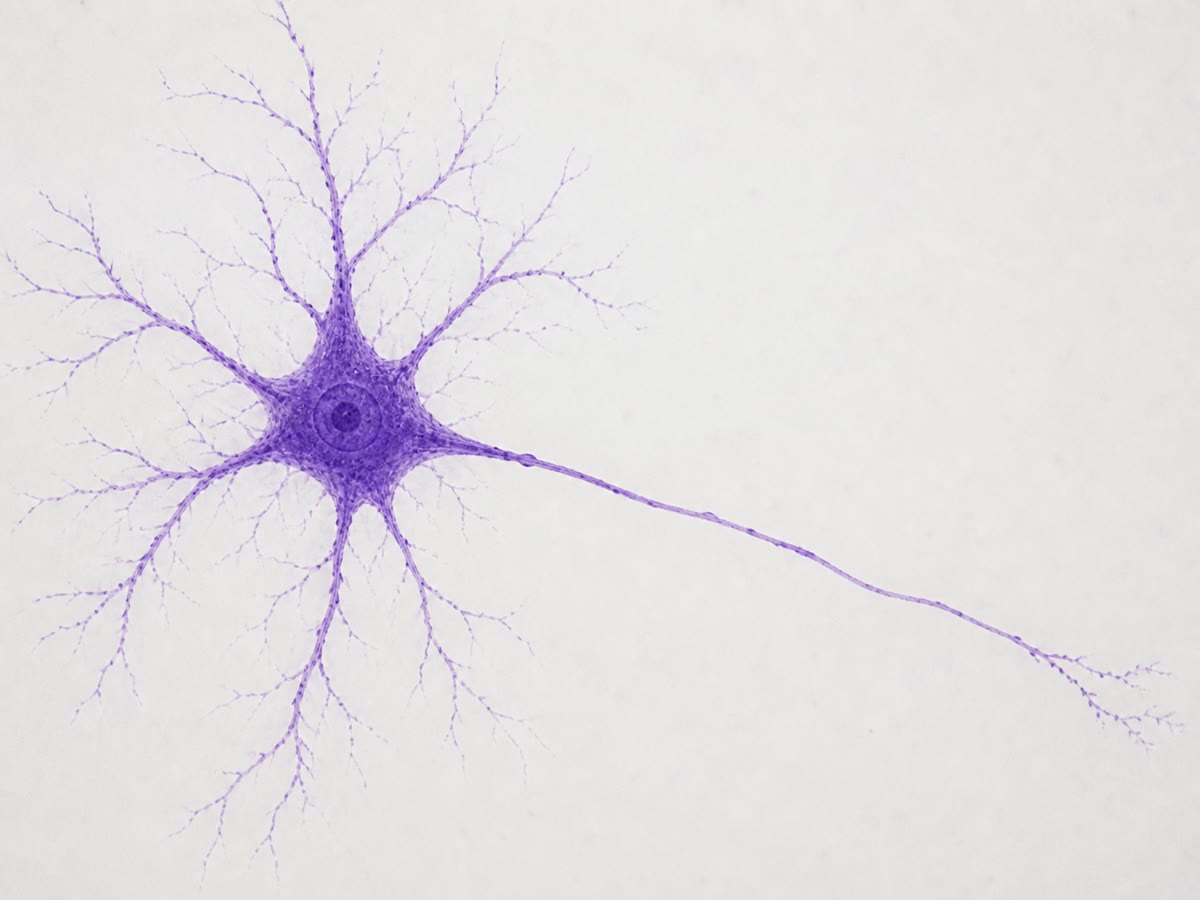
A motor neuron, stained: the cell body with its nucleus, the branching dendrites that receive signals, and the single axon leaving to carry the neuron’s own message to a muscle.
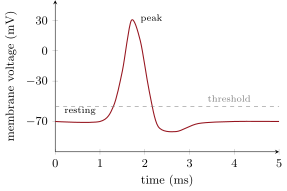
An action potential recorded inside an axon: from the resting -70\, mV, a rapid rise past the threshold to about +30\, mV, a return below rest, and recovery — all in about two milliseconds. Every action potential of a given neuron has this same shape.
An action potential recorded inside an axon: from the resting 70mV-70\,\mathrm{mV}, a rapid rise past the threshold to about +30mV+30\,\mathrm{mV}, a return below rest, and recovery — all in about two milliseconds. Every action potential of a given neuron has this same shape.
Read in context →