
Biology · Glossary

What is Neuron, axon, nerve?

Definition 20.1 University Biology — Year 2 · Chapter 20 — Neurons, Action Potentials and Synapses

A neuron is a cell specialised for signalling: a cell body (soma) with the nucleus, branching dendrites that receive signals, and a single axon — a cable from a micrometre to twenty micrometres thick and up to a metre long — that carries its output to terminals on other cells. The human brain has some 101110^{11} neurons and each makes about a thousand synapses. Neurons are outnumbered by glia: astrocytes that feed and buffer them, microglia that police them, and the cells that wrap axons in myelin — dozens of turns of their own membrane, nearly free of cytoplasm, forming an insulating sheath interrupted every millimetre or so at the nodes of Ranvier. A nerve is a bundle of thousands of axons, sensory and motor, running together in connective tissue. Neurons do not divide in the adult (with few exceptions), and an axon cut from its body dies; a neuron is a cell that must last a lifetime.
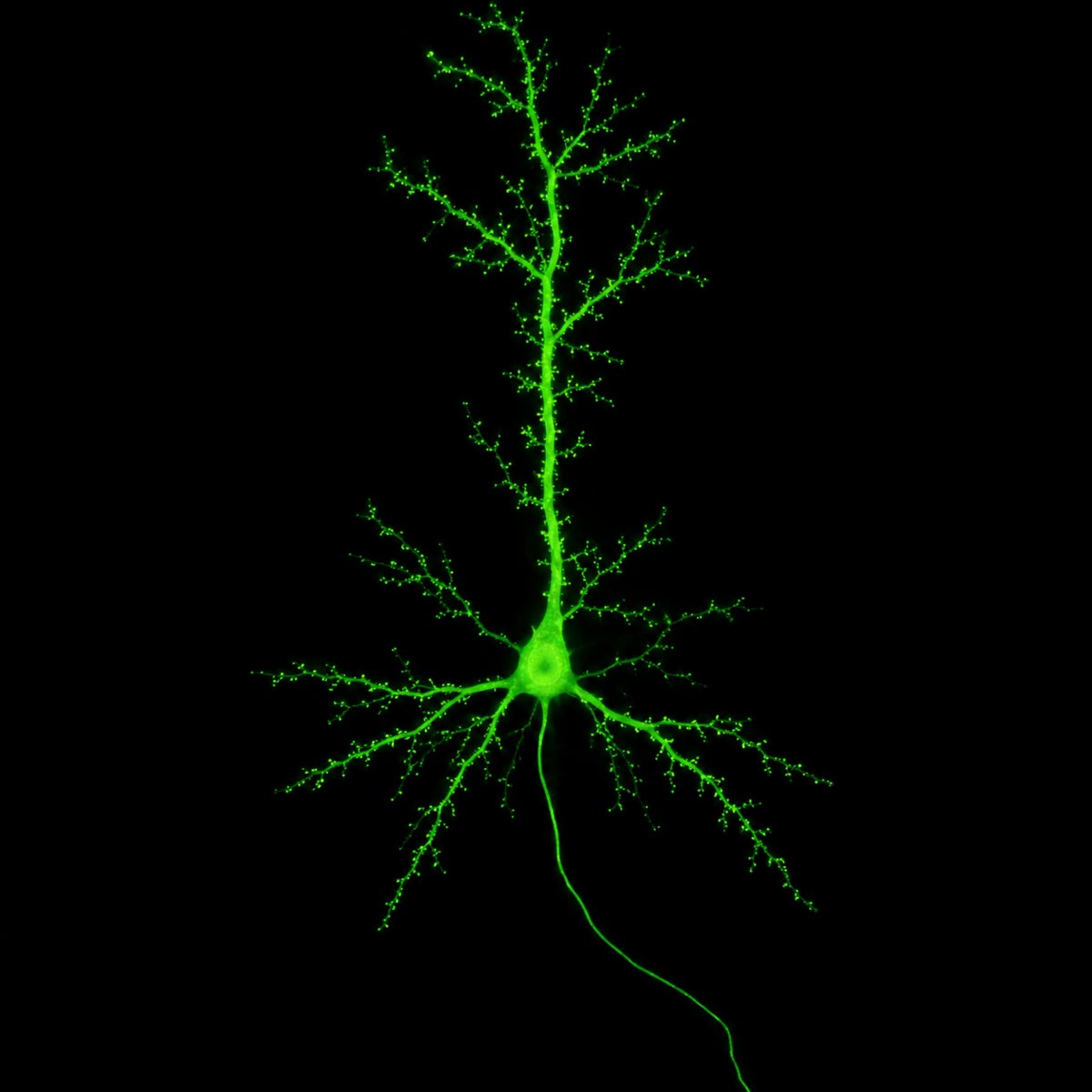
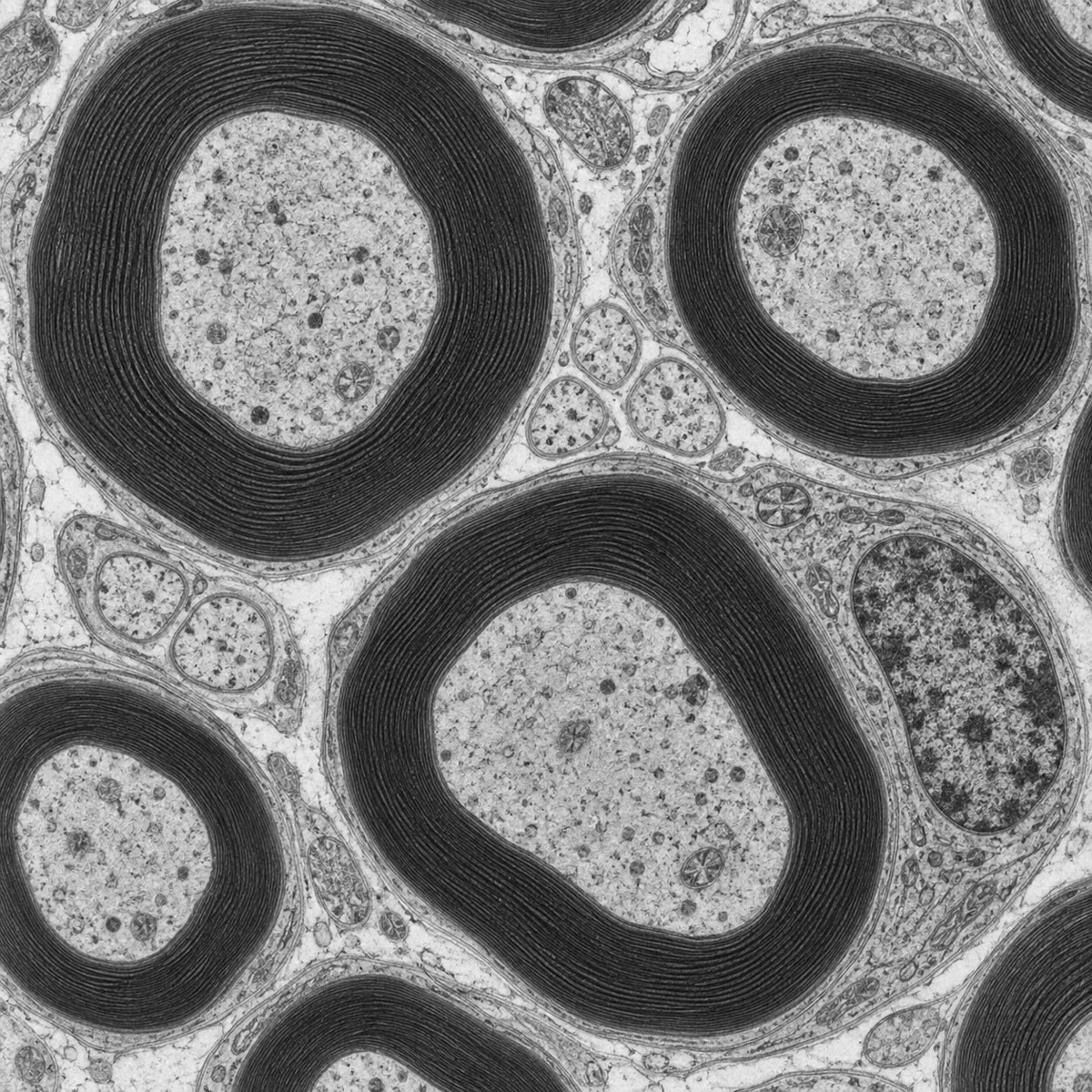
Left: a pyramidal neuron filled with dye — the cell body, the spiny dendrites that receive, and the thin axon that leaves the base. Right: axons in cross-section under the electron microscope, each wrapped in the dark spiral of its myelin sheath. Left: a pyramidal neuron filled with dye — the cell body, the spiny dendrites that receive, and the thin axon that leaves the base. Right: axons in cross-section under the electron microscope, each wrapped in the dark spiral of its myelin sheath.
Left: a pyramidal neuron filled with dye — the cell body, the spiny dendrites that receive, and the thin axon that leaves the base. Right: axons in cross-section under the electron microscope, each wrapped in the dark spiral of its myelin sheath.
Read in context →