 Coach
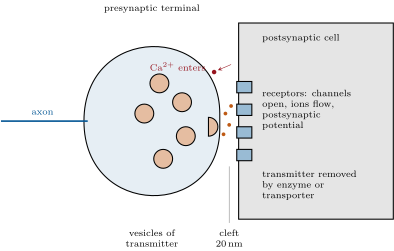
CoachAt a synapse a neuron’s terminal meets a target — another neuron, a muscle fibre, a gland cell. In an electrical synapse gap junctions join the two cells and current passes directly — fast, bidirectional, without amplification, used where speed and synchrony matter (escape reflexes, the heart). In a chemical synapse the cells are separated by a cleft of and the signal is a molecule. An action potential arriving at the terminal opens voltage-gated calcium channels; calcium enters and, within a fraction of a millisecond, makes vesicles of neurotransmitter fuse with the membrane and empty into the cleft; the transmitter diffuses across in microseconds and binds receptors on the postsynaptic membrane — either ion channels that it opens (ionotropic, fast) or G-protein-coupled receptors (metabotropic, slower, Chapter 19); the resulting current shifts the postsynaptic potential by a few millivolts, up (an excitatory postsynaptic potential, from channels passing sodium) or down (an inhibitory one, from channels passing chloride or potassium); and the transmitter is removed within milliseconds by an enzyme or a transporter. The delay is half a millisecond; the price buys one-way transmission, amplification, inhibition, and modifiability — everything a nervous system needs beyond mere conduction.
Examples
Example 20.10 (Transmitters and drugs)
Acetylcholine at the neuromuscular junction and in the autonomic system; glutamate, the main excitatory transmitter of the brain, and GABA, the main inhibitory one; the monoamines noradrenaline, dopamine and serotonin, which modulate whole circuits from a few thousand cells; and dozens of peptides. Almost every drug that acts on the mind acts on a synapse: benzodiazepines strengthen GABA’s channel, antidepressants block serotonin’s transporter, cocaine blocks dopamine’s, opiates mimic a peptide, nicotine mimics acetylcholine on one receptor and atropine blocks it on another, botulinum toxin cuts the proteins that fuse the vesicle. The synapse is where the chemistry of Chapter 19 and the electricity of this chapter meet, and where a nervous system learns: synapses that are used strengthen, and that strengthening (the Year 3 volume) is memory.