 Coach
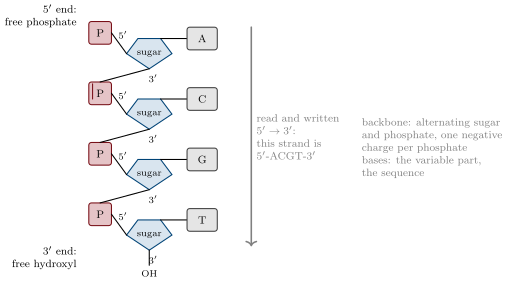
CoachNucleotides are joined into a polynucleotide by phosphodiester bonds: the phosphate on carbon of one nucleotide is linked to the hydroxyl of the next. The chain therefore has a sugar–phosphate backbone, uniform and negatively charged (one charge per phosphate), from which the bases project as a sequence; and it has a direction: a end bearing a free phosphate and a end bearing a free hydroxyl. Sequences are written and read , the direction in which chains are synthesised. DNA (deoxyribonucleic acid) uses deoxyribose and the bases A, G, C, T; RNA (ribonucleic acid) uses ribose and A, G, C, U.
Examples
Example 11.4 (RNA is fragile, DNA is durable)
The hydroxyl of ribose can attack the neighbouring phosphodiester bond: in mild alkali RNA is hydrolysed to nucleotides within hours, while DNA, lacking that hydroxyl, survives boiling in alkali and has been recovered intact from bones tens of thousands of years old. Uracil in RNA is thymine without a methyl group; DNA uses thymine so that cytosine, which slowly loses its amino group to become uracil, can be recognised as damaged and repaired — a uracil in DNA is always a mistake.
Example 11.11 (A probe finds a gene)
A twenty-nucleotide probe complementary to one gene, at below its own , binds its exact complement and nothing else in three billion base pairs: a single mismatch in twenty lowers by several degrees and the mismatched hybrid melts. The specificity of base pairing, multiplied over twenty positions, is what every DNA test, from paternity to pathogen detection, relies on.