
Biology · Glossary

What is Photosynthetic pigments?

Also known as: chlorophyll · carotenoid

Definition 14.2 University Biology — Year 1 · Chapter 14 — Photosynthesis and Autotrophy

Chlorophyll aa and bb are porphyrin rings around a magnesium atom with a long hydrophobic tail anchoring them in the thylakoid membrane; they absorb blue (430 to 450nm430\text{ to }450\,\mathrm{nm}) and red (640 to 680nm640\text{ to }680\,\mathrm{nm}) light and reflect green. Carotenoids (isoprenoids, Chapter 9) absorb blue-green light and pass the energy to chlorophyll, and protect it by quenching excess excitation. A few hundred pigment molecules, held on proteins as an antenna (light-harvesting complex), funnel the energy of every absorbed photon to one special pair of chlorophyll aa molecules, the reaction centre, where it is turned into chemistry.
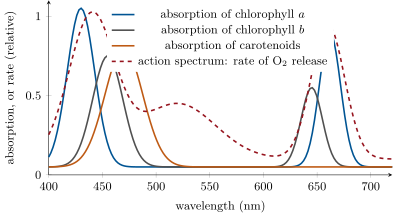
Absorption spectra of the three pigment classes and the action spectrum of photosynthesis (the rate of oxygen release at each wavelength). The action spectrum follows the chlorophylls, filled in by the carotenoids in the blue-green: every pigment that absorbs contributes.
Read in context →