University Biology — Year 1 · Bachelor Year 1
14Photosynthesis and Autotrophy
Every gram of carbon in the rabbit, the oak, the reader and this page was once carbon dioxide in the air, and was fixed into sugar by a leaf — or by an alga, or a cyanobacterium — using the energy of sunlight. The reaction, six and six water to one glucose and six oxygen, is uphill by ; a leaf runs it by splitting water with light, storing the electrons on NADPH and the energy on ATP, and spending both in a cycle that builds sugar. This chapter describes the chloroplast, the pigments and the light reactions that make ATP and NADPH, the Calvin cycle that fixes carbon, the leak called photorespiration and the two designs that seal it, and what autotrophy is in general.
14.1 The chloroplast and its pigments
Definition 14.1 (Chloroplast)
The chloroplast is a lens-shaped organelle long bounded by two envelope membranes; its interior, the stroma, holds the enzymes of carbon fixation, starch grains, ribosomes and a circular DNA; within the stroma a third membrane system, the thylakoids, forms flattened sacs stacked into grana and connected by lamellae, enclosing one continuous thylakoid lumen. The light reactions take place in the thylakoid membrane; carbon fixation in the stroma. A leaf cell holds chloroplasts; a square millimetre of leaf, half a million.
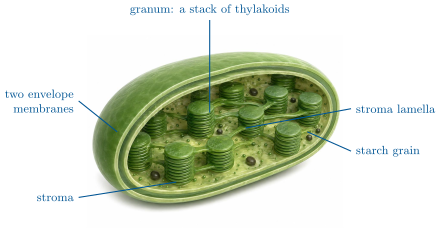
Definition 14.2 (Photosynthetic pigments)
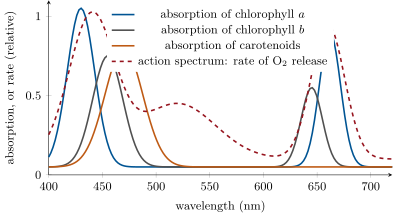
Chlorophyll and are porphyrin rings around a magnesium atom with a long hydrophobic tail anchoring them in the thylakoid membrane; they absorb blue () and red () light and reflect green. Carotenoids (isoprenoids, Chapter 9) absorb blue-green light and pass the energy to chlorophyll, and protect it by quenching excess excitation. A few hundred pigment molecules, held on proteins as an antenna (light-harvesting complex), funnel the energy of every absorbed photon to one special pair of chlorophyll molecules, the reaction centre, where it is turned into chemistry.
Proposition 14.3 (The action spectrum follows the pigments)
Photosynthesis is driven by the light the pigments absorb: it is fastest in red and blue light, weakest in green.
Evidence. Engelmann (1882) laid a filament of alga across a spectrum projected under his microscope and added oxygen-seeking bacteria: they gathered where the red and blue light fell, not in the green (recalled from the High School volume). Measured with an oxygen electrode, the rate at each wavelength gives the action spectrum above, which follows the absorption of the chlorophylls; the excess in the blue-green is the carotenoids’ contribution, showing that they pass their energy on. ∎
14.2 The light reactions
Proposition 14.4 (What the light reactions do)
In the thylakoid membrane, light energy is used to move electrons from water to — uphill, against a redox potential difference of — and to pump protons into the lumen:
The oxygen released is the oxygen of water, not of carbon dioxide; the NADPH carries the reducing power and the ATP the energy that the Calvin cycle will spend.
Evidence. Hill (1937) showed that isolated chloroplasts in light release oxygen in the absence of if an artificial electron acceptor is present: the splitting of water is separable from carbon fixation. Ruben and Kamen (1941) fed algae water labelled with heavy oxygen and found the label in the released, and not when the label was in the . Emerson (1957) found that red light of , nearly useless alone, and light of together gave more than the sum of their separate rates: two photosystems with different pigments must work in series. ∎
Definition 14.5 (Photosystems and the Z-scheme)
Two photosystems sit in the thylakoid membrane. In photosystem II (PSII, reaction centre P680) an absorbed photon raises an electron of the special pair to a high energy; the electron leaves, and the oxidised P680, the strongest biological oxidant, takes an electron from water: a manganese cluster splits two water molecules into , four protons (released into the lumen) and four electrons, one photon at a time. The electron descends an electron-transport chain — plastoquinone, the cytochrome complex, plastocyanin — and the energy it loses pumps protons into the lumen. In photosystem I (PSI, P700) a second photon lifts it again, to a potential low enough to reduce ferredoxin and then to NADPH. Drawn on a scale of redox potential, the path is a Z: two climbs by light, two descents by chemistry.
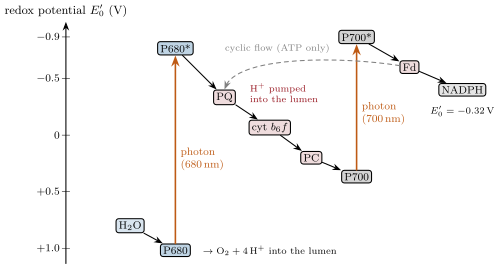
Theorem 14.6 (Chemiosmotic synthesis of ATP)
The protons released by water splitting and pumped by the cytochrome complex accumulate in the thylakoid lumen, which in the light falls to pH 5 while the stroma rises to pH 8: a difference of three units, a proton-motive force of about , equivalent to per mole of protons. The ATP synthase, a rotary motor spanning the thylakoid membrane, lets protons flow back into the stroma and uses the energy to phosphorylate ADP: about per ATP. Electron transport and ATP synthesis are coupled only through this gradient (Mitchell’s chemiosmotic theory, 1961).
Evidence. Jagendorf (1966) soaked thylakoids in the dark in an acid bath (pH 4) until their lumen was acid, then transferred them suddenly to pH 8 with ADP and phosphate: ATP was made in the dark, from the gradient alone. Uncouplers — lipid-soluble weak acids that carry protons across membranes — abolish ATP synthesis while electron transport and oxygen release continue, and even speed up. Isolated ATP synthase reconstituted into artificial vesicles makes ATP when a pH gradient is imposed, and hydrolyses ATP to pump protons when it is not. The enzyme’s rotation has since been watched directly, one molecule at a time, under the microscope. ∎
Example 14.7 (Cyclic and non-cyclic flow)
The linear path from water to NADPH gives, per , two NADPH and about three ATP; the Calvin cycle needs a ratio of three ATP to two NADPH exactly, and other work of the chloroplast needs more ATP. When ATP runs short, electrons from ferredoxin return to plastoquinone instead of going to (cyclic photophosphorylation): PSI alone, pumping protons and making ATP without oxygen or NADPH. The two modes are balanced to the demand.
14.3 The Calvin cycle
Definition 14.8 (Carbon fixation)
The Calvin cycle in the stroma fixes into sugar in three stages. Fixation: RuBisCO (ribulose bisphosphate carboxylase/oxygenase) adds to ribulose-1,5-bisphosphate (RuBP, five carbons), and the six-carbon product splits at once into two molecules of 3-phosphoglycerate (3-PGA, three carbons). Reduction: each 3-PGA is phosphorylated by ATP and reduced by NADPH to glyceraldehyde-3-phosphate (G3P), the first sugar. Regeneration: five of every six G3P are rearranged, at the cost of ATP, back into three RuBP, and one G3P leaves the cycle as the net product. The stoichiometry for one G3P (three carbons) is
two G3P make one glucose: ATP and per glucose.
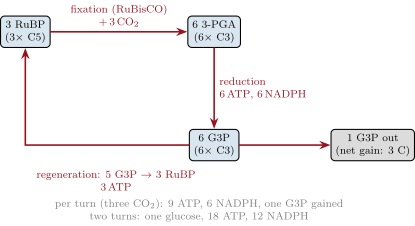
Proposition 14.9 (Calvin’s evidence)
The first stable product of fixation is 3-phosphoglycerate, and the acceptor is ribulose bisphosphate.
Evidence. Calvin and Benson (1948–1954) illuminated algae in a flat flask (the “lollipop”), injected , and killed samples in boiling alcohol after seconds; two-dimensional paper chromatography and autoradiography showed where the label was. After five seconds nearly all of it was in 3-PGA; longer exposures spread it through the sugar phosphates and then into sucrose and starch. When the was suddenly removed, RuBP accumulated and 3-PGA fell; when the light was switched off, 3-PGA accumulated and RuBP fell — so RuBP is the acceptor consumed by fixation, and 3-PGA the product consumed by the light’s ATP and NADPH. ∎
Method 14.10 (Balancing a photosynthetic budget)
- Count carbons: each fixed yields one carbon of product; one glucose needs six turns of RuBisCO.
- Count carriers: each turn costs 3 ATP and 2 NADPH (9 and 6 per G3P); one glucose costs 18 ATP and 12 NADPH.
- Count photons: the linear flow gives 2 NADPH and about 3 ATP per , for 8 photons (4 per photosystem); 12 NADPH need 6 and 48 photons; the extra ATP comes from cyclic flow (a few more photons). About 8 photons per : the quantum requirement.
- Count energy: a mole of photons is ; 48 photons are for stored in glucose: at best, before any loss to reflection, respiration and the fraction of the spectrum not absorbed.
14.4 Photorespiration, C4 and CAM
Proposition 14.11 (RuBisCO’s flaw)
RuBisCO also accepts in place of : the oxygenation of RuBP yields one 3-PGA and one two-carbon phosphoglycolate, which the cell must salvage through a costly route across three organelles that releases and consumes ATP — photorespiration. The enzyme discriminates poorly (about to 1 in favour of at equal concentrations), and in air is five hundred times more abundant than ; at a quarter of the fixations are wasted, more in hot, dry weather when stomata close and falls inside the leaf. RuBisCO, evolved when the air had no oxygen, is also slow (three turnovers per second) and is compensated by abundance: it is the most plentiful protein on Earth, half the soluble protein of a leaf.
Definition 14.12 (C4 and CAM plants)
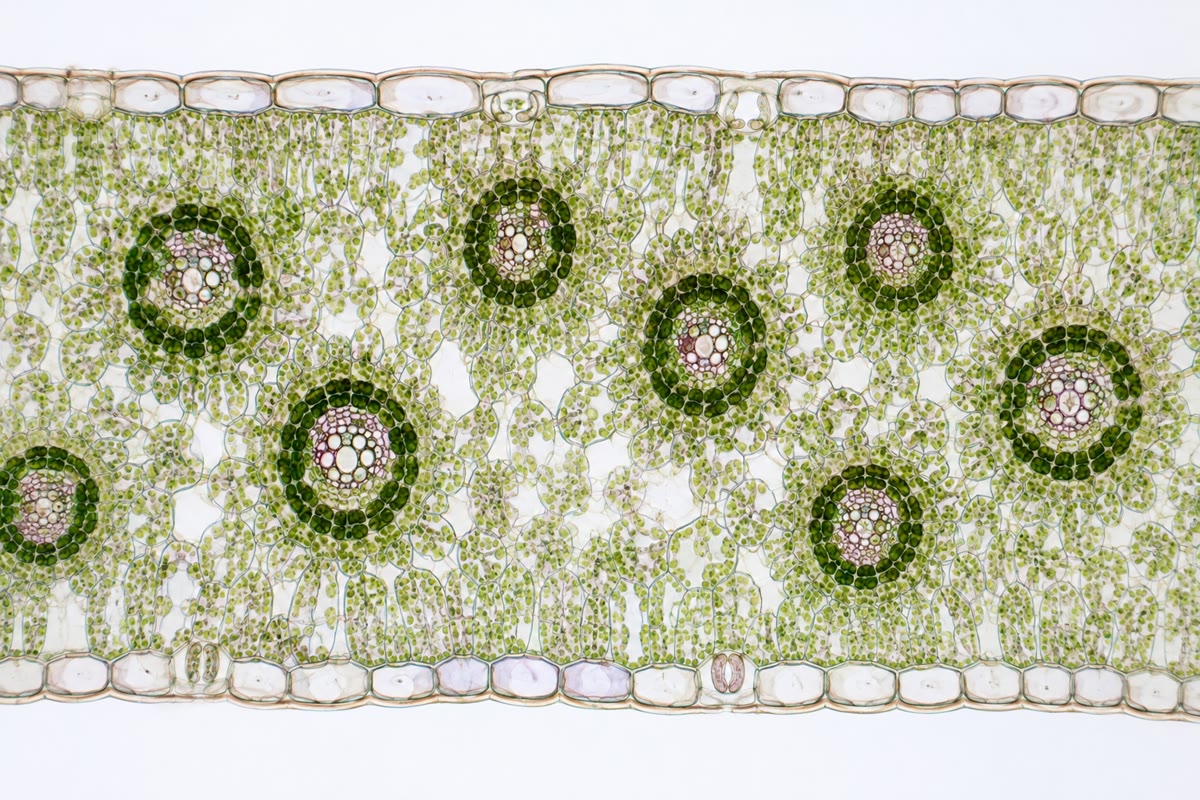
C4 plants (maize, sugar cane, sorghum, many tropical grasses) seal the leak by concentrating : in the mesophyll cells an enzyme with no affinity for (PEP carboxylase) fixes bicarbonate into a four-carbon acid, which is shuttled into the bundle-sheath cells around the veins and decarboxylated there, raising the around RuBisCO tenfold and suppressing oxygenation — at a cost of two extra ATP per . The two cell types form the Kranz (“wreath”) anatomy. CAM plants (cacti, pineapple, agaves) separate the same two steps in time rather than space: they open their stomata at night, store as malic acid in the vacuole, and release it to RuBisCO by day behind closed stomata, losing a tenth of the water a C3 plant loses per carbon fixed.
Example 14.13 (Which plant where)
At in moist air a C3 wheat leaf and a C4 maize leaf fix carbon at similar rates, and the maize pays two ATP more per carbon. At in dry air the wheat loses a third of its fixation to photorespiration while the maize loses none: C4 grasses dominate hot open country, C3 plants the cool and shaded. A cactus fixes slowly by either standard but survives where the others would die of thirst.
14.5 Autotrophy
Definition 14.14 (Autotrophy)
An organism is autotrophic when it builds its organic matter from (Chapter 1). It needs a source of energy and a source of electrons. Photoautotrophs take energy from light: plants, algae and cyanobacteria take their electrons from water and release oxygen (oxygenic); purple and green bacteria take them from hydrogen sulfide or organic acids and release none. Chemoautotrophs take both energy and electrons from the oxidation of inorganic compounds — ammonia, nitrite, sulfide, hydrogen, ferrous iron — with no light at all: the nitrifying bacteria of the soil, and the bacteria that feed the ecosystems of deep-sea vents. All use the Calvin cycle, or a related cycle, to fix the carbon; all reduce it with NADPH and pay with ATP; they differ only in where the ATP and the electrons come from.
Example 14.15 (The global budget)
Photosynthesis fixes about of carbon a year on land and in the oceans, half of it by single-celled algae and cyanobacteria invisible to the eye; it turns over the carbon dioxide of the atmosphere every seven years and its oxygen every two thousand. The oxygen came the same way: for two billion years cyanobacteria released it into an atmosphere that had none, and every aerobic organism, from the mitochondrion up, is built on the leak of one enzyme system that splits water.
14.6 Exercises
Exercise 14.1 ★
Name the three membrane systems of the chloroplast and say where the light reactions and the Calvin cycle take place.
Solution
Solution of Exercise 14.1.
The outer and inner envelope membranes, and the thylakoid membrane inside. Light reactions: in the thylakoid membrane (protons pumped into the lumen). Calvin cycle: in the stroma.
Exercise 14.2 ★
Write the equation of the light reactions and say where the released oxygen comes from, with the evidence.
Solution
Solution of Exercise 14.2.
with eight photons. The oxygen comes from water: algae given release ; given they do not (Ruben and Kamen).
Exercise 14.3 ★
Name the three stages of the Calvin cycle and the number of ATP and NADPH consumed per fixed.
Exercise 14.4 ★
From the spectra figure, at which wavelengths does chlorophyll absorb most, and why is the action spectrum higher than the chlorophyll absorption around ?
Solution
Solution of Exercise 14.4.
Near (blue) and (red). Around the carotenoids absorb and pass the energy to chlorophyll, so oxygen is released although chlorophyll itself absorbs little there.
Exercise 14.5 ★★
Explain the Emerson enhancement effect and what it revealed about the organisation of the light reactions.
Solution
Solution of Exercise 14.5.
Far-red light () alone drives little photosynthesis; added to light it gives more than the two rates summed. Two pigment systems with different absorption maxima must cooperate in series, each needing its own photons: photosystem I (P700) and photosystem II (P680).
Exercise 14.6 ★★
A proton-motive force of corresponds to how much free energy per mole of protons ()? How many protons must flow to make one ATP at ? Compare with the four the synthase uses.
Solution
Solution of Exercise 14.6.
of protons; protons at least; the synthase uses four, i.e. efficiency.
Exercise 14.7 ★★
Jagendorf’s thylakoids made ATP in the dark after an acid bath. Explain what this proves and what it does not, and predict the result if an uncoupler is added before the transfer.
Solution
Solution of Exercise 14.7.
It proves that a proton gradient across the thylakoid membrane is sufficient to drive ATP synthesis, with no light and no electron transport: the coupling is through the gradient. It does not by itself prove that the light reactions make ATP this way in the leaf (that needs the uncoupler and pH measurements). With an uncoupler the gradient collapses before the synthase can use it: no ATP.
Exercise 14.8 ★★
Follow the carbon: starting from 3 RuBP (15 carbons) and 3 , count carbons through 3-PGA, G3P, the exported G3P and the regenerated RuBP, and verify the balance.
Solution
Solution of Exercise 14.8.
carbons; six 3-PGA ; six G3P ; one G3P out (3) and five G3P (15) regenerate three RuBP (15): . Balanced.
Exercise 14.9 ★★
In Calvin’s experiment, RuBP rises and 3-PGA falls when is removed; 3-PGA rises and RuBP falls when the light is switched off. Explain both from the cycle.
Solution
Solution of Exercise 14.9.
Without RuBisCO stops: RuBP is no longer consumed (rises) and 3-PGA no longer made (falls) while the light keeps reducing it away. Without light there is no ATP or NADPH: 3-PGA is no longer reduced (rises) and RuBP no longer regenerated (falls) while fixation continues briefly.
Exercise 14.10 ★★★
Compute the energy of a mole of photons (, , ), the energy of the 48 photons needed per glucose, and the efficiency of storing . Why is the efficiency of a whole crop, about of the sunlight, so much lower?
Solution
Solution of Exercise 14.10.
; per mole . 48 photons: ; efficiency . A crop loses the light not absorbed (half the spectrum, reflection, transmission, gaps between plants), the photorespiration, the respiration of leaves, stems and roots, the light saturation of the enzymes at full sun, and the seasons when leaves are absent.
Exercise 14.11 ★★★
At in air RuBisCO oxygenates once for every three carboxylations; each oxygenation releases half a in salvage and costs ATP. Compute the net carbon fixed per 100 carboxylations and the fraction lost. A C4 plant avoids the loss but spends 2 extra ATP per : at what fraction of loss does the C4 design pay, if one ATP is worth about a tenth of a fixed?
Solution
Solution of Exercise 14.11.
Per 100 carboxylations, 33 oxygenations releasing carbons: net , a loss of . Cost of avoiding it: 2 ATP carbon per , i.e. ; the C4 design pays only when the loss exceeds about a fifth — in hot, dry conditions, not in cool ones.
Exercise 14.12 ★★★
“Photosynthesis is respiration run backward.” Discuss in a paragraph, comparing the chemiosmotic mechanism, the direction of electron flow, the carriers and the cycles, and saying where the analogy holds and where it fails.
Solution
Solution of Exercise 14.12.
Both use membranes that pump protons with the energy of electron transport and an ATP synthase that spends the gradient: the mechanism is the same, and the synthases are homologous. But the electrons run opposite ways — from water to NADPH in the chloroplast, lifted by light; from NADH to oxygen in the mitochondrion, falling (Chapter 15) — and the carbon cycles are not each other’s reverse: the Calvin cycle and the Krebs cycle share no enzyme, and the reduction of uses NADPH while its release uses . The overall equations are reverses; the machinery is a common inheritance used in two directions, with different chemistry at the carbon end.
14.7 Problem: The Price of a Molecule of Glucose
Problem 14.1
Weekend problem — photons counted, electrons and protons followed through the thylakoid, ATP and NADPH reckoned and spent, a leaf’s daily harvest weighed, ending on the energy efficiency of photosynthesis
Constants: , , , , , . Free energy of glucose combustion ; ATP synthesis in the chloroplast costs ; NADPH holds of reducing power.
Part I — Photons and electrons.
- Compute the energy of one photon of and of a mole of them.
- Compute the energy of a mole of photons and of photons. Why does blue light give no more photosynthesis per photon than red?
- How many photons of carry one joule?
- Moving one electron from water () to () requires how much free energy per mole of electrons ()?
- Two photons are used per electron (one in each photosystem). Compute the energy supplied per mole of electrons and the fraction of it stored in the redox change.
- How many electrons, and hence how many photons, are needed to make one and two NADPH?
- How many photons per glucose, if 12 NADPH are needed?
Part II — Protons and ATP. For each released, four protons are freed in the lumen by water splitting and eight are pumped by the cytochrome complex; the ATP synthase uses per ATP. The lumen is at pH 5 and the stroma at pH 8; the membrane potential across the thylakoid is negligible.
- Compute the proton-motive force from the pH difference, in volts (), and the free energy per mole of protons.
- Compute the protons delivered to the lumen per and the ATP they can make.
- Compute the ATP made per glucose by linear flow (6 ), and compare with the 18 the Calvin cycle needs. How is the shortfall made up?
- Compute the free energy available from the protons per ATP () and the efficiency of the synthase.
- The lumen of a chloroplast has a volume of about . How many free protons does it hold at pH 5? Compare with the roughly protons that pass through the synthases each second, and conclude what buffers the lumen.
Part III — Sugar.
- Write the energy stored per glucose as 18 ATP plus 12 NADPH , and compare it with the of glucose. Where does the difference go?
- Compute the energy of the 48 photons of question 6 and the efficiency of photosynthesis from photon to glucose.
- Only of sunlight is in the wavelengths the pigments absorb, and of that a tenth is reflected or transmitted. Compute the efficiency from incident sunlight to glucose, before respiration.
- A leaf of receives of sunlight for . Compute the energy received and, at the efficiency of question 14, the glucose made in grams ().
- The leaf respires of that glucose to stay alive. What is its net gain, in grams of glucose and in grams of carbon?
- A crop reaches overall efficiency in a season. List three losses, beyond those already counted, that separate the leaf’s figure from the crop’s.
Part IV — The leak. RuBisCO in air at performs one oxygenation per three carboxylations; each oxygenation costs the equivalent of half a fixed and 3.5 ATP.
- Per 100 carboxylations, compute the oxygenations, the carbon lost and the net carbon gained.
- Compute the ATP spent on salvage per 100 carboxylations and the total ATP per net carbon gained (Calvin cycle 3 ATP per carboxylation plus salvage).
- A C4 plant has no oxygenation but spends 2 extra ATP per delivered. Compute its ATP per net carbon and compare.
- At the oxygenation ratio rises to one in two. Recompute the C3 figures and say which design wins.
- Explain why raising the of a greenhouse to three times the atmospheric value raises the yield of C3 crops (tomato, wheat) but barely that of C4 crops (maize).
- A C3 leaf loses about 250 water molecules per fixed, a CAM plant about 25. Compute the water each loses to fix of carbon.
- State the result: the quantum requirement per , the efficiency from photon to glucose, and the efficiency from sunlight to net leaf sugar.
Solution
Solution of Problem 14.1.
1. ; . 2. : ; : . A blue photon excites chlorophyll to a higher state that decays within picoseconds to the same lowest excited state a red photon reaches; the excess is lost as heat, and the chemistry sees one photon either way. 3. photons per joule. 4. : per mole of electrons. 5. Two photons: about ; stored : . 6. Four electrons per (two water molecules), giving two NADPH: eight photons. 7. 12 NADPH: 24 electrons, 48 photons. 8. ; per mole of protons. 9. protons per : 3 ATP. 10. ATP: exactly the cycle’s need on this accounting; in practice the yield is nearer 2.6 per ( per ATP in the chloroplast) and cyclic flow around photosystem I supplies the rest. 11. for one ATP of : . 12. free protons in the lumen against per second through the synthases: the flux is carried by protons bound to the buffering groups of the lumen’s proteins and lipids, which release them as fast as they leave. 13. for stored: (a fifth) dissipated as heat in the cycle’s reactions, which must be downhill to run. 14. ; . 15. . 16. ; glucose . 17. Net of glucose, of carbon (). 18. Light falling between plants or on soil; leaves in the shade of other leaves working below capacity, and leaves in full sun saturated (the enzymes cannot use all the photons); respiration of roots, stems and at night; photorespiration; the weeks before the canopy closes and after it senesces. 19. 33 oxygenations, 16.7 carbons lost, net 83.3 gained. 20. Salvage ATP; cycle 300 ATP; total 417 ATP for 83.3 carbons: 5.0 ATP per net carbon. 21. ATP per carbon, with no carbon lost — equal in ATP, but the C3 plant has also lost of its carboxylation capacity; roughly a draw at . 22. 50 oxygenations, 25 carbons lost, net 75; salvage 175 ATP; ATP per net carbon against the C4 plant’s 5, with a quarter of the carbon lost: C4 wins clearly. 23. Tripling shifts RuBisCO’s competition toward carboxylation, cutting photorespiration and raising net fixation in C3 plants; C4 plants already saturate RuBisCO with concentrated and gain nothing but a little saving of water. 24. of carbon is : C3, of water, ; CAM, . 25. About 8 photons per (48 per glucose); from absorbed photons to glucose; about from incident sunlight to gross sugar and to the leaf’s net sugar — a figure that the losses of a whole plant over a whole season reduce to .