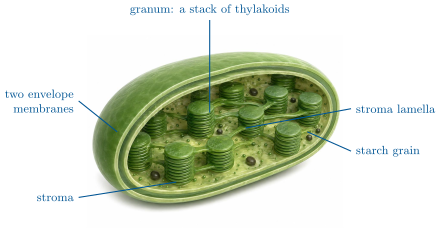
The chloroplast is the organelle of photosynthesis: a lens-shaped body some long, bounded by a double membrane, containing a fluid, the stroma, in which lie stacks of flattened membrane sacs, the thylakoids. The thylakoid membranes hold the pigments — chlorophylls a and b, green, and orange carotenoids — and the proteins that convert light energy; the stroma holds the enzymes that build sugar. A leaf cell contains tens of chloroplasts, a square millimetre of leaf some half a million.
Biology · Glossary
What is Chloroplast?
Also known as: thylakoid · stroma
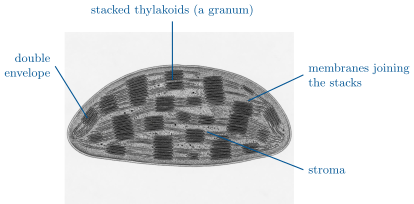
The chloroplast is a lens-shaped organelle long bounded by two envelope membranes; its interior, the stroma, holds the enzymes of carbon fixation, starch grains, ribosomes and a circular DNA; within the stroma a third membrane system, the thylakoids, forms flattened sacs stacked into grana and connected by lamellae, enclosing one continuous thylakoid lumen. The light reactions take place in the thylakoid membrane; carbon fixation in the stroma. A leaf cell holds chloroplasts; a square millimetre of leaf, half a million.
Examples
Example 14.7 (Cyclic and non-cyclic flow)
The linear path from water to NADPH gives, per , two NADPH and about three ATP; the Calvin cycle needs a ratio of three ATP to two NADPH exactly, and other work of the chloroplast needs more ATP. When ATP runs short, electrons from ferredoxin return to plastoquinone instead of going to (cyclic photophosphorylation): PSI alone, pumping protons and making ATP without oxygen or NADPH. The two modes are balanced to the demand.