University Biology — Year 1 · Bachelor Year 1
9Lipids
A camel crossing a desert carries thirty kilograms of fat in its hump and no water there at all; a trout in a mountain stream at has membranes as fluid as a carp’s in a warm pond; and a drop of olive oil shaken into water breaks into a cloud of droplets that, left alone, gather back into one. All three are lipids at work: the densest store of chemical energy an organism can carry, the film that bounds every cell and every organelle, and the class of molecule that water refuses to dissolve. This chapter describes fatty acids and the fats built from them, the amphiphilic lipids that assemble into membranes, what makes a membrane more or less fluid, and the other lipids — sterols, pigments, hormones — that a few carbons arranged in rings and chains can be.
9.1 Fatty acids
Definition 9.1 (Lipid, fatty acid)
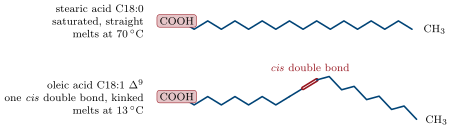
Lipids are the biological molecules defined not by a common structure but by a common property: they are insoluble in water and soluble in non-polar solvents. Most are built on fatty acids: carboxylic acids with an unbranched hydrocarbon chain of carbons, almost always an even number (they are assembled two carbons at a time, Chapter 16). A saturated fatty acid has only single bonds and a straight, flexible chain; an unsaturated one has one or more double bonds, in the cis configuration, each putting a rigid kink of about in the chain. Notation: C18:1 is an 18-carbon acid with one double bond after carbon 9 (oleic acid); an omega-3 acid has its last double bond three carbons from the methyl end.
Proposition 9.2 (Melting points)
The melting point of a fatty acid, and the fluidity of any lipid assembly it belongs to, is set by how closely the chains can pack: it rises with chain length ( for C12:0, for C16:0, for C18:0) and falls sharply with each cis double bond (C18:0 , C18:1 , C18:2 , C18:3 ). Animal fats, rich in saturated acids, are solid at room temperature; plant and fish oils, rich in unsaturated ones, are liquid.
Proof. Straight chains lie side by side and every makes van der Waals contacts with its neighbours, each worth a few kilojoules per mole, summed along the chain: more carbons, more contacts, more heat to separate them. A kink prevents close contact over several carbons on each side and removes many contacts at once. ∎
9.2 Fats: the energy store
Definition 9.3 (Triglyceride)
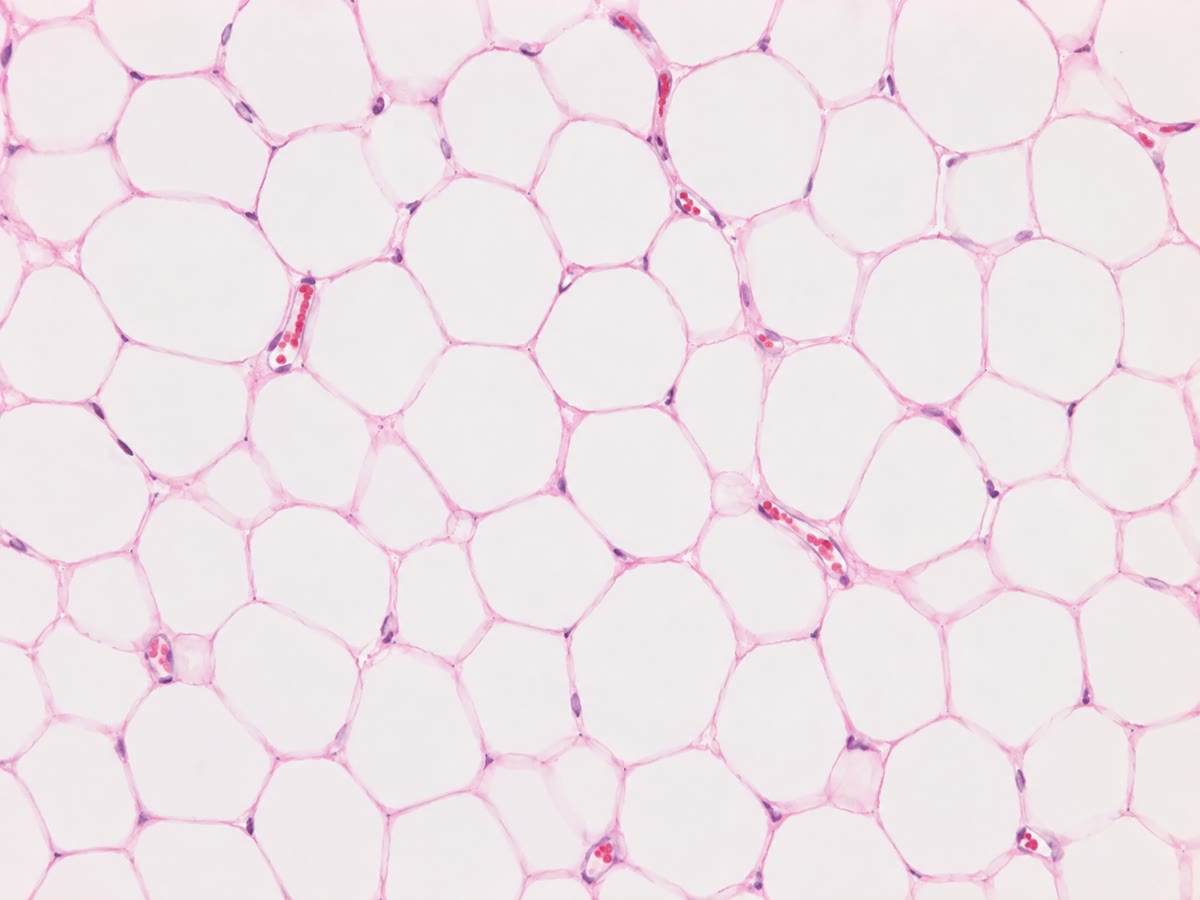
A triglyceride (triacylglycerol, a fat when solid, an oil when liquid) is glycerol — a three-carbon alcohol — esterified on its three hydroxyls by three fatty acids. It has no charge and no polar group left: it is entirely hydrophobic, and it is stored as anhydrous droplets in adipocytes, cells of the adipose tissue that are little more than a droplet of fat with a nucleus pushed to one side.
Proposition 9.4 (Fat is the densest energy store)
Oxidising of fat releases , against for of carbohydrate or protein: the carbons of a fatty acid are more reduced (more C–H bonds, fewer C–O) and so give up more electrons to oxygen. Moreover fat is stored dry, whereas glycogen binds about of water per gram: of stored glycogen yields per gram of stored mass, fat nine times more. A lean human carries of glycogen (a day’s energy) and of fat (more than a month’s).
Example 9.5 (Why not store everything as fat)
Fat can only be burnt with oxygen, slowly, and cannot be turned back into glucose in animals (Chapter 16); the brain and the red cells need glucose, and a sprinting muscle needs it faster than fat can supply. Glycogen is the fast, oxygen-free, glucose store for hours; fat, the dense store for weeks. A migrating bird, a hibernating dormouse and a camel are fat; a sprinter’s legs are glycogen.
Definition 9.6 (Waxes)
Waxes are esters of a fatty acid with a long-chain alcohol: solid, entirely hydrophobic, and used as coatings — the cuticle of leaves (Chapter 3), the surface of insects, the waterproofing of feathers and fur, the comb of bees.
9.3 Membrane lipids and self-assembly
Definition 9.7 (Amphiphilic lipids)
The lipids of membranes are amphiphilic: a polar head that water solvates and one or two non-polar tails that it excludes. Glycerophospholipids are glycerol bearing two fatty acids and, on the third carbon, a phosphate linked to a small polar alcohol (choline, ethanolamine, serine, inositol): phosphatidyl-choline is the commonest lipid of animal membranes. Sphingolipids are built on the amino-alcohol sphingosine instead of glycerol, with one fatty acid and a head of phosphocholine (sphingomyelin) or of sugars (glycolipids), and are enriched in the outer leaflet and in nerve sheaths. Sterols — cholesterol in animals, related sterols in plants and fungi — are rigid four-ring molecules with a single hydroxyl as their head, lying among the tails of the other lipids.
Proposition 9.8 (Self-assembly)
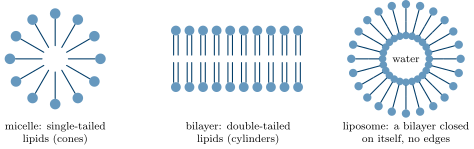
In water, amphiphilic molecules assemble spontaneously so as to hide their tails and expose their heads. The shape of the molecule decides the structure: single-tailed lipids (fatty acids, detergents), shaped like cones, form micelles — spheres a few nanometres across with the tails inside; double-tailed phospholipids, shaped like cylinders, form bilayers, which close on themselves into liposomes (vesicles) to leave no edge exposed. The assembly is driven by the hydrophobic effect (Chapter 8): it costs no energy and needs no enzyme, and a torn bilayer reseals by itself. Membranes are self-healing sheets that grow by insertion of new lipids and never form from nothing: every membrane comes from a membrane.
Evidence. Dried phospholipid dispersed in water forms closed vesicles with bilayer walls visible in the electron microscope (Bangham, 1965); their permeability to ions and water matches that of cell membranes, and they can be loaded with drugs and fused with cells. Adding a detergent (single-tailed, cone-shaped) dissolves the bilayer into mixed micelles; removing it by dialysis lets the bilayer reform. ∎
Example 9.9 (Bile salts)
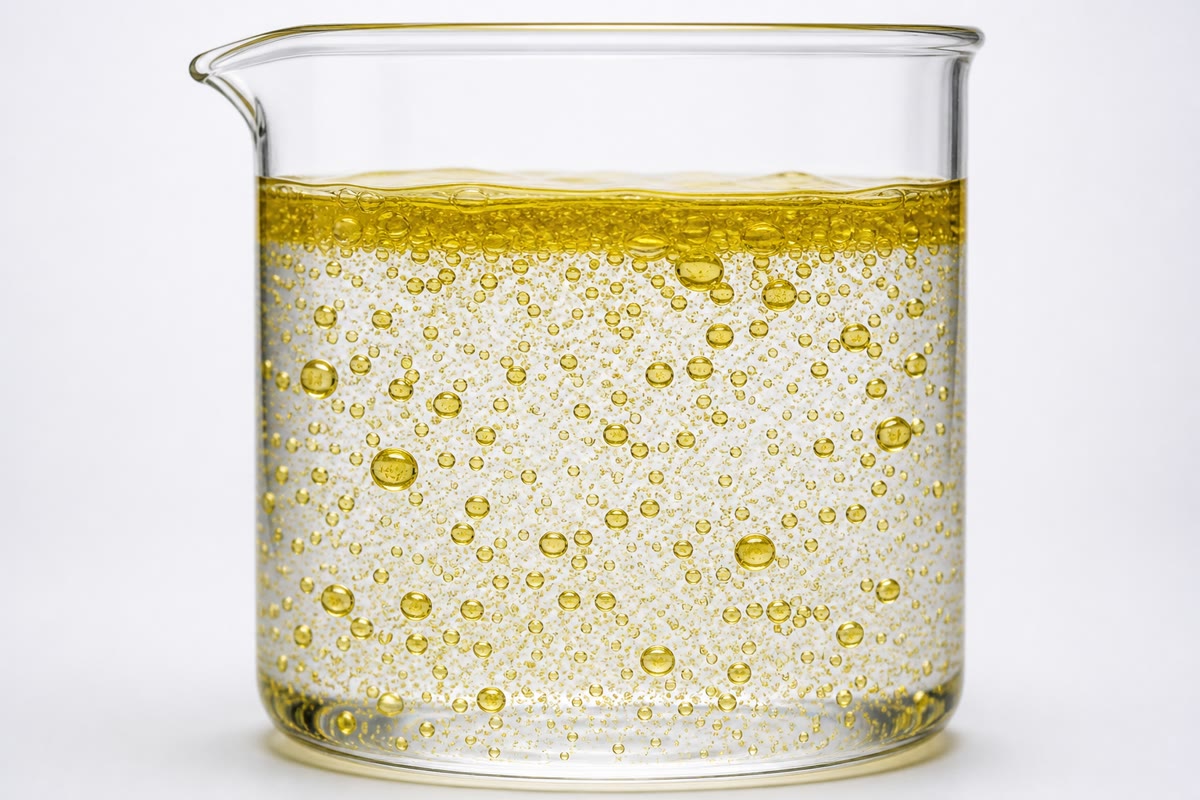
Dietary fat arrives in the intestine as oil; the lipase that digests it works only at the oil–water interface. Bile salts, amphiphilic derivatives of cholesterol, coat the fat into droplets a micrometre across, multiplying the interface a thousandfold, and then carry the fatty acids released, in micelles, to the absorbing cells (Chapter 22). The same trick is used by soap.
9.4 Membrane fluidity
Definition 9.10 (Fluidity, phase transition)
A lipid bilayer has a phase transition temperature : below it the chains are packed in an ordered, gel-like state in which lipids barely move; above it they are disordered and the bilayer is a two-dimensional fluid in which a lipid changes places with its neighbour a million times a second and crosses the membrane’s plane at . Cells keep their membranes above : the fluidity lets proteins diffuse and rotate, vesicles bud and fuse, and the bilayer reseal.
Proposition 9.11 (What sets the fluidity)
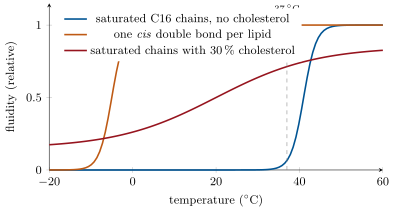
rises with the length of the chains and falls with their unsaturation, as for free fatty acids; a bilayer of C18:0 chains melts at , one of C18:1 chains at . Cholesterol, inserted among the tails, has a double effect: above its rigid rings restrict the motion of the chains and stiffen the membrane; below they prevent the chains from packing and keep it from freezing. It broadens the transition into a gradual change and keeps the fluidity nearly constant over a wide range of temperature — a buffer of fluidity. Animal plasma membranes are up to one cholesterol for every phospholipid.
Proposition 9.12 (Homeoviscous adaptation)
Organisms that cannot regulate their temperature adjust the composition of their membranes to keep the fluidity constant: as the temperature falls, they replace saturated by unsaturated fatty acids and long chains by shorter ones, and the reverse when it rises.
Evidence. E. coli grown at has twice the proportion of unsaturated fatty acids of the same strain grown at , and the membranes of the two cultures, measured by the mobility of a probe, are equally fluid at their growth temperatures. Trout acclimated to carry more polyunsaturated acids in their membrane lipids than trout at ; the fat of reindeer legs, close to the snow, is more unsaturated than the fat of the trunk. Plants that survive frost enrich their membranes in unsaturated lipids in autumn, and mutants unable to do so die when chilled. ∎
Example 9.13 (Butter, olive oil, fish oil)
Butter ( saturated) is solid in the refrigerator and soft at room temperature; olive oil ( oleic acid) is liquid at room temperature and clouds in the refrigerator; fish oil, rich in omega-3 acids with five and six double bonds, stays liquid at , which is what a cod’s membranes need in the North Atlantic.
9.5 Sterols, pigments and signals
Definition 9.14 (Steroids, isoprenoids)
Steroids share cholesterol’s four fused rings: cholesterol itself (membranes, and the precursor of the rest), the bile salts, vitamin D, and the steroid hormones — cortisol, aldosterone, the sex hormones — small, hydrophobic molecules that cross membranes freely and act on receptors inside the cell. Isoprenoids (terpenes) are chains and rings of five-carbon isoprene units: the carotenoids that colour carrots and protect chloroplasts (Chapter 14), the side chain of chlorophyll, the quinones of the electron-transport chains, rubber, and the fat-soluble vitamins A, E and K.
Proposition 9.15 (What lipids do)
Energy storage (triglycerides); membranes (phospholipids, sphingolipids, sterols); insulation and waterproofing (fat, waxes); light absorption and protection (carotenoids); electron carriage (quinones); signalling between cells (steroid hormones, prostaglandins) and within them (inositol phospholipids, diacylglycerol); vitamins. One property — insolubility in water — underlies all of them: a lipid stays where it is put, in a droplet, a film or a membrane, or crosses a membrane without a carrier.
Example 9.16 (A hormone that needs no receptor at the surface)
Cortisol, secreted by the adrenal gland, travels in the blood bound to a carrier protein, leaves it at a target cell, dissolves through the plasma membrane in seconds, and binds a receptor in the cytosol that then enters the nucleus and switches genes on (Chapter 20). A protein hormone such as insulin, water-soluble and too large to cross, must bind a receptor on the outside and have its message relayed inward. The chemistry of the messenger decides the route of the message.
9.6 Exercises
Exercise 9.1 ★
Define a lipid and explain why the definition is by property rather than by structure.
Solution
Solution of Exercise 9.1.
A lipid is a biological molecule insoluble in water and soluble in non-polar solvents. Fats, phospholipids, sterols and carotenoids share no common skeleton, only this behaviour toward water, which is what gives them their common roles (stores, films, membranes).
Exercise 9.2 ★
Write the notation of linoleic acid (18 carbons, double bonds after carbons 9 and 12) and say whether it is an omega-3 or an omega-6 acid.
Solution
Solution of Exercise 9.2.
C18:2 . The last double bond starts at carbon 12 from the carboxyl, i.e. at carbon 6 from the methyl end: omega-6.
Exercise 9.3 ★
Why does a triglyceride form droplets while a phospholipid forms bilayers? What structural difference is responsible?
Solution
Solution of Exercise 9.3.
A triglyceride has no polar head: entirely hydrophobic, it is excluded from water as a bulk phase, a droplet. A phospholipid is amphiphilic: its polar head must stay in water while its tails must leave it, which only a sheet two molecules thick can satisfy.
Exercise 9.4 ★
From the fluidity figure, at what temperature is each of the three bilayers half-way through its transition? Which would you expect in a bacterium living at ?
Solution
Solution of Exercise 9.4.
About , and (the cholesterol curve has no sharp transition; half its rise is near ). A bacterium at needs the unsaturated composition, fluid well below its growth temperature.
Exercise 9.5 ★★
A person stores of fat. Compute the energy it holds, the number of days it could sustain a resting expenditure of , and the mass of hydrated glycogen that would hold the same energy.
Solution
Solution of Exercise 9.5.
; days. Glycogen: dry , hydrated .
Exercise 9.6 ★★
Rank by melting point: C14:0, C18:0, C18:1, C18:3, C22:0, and justify each step of the ranking.
Solution
Solution of Exercise 9.6.
C22:0 C18:0 C14:0 C18:1 C18:3. Among saturated acids, longer chains make more van der Waals contacts; one cis double bond removes more packing than four extra carbons add (C18:1 melts below C14:0); each further bond lowers it again.
Exercise 9.7 ★★
A red blood cell has a surface of ; a phospholipid head occupies . Compute the number of phospholipid molecules in the membrane (two leaflets) and, at , their total mass in picograms.
Solution
Solution of Exercise 9.7.
molecules; mass .
Exercise 9.8 ★★
of olive oil (density ) is emulsified into droplets of diameter. Compute the total interface area. Repeat for a single drop. Why does the pancreatic lipase need the emulsion?
Solution
Solution of Exercise 9.8.
Volume ; surface of spheres . One drop of that volume: , surface : the emulsion has thirteen thousand times more interface. Lipase is water-soluble and acts only at the interface; the rate is proportional to it.
Exercise 9.9 ★★
Explain the two opposite effects of cholesterol on membrane fluidity and why a membrane with cholesterol has no sharp transition.
Solution
Solution of Exercise 9.9.
Above its rigid rings hinder the motion of the neighbouring chains and reduce fluidity; below its bulk prevents the chains from packing into the ordered gel and prevents freezing. With no cooperative packing possible, there is no temperature at which the whole bilayer changes state at once: the transition is spread out.
Exercise 9.10 ★★★
A mutant plant cannot make unsaturated fatty acids. Predict its membranes at and at , what happens to its cells on a cold night, and why the wild type survives.
Solution
Solution of Exercise 9.10.
All-saturated chains: at the membranes are already close to their transition and stiff; at they gel. Gelled membranes let proteins stop working and, on rewarming or mechanical stress, crack and leak: the cells lose their contents and the tissue dies (chilling injury). The wild type desaturates its lipids in autumn and stays fluid at .
Exercise 9.11 ★★★
Fat gives of water per gram oxidised (glycogen , protein ). Compute the water produced by a camel oxidising of fat. The oxygen needed is per gram of fat; breathing it in dry desert air costs about of water per litre of air ventilated, at oxygen extraction. Compute the water lost in breathing and say whether the hump is a water store.
Exercise 9.12 ★★★
“A membrane assembles itself, but a cell cannot make a membrane from nothing.” Reconcile the two halves of the sentence in a paragraph, using the hydrophobic effect, the growth of membranes by insertion, and the continuity of membranes through cell division.
Solution
Solution of Exercise 9.12.
Given a bilayer, the hydrophobic effect makes it reseal, close into vesicles and accept new lipids with no energy input: assembly is spontaneous. But the cell makes its lipids with enzymes sitting in an existing membrane (the ER), which insert them in place; a new membrane grows by expansion of an old one and is partitioned at division, so that every membrane of every cell descends from the membranes of the previous cell. Self-assembly explains the physics of the sheet, not its origin in the cell.
9.7 Problem: Cold Water and Desert Fat
Problem 9.1
Weekend problem — a trout’s membranes in a mountain stream and a camel’s hump in the desert: unsaturation, transition temperatures, energy density and metabolic water, ending on the mass that storing fat instead of glycogen saves
Part I concerns a trout whose membrane phospholipids carry chains of C16:0, C18:1 and C22:6 (an omega-3 acid with six double bonds). Part II concerns a dromedary of with a hump of triglyceride, crossing a desert at a metabolic rate of . Energy: fat , glycogen dry, stored with of water per gram. Metabolic water: of fat. Oxygen: per gram of fat; air is oxygen; the camel extracts of the oxygen it breathes; exhaled air carries of water more than the desert air inhaled.
Part I — The trout. Trout acclimated to have membrane chains that are C16:0, C18:1 and C22:6; trout at , , and .
- Write the notation of the three acids and count the double bonds per chain in each.
- Compute the mean number of double bonds per chain at each temperature.
- Explain, from chain packing, why the change lowers the transition temperature of the membrane.
- A bilayer’s falls by about for each additional double bond per chain on average. Estimate the shift of between the two trout.
- The warm trout’s membrane is fluid at but would gel at . What would happen to its transport proteins, its pumps and its nerve conduction on a sudden cold night?
- The adaptation takes days. Name the enzymes the trout must make more of, and where in the cell they act (Chapter 6).
- Cholesterol is at one molecule per two phospholipids in both trout. Explain what it contributes in each case.
Part II — The camel’s energy.
- Compute the energy stored in the hump.
- For how many days of the crossing does it suffice?
- Compute the mass of dry glycogen holding the same energy, and the mass of hydrated glycogen.
- Compute the mass saved by storing fat rather than glycogen, and express it as a fraction of the camel’s body mass.
- Fat is stored in a hump rather than spread under the skin. Propose a reason, from the heat budget of Chapter 2.
Part III — Is the hump a water store?
- Compute the metabolic water produced by oxidising the whole hump.
- Compute the oxygen needed, in litres.
- Compute the volume of air the camel must ventilate to obtain it.
- Compute the water lost in exhaling that air.
- Compare the water gained with the water lost, and conclude.
- Instead of sweating, the camel lets its body temperature rise by during the day and cool at night. Compute the heat it stores this way (heat capacity ) and the water that evaporating the same heat would cost ().
- A camel can lose of its body water and survive, and its red cells swell to twice their volume without bursting when it drinks in ten minutes. Relate the second property to the membranes of Chapter 7.
Part IV — The bilayer’s arithmetic. A phospholipid head occupies ; a bilayer is thick; the camel’s red cells have a surface of and number per litre of blood.
- Compute the number of phospholipids in one red-cell membrane.
- Compute the number in all the red cells of of blood.
- At , compute the mass of that lipid in grams.
- A phospholipid flips from one leaflet to the other spontaneously about once a week, but diffuses laterally in a second. Explain both numbers from the hydrophobic effect.
- Explain why, given the flip rate, the two leaflets of a membrane can stay different in composition for the life of a cell.
- State the result: the mass the camel saves by carrying of fat rather than the glycogen of equal energy, and the verdict on the hump as a water store.
Solution
Solution of Problem 9.1.
1. C16:0 (0), C18:1 (1), C22:6 (6). 2. Warm: ; cold: double bonds per chain. 3. Each cis bond kinks the chain and prevents close packing with neighbours; fewer van der Waals contacts, less heat needed to disorder the chains, lower . 4. more bonds per chain: about lower. 5. In a gel the lipids cannot move: carriers cannot change conformation, pumps stop, channels stick; ion gradients decay, nerve conduction fails, and the fish is paralysed and dies of the cold that a cold-acclimated fish tolerates. 6. Desaturases, which introduce double bonds into fatty acyl chains; they are integral proteins of the endoplasmic reticulum, where the lipids are made. 7. In both it buffers fluidity: stiffening the very unsaturated cold membrane above its low , and keeping the warm membrane from gelling on a cool day. 8. . 9. days. 10. Dry: ; hydrated: . 11. , nearly half the camel’s mass. 12. A layer of fat under the whole skin would insulate the body and prevent it from shedding heat in the desert; concentrating the fat in one hump leaves the rest of the skin free to lose heat. 13. of water. 14. of oxygen. 15. of air. 16. of water. 17. Lost five times what is gained: oxidising the hump costs water. The hump is a store of energy that lets the camel go without food; its water economy comes from its kidneys, its tolerance of dehydration and its ability to let its temperature rise. 18. stored as heat and released at night; evaporating it away would have cost of water a day. 19. A membrane can stretch only a few percent, so doubling the volume of a red cell requires a large excess of membrane folded into the resting biconcave shape, and a cytoskeleton that lets it unfold without tearing: the camel’s red cells are oval, with more membrane per volume than a human’s. 20. . 21. . 22. . 23. Lateral diffusion keeps the head in water and the tails in oil at every step, costing nothing; flipping requires the polar head to cross the hydrophobic core, a large energy barrier that thermal agitation surmounts once a week. 24. A difference between leaflets decays only as fast as lipids flip; at once a week per molecule, an asymmetry set up by enzymes that move specific lipids across (flippases) persists indefinitely against spontaneous flipping. 25. About saved — nearly half its body mass — by carrying of fat instead of of hydrated glycogen; and the hump is not a water store: oxidising it loses five times more water in the breath than it produces.