 Coach
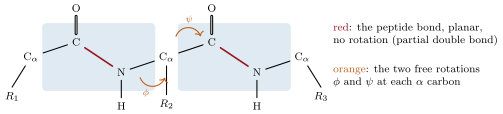
CoachThe peptide bond joins the carboxyl of one amino acid to the amino group of the next by condensation (an amide bond, ). A chain of amino acids so joined is a polypeptide: a backbone of repeating units from which the side chains project, with an N-terminus (free amino group) and a C-terminus (free carboxyl). Sequences are written from N to C, the order of synthesis (Chapter 19). A protein is one or more polypeptides folded into a definite shape; typical chains have residues of mean mass , so a protein of residues is .
Examples
Example 12.10 (Collagen)
A quarter of a mammal’s protein is collagen: three chains, each a left-handed helix of a thousand residues with glycine at every third position (Gly–X–Y, Y often hydroxyproline), wound together into a right-handed triple helix long, then packed side by side into fibrils cross-linked by covalent bonds. Glycine’s absence of a side chain is what lets the three chains pack at the axis; a single substitution of glycine by any other residue kinks the helix and gives brittle bones. Vitamin C is needed to hydroxylate the prolines; without it the helix is unstable and the fibrils fail: scurvy.
Example 12.15 (Reading a gel)
A crude extract shows dozens of bands; after affinity chromatography one band remains at the position of the marker. Run without SDS and without reducing agent, the same protein migrates as a species: it is a dimer of two identical chains held by a disulfide bridge, which the reducing agent breaks and the detergent separates. Two gels, one line of reasoning, and the quaternary structure is known.