 Coach
CoachProtists are the eukaryotes that are neither animals, nor land plants, nor fungi — mostly unicellular, some colonial, a few (the kelps) multicellular. They share the eukaryotic cell of the Year 1 volume (nucleus, mitochondria, endomembranes, cytoskeleton, cilia) and nothing else in particular: the lineages that contain them are as distant from one another as animals are from plants. Green algae belong with the land plants; diatoms and brown algae form a lineage of their own; ciliates, dinoflagellates and the malaria parasite form another; amoebae and slime moulds are closer to animals and fungi than to any of these. The word names a level of organisation — the eukaryotic cell living alone — and not a branch of the tree.
Examples
Example 1.13 (Four ways to be a eukaryotic cell alone)
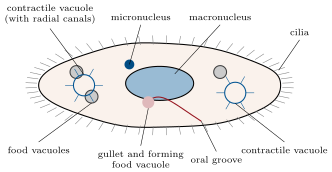
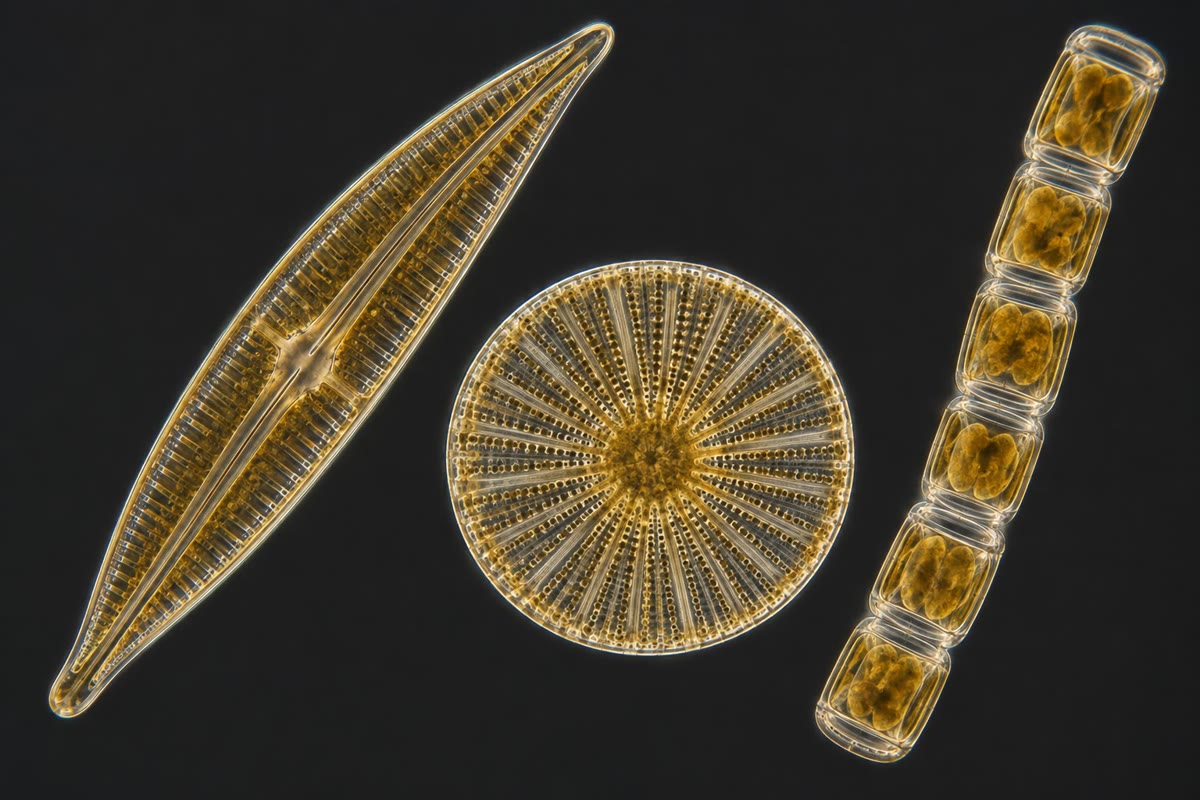
Chlamydomonas: an ovoid green alga with a cellulose-free glycoprotein wall, one cup-shaped chloroplast, an orange eyespot that shades a light sensor so that the cell knows which way the light is as it rotates, and two anterior flagella that beat in a breaststroke; it is a phototroph. Paramecium: a ciliate, its whole surface beating with cilia in coordinated waves, a mouth-like oral groove that sweeps bacteria into food vacuoles, two contractile vacuoles, and two kinds of nucleus — a small germinal micronucleus and a large working macronucleus with hundreds of copies of each gene; it is a phagotroph. Amoeba: no wall, no fixed shape, moving and feeding by pseudopods that actin polymerisation pushes out. The diatom: a photosynthetic cell enclosed in two overlapping valves of silica like a box and its lid, so ornamented with pores that the shells were once used to test microscope lenses; when it divides, each daughter keeps one valve and makes a new, smaller, inner one.