 Coach
CoachAn environment — a yard, a wood, a pond bank — contains three kinds of components:
- living things: the animals, plants, mushrooms and microscopic life present;
- mineral matter, which was never alive: rock, stone, soil’s mineral part, water, air;
- traces and remains of living things: dead leaves, fallen wood, droppings, feathers, shells — the “was living” box of Definition 1.5, now a clue kit for the explorer.
Examples
Example 37.2 (Inventory behind the north wall)
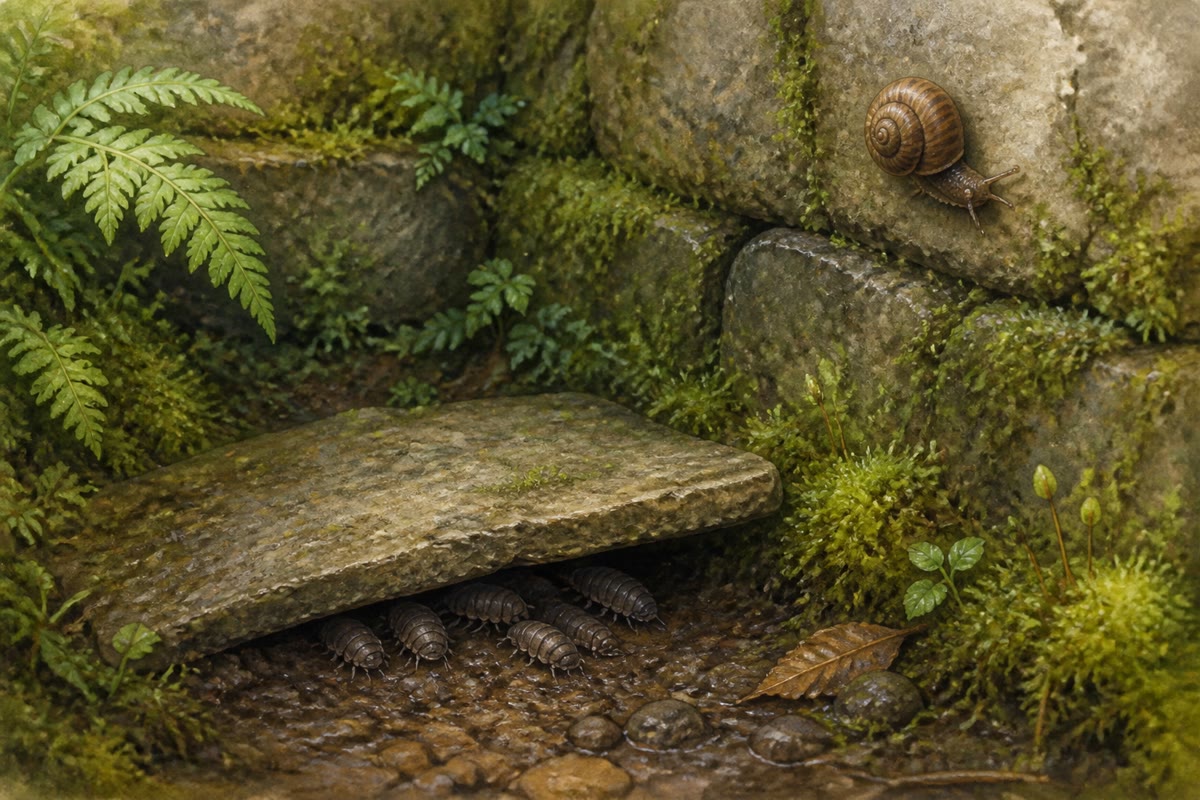
Ten minutes’ inventory in the cool corner: living — moss, ferns, woodlice, a snail, a centipede, ivy; mineral — the stone of the wall, damp soil, a puddle; traces — dead leaves, a snail shell, bird droppings on the coping. Three lists, and the corner is described like a scientist’s site.
Example 37.11 (The stone, above and below)
One stone in the cool corner: on top, lichen and a sunning fly — lit, dry, warm. Beneath, woodlice, a centipede, pale rootlets — dark, damp, cool. Two complete microhabitats separated by five centimetres of rock, each inhabited by exactly those living things whose ranges its conditions match.