Primary & Middle School Biology · Grades 1–9
37Exploring Our Environment
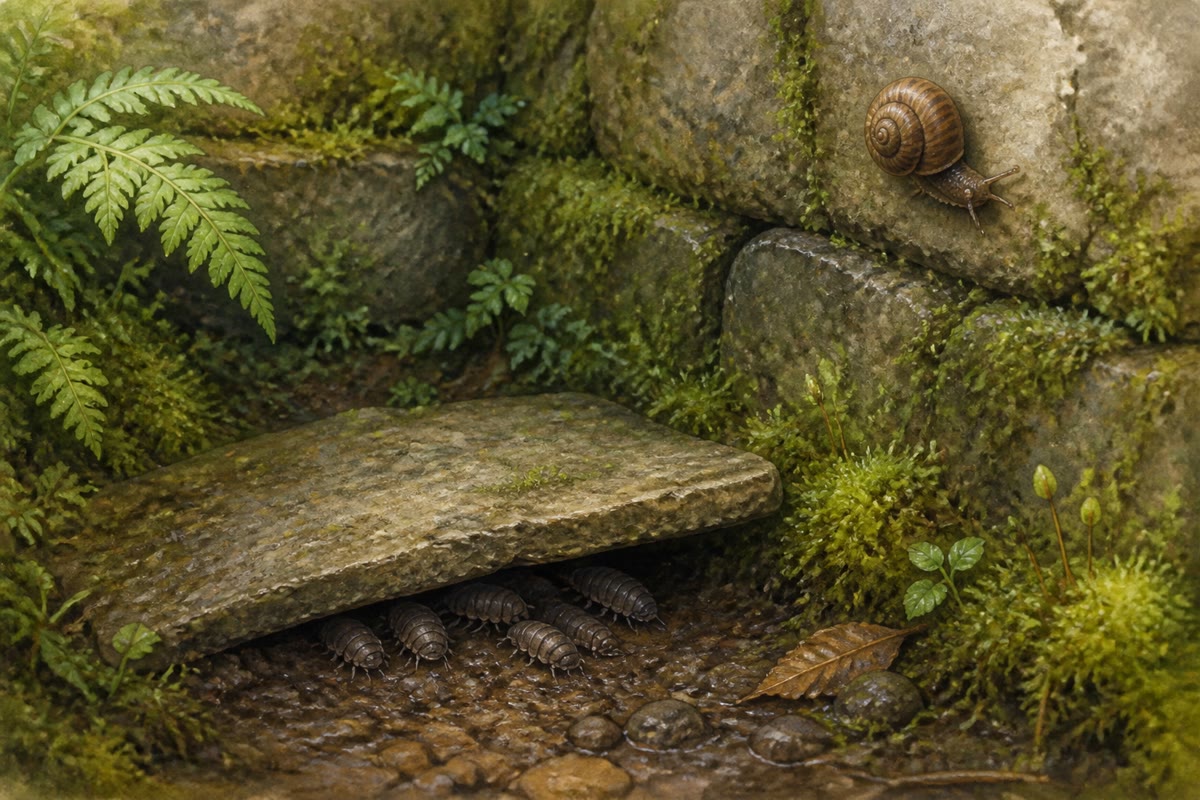
Cross the schoolyard on a July noon and the wall’s south face is hot under your hand, the air above the asphalt shimmers, and the only green thing in sight is a weed in a crack. Step behind the north wall: cool air, damp soil, moss, woodlice under a stone. Two worlds, three metres apart. This year begins by exploring environments the way scientists do — measuring them, and asking why each living thing lives exactly where it does.
37.1 What an environment is made of
Definition 37.1 (The components of an environment)
An environment — a yard, a wood, a pond bank — contains three kinds of components:
- living things: the animals, plants, mushrooms and microscopic life present;
- mineral matter, which was never alive: rock, stone, soil’s mineral part, water, air;
- traces and remains of living things: dead leaves, fallen wood, droppings, feathers, shells — the “was living” box of Definition 1.5, now a clue kit for the explorer.
Example 37.2 (Inventory behind the north wall)
Ten minutes’ inventory in the cool corner: living — moss, ferns, woodlice, a snail, a centipede, ivy; mineral — the stone of the wall, damp soil, a puddle; traces — dead leaves, a snail shell, bird droppings on the coping. Three lists, and the corner is described like a scientist’s site.
Remark 37.3 (Traces count as data)
Most animals hide or flee, so the explorer often reads traces instead: a nibbled hazelnut names the wood mouse, a spider’s web names its owner, tracks in mud name the heron. An inventory that only lists what sat still enough to be seen misses half the inhabitants.
37.2 Measuring the conditions
Definition 37.4 (Environmental conditions)
The conditions of an environment are its measurable physical characteristics:
- temperature, measured with a thermometer, in degrees Celsius;
- humidity — how damp the air or soil is;
- light — from full sun to deep shade.
Conditions change from spot to spot — often sharply within metres — and through the day and the year.
Example 37.5 (The yard, measured)
The July noon survey, with instruments: south wall foot — , dry, full sun; north corner — , damp soil, deep shade. Three metres of distance, sixteen degrees of difference. The two worlds of the opening paragraph are now two rows in a table — and that is progress, because tables can be compared.
Proposition 37.6 (Conditions decide the inhabitants)
The living things of a spot match its conditions: each species thrives only within its own range of temperature, humidity and light. Moss and woodlice need dampness (the woodlouse’s covering, unlike an insect’s, lets water escape — it dries out fatally in an hour of sun); the weed in the crack bears drought and glare. Where conditions differ, inhabitants differ — the rule behind every habitat of Chapter 11.
Proof. Admitted at this level. ∎
Example 37.7 (The woodlouse chooser)
The classic experiment: a closed box, half lined with damp paper, half with dry, and a dozen woodlice released along the middle. Within minutes, nearly all are on the damp side. Run again with a shaded half against a lit half: they gather in the shade. No one herds them — each animal, wandering and turning, ends where its body is comfortable. The map of woodlice is a map of dampness.
Method 37.8 (Surveying a site)
To survey a small site like a field scientist:
- choose and mark a small area — a square metre tells more, well searched, than a hectare glanced at;
- measure the conditions: temperature, dampness, light — same instruments, same way, at each site (Method 22.1’s fairness rule);
- inventory the three component kinds — living things, mineral matter, traces — searching properly: under stones (put them back: Method 13.6), in crevices, on leaf undersides;
- record everything on the spot — lists, sketches, counts; memory is not a recording instrument;
- compare sites: pair each difference of inhabitants with a difference of conditions.
Remark 37.9 (Why records beat memories)
Back indoors, two surveyors who trusted memory will argue about whether the snails numbered three or five. The notebook settles it — or admits honestly that snails were not counted. Written records, made at the site, are what turn a walk into data; every science of this book runs on them.
37.3 One environment, many micro-worlds
Definition 37.10 (Microhabitat)
Within one environment, each small spot with its own conditions and its own inhabitants — the underside of a stone, a crack in the wall, the shaded foot of the hedge — is a microhabitat. Remark 11.3’s forest floors were microhabitats; the surveyor’s square metre usually holds several.
Example 37.11 (The stone, above and below)
One stone in the cool corner: on top, lichen and a sunning fly — lit, dry, warm. Beneath, woodlice, a centipede, pale rootlets — dark, damp, cool. Two complete microhabitats separated by five centimetres of rock, each inhabited by exactly those living things whose ranges its conditions match.
37.4 Exercises
Exercise 37.1 ★
Name the three kinds of components of an environment, with two examples of each from the north-corner inventory.
Solution
Solution of Exercise 37.1.
Living things (moss, woodlice); mineral matter (the wall’s stone, the puddle); traces and remains of living things (dead leaves, the snail shell).
Exercise 37.2 ★
Which conditions does a field scientist measure at a site, and with what (where an instrument was named)?
Solution
Solution of Exercise 37.2.
Temperature, with a thermometer (in degrees Celsius); humidity of air and soil; light, from full sun to deep shade.
Exercise 37.3 ★
Sort into the three component kinds: a fern, a snail shell, a puddle, bird droppings, a centipede, the wall’s stone.
Solution
Solution of Exercise 37.3.
Living: the fern, the centipede. Mineral: the puddle, the wall’s stone. Traces: the snail shell, the bird droppings.
Exercise 37.4 ★
From Example 37.5: what are the temperature and light differences between the two spots? Which inhabitants match each?
Solution
Solution of Exercise 37.4.
Sixteen degrees ( against ) and full sun against deep shade (dry against damp, too). The drought-and-glare weed matches the south foot; moss, ferns and woodlice match the cool damp corner.
Exercise 37.5 ★
Why does the woodlouse die in an hour of sun, and what does that explain about where woodlice are found?
Solution
Solution of Exercise 37.5.
Its covering lets water escape, so in dry sun its body loses its water fatally fast. That is why woodlice are found in damp, dark microhabitats — under stones, under dead wood.
Exercise 37.6 ★
Name three traces and the animal each one names, as in Remark 37.3.
Exercise 37.7 ★★
Describe the woodlouse chooser experiment: setup, result, and what it shows — without anyone herding the animals.
Solution
Solution of Exercise 37.7.
A closed box, half damp paper and half dry, woodlice released along the middle line; minutes later nearly all sit on the damp side (likewise shade against light). It shows each animal settles where conditions suit its body — the group’s map draws itself with no herding.
Exercise 37.8 ★★
Why must conditions be measured the same way at each site? Which earlier method is this the field version of?
Solution
Solution of Exercise 37.8.
Because only measurements made the same way can be compared: a difference must come from the sites, not from the measuring. It is the field version of the fair test — one thing varies (the site), everything else is kept equal.
Exercise 37.9 ★★
Give the two microhabitats of the stone of Example 37.11, with their conditions and one inhabitant each.
Solution
Solution of Exercise 37.9.
Stone top: lit, dry, warm — lichen (with the sunning fly as a visitor). Stone underside: dark, damp, cool — woodlice (or the centipede). Five centimetres apart, two matched sets of inhabitants.
Exercise 37.10 ★★
A survey lists “some bugs, it was warmish”. Rewrite the surveyor’s instructions using Method 37.8 — what should have been done at each step?
Solution
Solution of Exercise 37.10.
Step 1: mark a definite square metre. Step 2: measure — thermometer reading written down, soil dampness felt and noted, light class noted. Step 3: search properly, stones lifted and replaced, all three component kinds listed. Step 4: record on the spot — counts, not “some”. Step 5: no comparison was even possible with one site; survey a second site the same way.
Exercise 37.11 ★★
Ivy grows up the north wall but not the south. Propose an explanation in the form of Proposition 37.6, and an observation or measurement that would test it.
Solution
Solution of Exercise 37.11.
Explanation: ivy thrives in the north wall’s range of conditions (shade, dampness) and not in the south wall’s (glare, drought). Test: measure both wall feet — temperature, dampness, light — and check ivy’s known preferences; or find ivy on other walls and record which orientation its walls share.
Exercise 37.12 ★★★
In the woodlouse box, a student objects: “maybe they just gathered near the wall, and the damp side happened to have more wall.” Design an improved version of the experiment that answers the objection. (Think fair test.)
Solution
Solution of Exercise 37.12.
Remove the wall difference: run the choice in a round box (wall everywhere the same), with the damp and dry halves swapped between runs — damp east in run 1, damp west in run 2. If the woodlice follow the dampness wherever it is put, walls are ruled out; only the tested condition changed between runs, everything else held equal.
37.5 Problem: The Two Ditches
Problem 37.1
Weekend problem — the naturalist club surveys two roadside ditches and finds two different worlds
The naturalist club surveys two ditches along the same lane, metres apart. Ditch N runs along the north side of a tall hedge; ditch S runs in the open, facing south. The club works by the book: same instruments, same square metre per site, same search time.
Part I — The measurements.
- The thermometers read in ditch N and in ditch S at the same hour. Which single feature of the sites best explains the difference?
- Ditch N’s soil sticks to the fingers; ditch S’s crumbles to dust. Translate both observations into the vocabulary of Definition 37.4.
- The club measures at noon. Give one reason the comparison would be less fair if ditch N were measured at noon and ditch S at 6 p.m.
- Why does the club use the same square-metre frame and the same search time at both sites?
Part II — The inventories.
- Ditch N’s list: moss, ferns, woodlice, snails, a toad. Ditch S’s list: dry grasses, a large weed with waxy leaves, ants, a basking lizard, grasshoppers. Sort each list’s members into the three component kinds — and note what the lists are missing (check Definition 37.1).
- For each of woodlice, toad and lizard, say which ditch’s conditions match its needs, and why (use Proposition 37.6 and what you know of each animal).
- In ditch S the club finds a snail shell, but no snail, and asks whether snails live there. What are the two honest possibilities a trace like this leaves open?
- Under a flat stone in ditch N: eight woodlice, a centipede, white rootlets. Name the microhabitat’s conditions, and state the rule that put those inhabitants there.
Part III — The explanation.
- Pair each difference of inhabitants with a difference of conditions: complete “N has moss and toads because …; S has lizards and waxy-leaved weeds because …”.
- The hedge is scheduled to be grubbed out. Predict ditch N’s conditions two summers later — and its inhabitants, using the pairing of question 9.
- A member proposes checking the prediction properly: survey both ditches again after the hedge is gone. Why must the same sites, instruments and season be used for the re-survey to count?
- The club’s report ends: “the inhabitants map the conditions.” Explain the sentence with the woodlouse chooser (Example 37.7), and say why no herding is needed for a map like that to draw itself.
Solution
Solution of Problem 37.1.
1. The tall hedge: it shades ditch N (and shelters it), while ditch S faces the sun all day.
2. Temperature: against . Humidity: ditch N’s soil is damp (sticks), ditch S’s is dry (dust). Light completes the trio: shade against full sun.
3. Conditions change through the day: by 6 p.m. any site is cooler and its light lower, so the difference measured would mix site with hour. Same hour keeps the comparison fair.
4. So that the search effort is equal: more area or more time at one site would find more inhabitants there — an unfair test of which ditch is richer.
5. Both lists name only living things. Missing: the mineral components (soil, stones, water) and the traces — which parts I of a proper inventory must also record.
6. Woodlice: ditch N — they need dampness and shade or they dry out. The toad: ditch N — moist skin, needing damp shelter. The lizard: ditch S — it warms its body in the sun, hunting where it can bask.
7. Either snails live there hidden (perhaps active only in damp night hours), or the shell is a remain from elsewhere or another season — a trace proves presence at some time, not residence now.
8. Dark, damp, cool. The rule of Proposition 37.6: each spot is inhabited by the species whose ranges its conditions match.
9. N has moss and toads because its shade keeps it cool and damp, which their bodies require; S has lizards and waxy-leaved weeds because its full sun makes it hot and dry, which suits a basking hunter and a drought-proof plant.
10. Without the hedge, ditch N gets full sun: hotter, drier — conditions drifting toward today’s ditch S. Expect the damp-lovers (moss, ferns, woodlice, the toad) to dwindle and sun-lovers (dry grasses, grasshoppers, perhaps the lizard) to move in.
11. Because the re-survey must differ from the first in one thing only — the hedge’s absence. New sites, instruments or season would add differences of their own, and the change could no longer be pinned on the hedge: the fair-test rule at the scale of a landscape.
12. Each woodlouse wanders and turns until its body is comfortable, so the group ends gathered where dampness is — the animals’ positions record the conditions, as surely as thermometer readings. Nobody herds them; each individual’s own comfort does the map-drawing, which is exactly why inhabitants can be read as measurements.