Primary & Middle School Biology · Grades 1–9
24Plants Without Seeds
The shady side of the old wall is upholstered in moss; under the beech trees, ferns unroll their great green fronds. Search them all summer: you will find no flower, no fruit, no seed — ever. Yet moss and ferns spread perfectly well. Plants, it turns out, have more than one way of making the next generation.
24.1 Ferns and mosses: reproduction by spores
Definition 24.1 (Spore)
A spore is a microscopic grain, made in enormous numbers, from which a new plant can grow. Unlike a seed (Definition 9.1), a spore is a single speck with no food store and no ready-made tiny plant inside — it is a beginning at its barest.
Example 24.2 (Under the fern’s fronds)
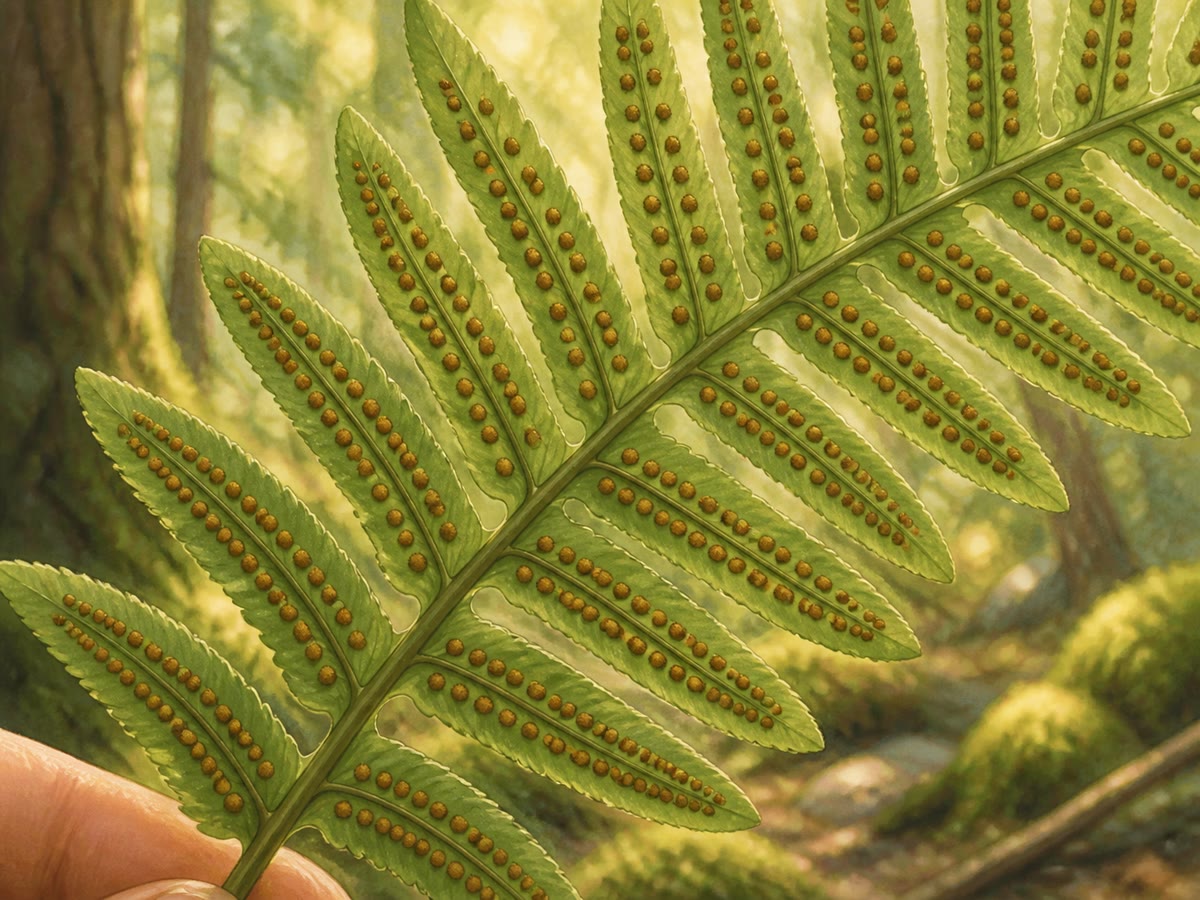
Turn a fern frond over in late summer: neat rows of brown dots line its underside. Each dot is a packet of thousands of spores; ripe, the packets split, and the spores drift off on the air like the finest dust. A spore landing on damp shaded ground can grow — by stages — into a new fern.
Proposition 24.3 (Spore plants need dampness)
Spore plants — mosses and ferns — can only reproduce where it is damp: their spores, and the delicate stages that grow from them, dry out and die in dry air. That is why moss carpets the shaded north wall but never the sunny south one, and why ferns crowd damp woods, stream banks and wells.
Proof. Admitted at this level. ∎
Remark 24.4 (A spore is not a seed)
Both are beginnings that travel, but the seed is a survival kit — coat, food store, ready-made plantlet — while the spore is bare. Hence the numbers: the fern’s millions of spores against the bean pod’s dozen seeds. Bare beginnings are cheap to make and easy to lose; the two plans echo the codfish and the elephant of Proposition 23.7.
24.2 New plants without any sowing
Definition 24.5 (Vegetative reproduction)
Many plants can also make new plants directly from a piece of themselves — no spores, no seeds, one parent only. This is vegetative reproduction. The new plant is a living continuation of the old one, and resembles it exactly.
Example 24.6 (The strawberry’s runners)
A strawberry plant sends out long thin horizontal stems — runners — across the soil. Where a runner touches down, it roots, sprouts leaves, and becomes a complete new strawberry plant; the runner then withers, and the child stands free. One plant becomes a patch without a single seed sown.
Example 24.7 (Bulbs and tubers)
The tulip bulb and the potato tuber are underground storerooms — and starting kits. Left in the ground, a bulb splits into daughter bulbs, each a future tulip; every “eye” of a sprouting potato can grow into a whole new plant. Gardeners plant potatoes, not potato seeds.
Method 24.8 (Taking a cutting)
Gardeners copy vegetative reproduction with cuttings:
Remark 24.9 (One parent, exact copies)
Seeds mix two parents (Remark 23.3 holds for plants too, via pollen); vegetative reproduction copies one. That is why every plant of a named apple variety is grown from cuttings and grafts, never from pips: the orchard wants exact copies of one excellent tree. The price of copying is sameness — an orchard of identical trees shares identical weaknesses, as a later year will show.
24.3 Exercises
Exercise 24.1 ★
Name two plants that never make seeds. How do they reproduce?
Exercise 24.2 ★
Exercise 24.3 ★
Where are the fern’s spores made? Describe what you find under a frond in late summer.
Solution
Solution of Exercise 24.3.
On the underside of the fronds: neat rows of brown dots, each a packet of thousands of spores that split open when ripe and let them drift off like dust.
Exercise 24.4 ★
Why does moss grow on the shaded north wall and not the sunny south one?
Exercise 24.5 ★
What is vegetative reproduction? How many parents does it take?
Exercise 24.6 ★
Tell the story of a strawberry runner, from first stem to free-standing child plant.
Exercise 24.7 ★
Why do gardeners plant potatoes rather than sow potato seeds? What can each “eye” do?
Exercise 24.8 ★
Try it: take a mint cutting by Method 24.8 and stand it in a glass of water on the windowsill. What appears, and after roughly how long?
Exercise 24.9 ★★
The fern makes millions of spores; the bean pod, a dozen seeds. Explain the difference in numbers with Remark 24.4 — and name the animal pair whose strategies they echo.
Solution
Solution of Exercise 24.9.
The spore is bare and cheap: without food store or plantlet, almost every one is lost, so millions must be made. The seed is an expensive survival kit, so a dozen well-equipped ones suffice. They echo the codfish (millions, uncared for) and the elephant (few, well provided).
Exercise 24.10 ★★
A gardener finds the new strawberry plants identical to the parent, while her bean plants vary a little from their parents. Explain both observations with Remark 24.9.
Exercise 24.11 ★★★
A willow branch snapped off by a winter flood, carried downstream and stranded on a mud bank, often grows into a new willow tree. Which kind of reproduction is this — and why are rivers so often lined with willows? What did the flood do that the gardener of Method 24.8 does with scissors?
Solution
Solution of Exercise 24.11.
Vegetative reproduction — the branch is a natural cutting. The flood did the gardener’s scissor-work: it cut the shoot, carried it, and planted it in wet mud, willow’s ideal rooting bed. Rivers line themselves with willows by breaking and planting them in the same stroke.