Coach
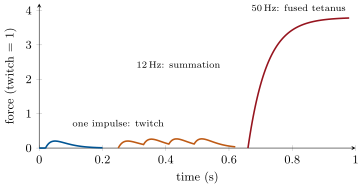
CoachA motor neuron in the spinal cord sends its axon to a muscle and branches to innervate from a handful to a thousand fibres, scattered through the muscle; the neuron and its fibres are a motor unit, the smallest quantity of force the nervous system can command. Every impulse in the neuron makes every fibre of the unit fire once and give a twitch: a force that rises in some and decays in , because the calcium pulse is brief. Impulses in quick succession make twitches sum, since the calcium of one has not been pumped away when the next arrives; at some 30 to 50 impulses a second the force fuses into a smooth tetanus, three to five times the twitch. The nervous system grades the force of a muscle in two ways: by the rate at which each unit fires, and by the number of units it recruits — small, slow, fatigue-resistant units first (the size principle), large fast ones last, only for the greatest efforts. A muscle in ordinary use is therefore never fully on: a fraction of its units fire, in rotation, and the rest rest.