
সব বই

পেশাদার

1 Markets I: The Ecosystem and Exchange-Traded Marketsবাজার অনলাইন 2 Markets II: Rates, FX and Creditবাজার অনলাইন 3 Markets III: Commodities, Energy and Cryptoবাজার অনলাইন 4 Quantitative Methodsপদ্ধতি অনলাইন 5 Derivatives and Volatilityডেরিভেটিভস অনলাইন 6 Rates, Credit, XVA and Riskসুদহার, ঋণ ও ঝুঁকি অনলাইন 7 Research Craft: Predictors, Backtests, Measurement, Portfoliosগবেষণা অনলাইন 8 Strategies I: Equities and Futuresকৌশল অনলাইন 9 Strategies II: Volatility, Relative Value, Macro and the Bank Desksকৌশল অনলাইন 10 Microstructure and Executionএক্সিকিউশন অনলাইন 11 Market Making and High-Frequency Tradingমার্কেট মেকিং অনলাইন 12 Machine Learning for Marketsমেশিন লার্নিং অনলাইন 13 Low-Latency Softwareপ্রযুক্তি অনলাইন 14 Networks, Hardware and Trading Infrastructureপ্রযুক্তি অনলাইন 15 Research, Data and Risk Platformsপ্রযুক্তি অনলাইন 16 The Desk and the Firmপ্রতিষ্ঠান অনলাইন 17 The Industry: Firms, Roles and Careersক্যারিয়ার অনলাইন 18 Interviews I: Maths, Probability and Speedক্যারিয়ার অনলাইন 19 Interviews II: Markets, Trading Games and the Final Roundক্যারিয়ার অনলাইন 20 Interviews III: Codeক্যারিয়ার অনলাইন
অ্যাপ পরিচিতি Coach সাইন ইন পড়া শুরু করো

বইগুলো এখনো বাংলা ভাষায় পাওয়া যায় না — ইংরেজি সংস্করণ দেখানো হচ্ছে।

Biology · পরিভাষা

The motor unit কী?

Definition 21.5 University Biology — Year 2 · অধ্যায় 21 — Muscle Contraction and Motor Function

A motor neuron in the spinal cord sends its axon to a muscle and branches to innervate from a handful to a thousand fibres, scattered through the muscle; the neuron and its fibres are a motor unit, the smallest quantity of force the nervous system can command. Every impulse in the neuron makes every fibre of the unit fire once and give a twitch: a force that rises in some 30 ms30\,\mathrm{ms} and decays in 100 ms100\,\mathrm{ms}, because the calcium pulse is brief. Impulses in quick succession make twitches sum, since the calcium of one has not been pumped away when the next arrives; at some 30 to 50 impulses a second the force fuses into a smooth tetanus, three to five times the twitch. The nervous system grades the force of a muscle in two ways: by the rate at which each unit fires, and by the number of units it recruits — small, slow, fatigue-resistant units first (the size principle), large fast ones last, only for the greatest efforts. A muscle in ordinary use is therefore never fully on: a fraction of its units fire, in rotation, and the rest rest.
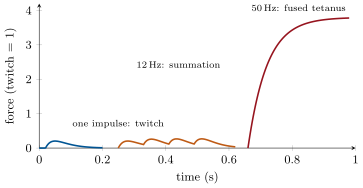
Grading force by rate. A single impulse gives a twitch; impulses at a dozen a second sum into a rippling force; at fifty a second the force fuses into a tetanus several times the twitch.
প্রসঙ্গসহ পড়ো →