University Biology — Year 2 · Bachelor Year 2
21Muscle Contraction and Motor Function
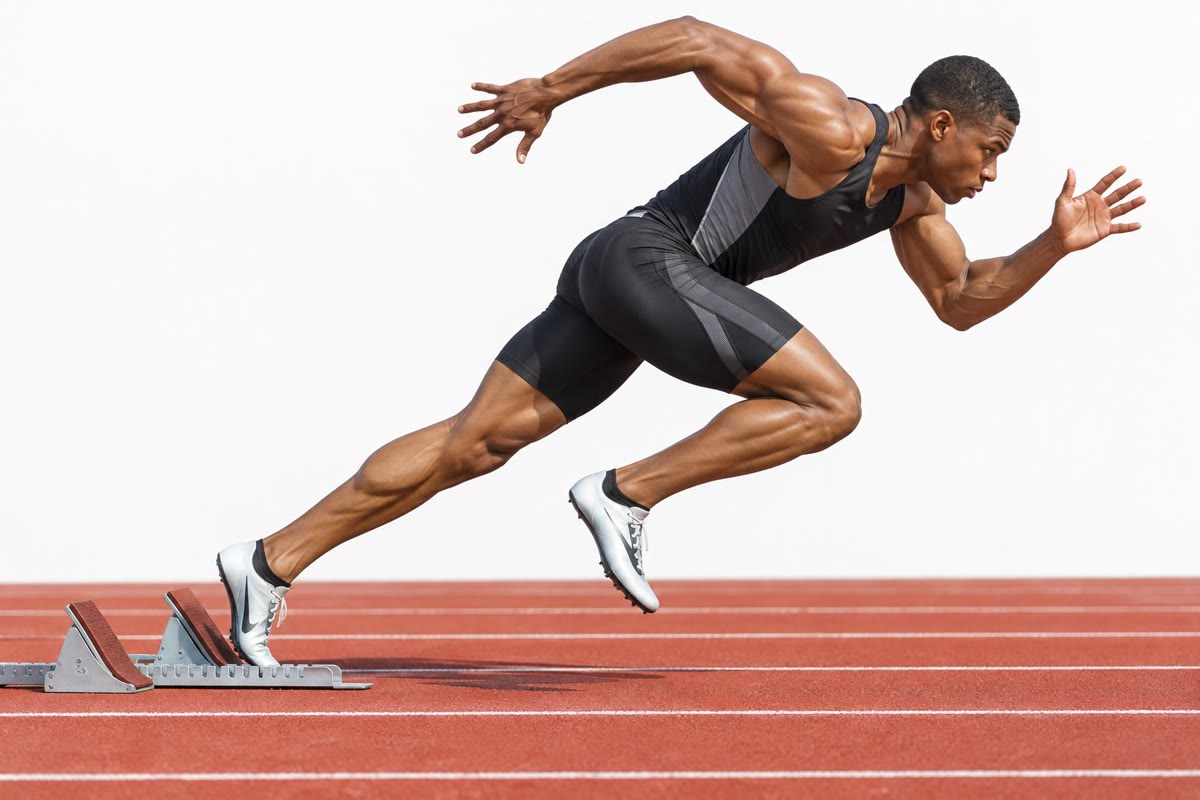
A sprinter leaves the blocks with a force on the track of three times her weight, developed in a fifth of a second by muscles that were slack a moment before. Nothing in the cell got shorter to do it: the filaments inside slid past each other, pulled by millions of molecular hands each taking a step of ten nanometres and letting go, ten times a second, paid for one ATP at a time. This chapter takes the muscle fibre built in Chapter 12 and makes it work: the sliding of the filaments and the motor that drives them, the calcium switch that turns the motor on and off, the command from the nerve, the mechanics of force and speed, and the way the nervous system grades the whole from a twitch to a sprint.
21.1 The sliding filaments
Proposition 21.1 (The sliding filament mechanism)
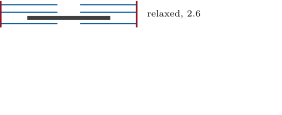
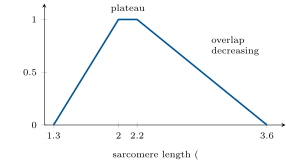
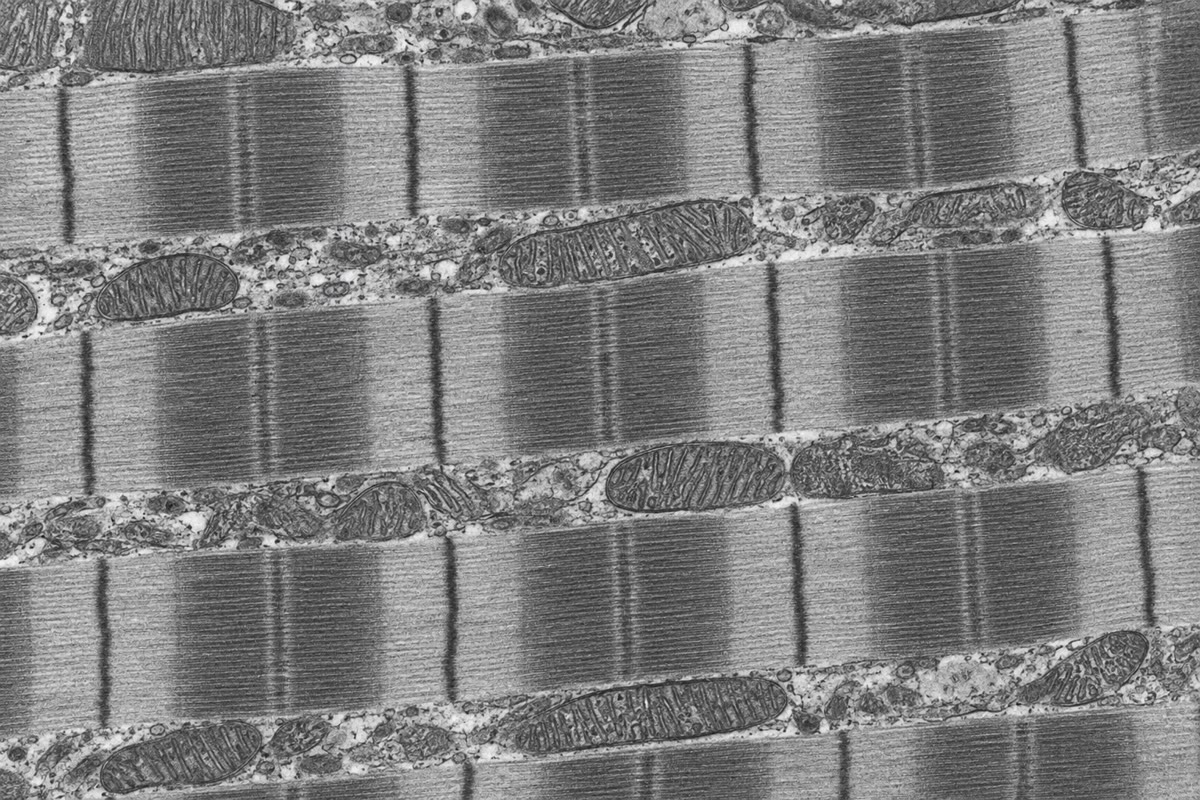
When a muscle fibre shortens, its sarcomeres shorten (Chapter 12), but neither the thick filaments of myosin nor the thin filaments of actin change length: the thin filaments slide inward along the thick ones, the I band and the H zone narrow, and the Z discs approach. The overlap between the two sets of filaments is where force is generated, and a sarcomere generates force in proportion to the overlap: from a stretched length of , with no overlap and no force, the force rises linearly as the filaments overlap more, reaches a plateau near where every myosin head faces actin, and falls again below as the thin filaments collide and the thick ones hit the Z discs. The resting length of a muscle in the body sits on the plateau — which is the first hint of how the force is made.
Evidence. A. F. Huxley and Niedergerke, and H. E. Huxley and Hanson (1954), measured the bands of single fibres and of isolated myofibrils by interference and phase microscopy as they shortened: the A band kept its length, the I band shrank, so the filaments slide. Gordon, Huxley and Julian (1966) held a single fibre at set lengths with a feedback device that kept one segment’s sarcomere length constant, and found the force to be proportional to the overlap of thick and thin filaments measured by electron microscopy — the length–tension curve with its plateau and two linear limbs, exactly as the geometry of the filaments predicts. ∎
21.2 The motor
Proposition 21.2 (The cross-bridge cycle)
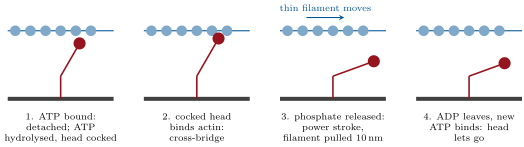
Each thick filament bristles with some three hundred myosin heads, and each head is a motor that walks along actin in a cycle of four steps. (1) With ATP bound, the head is detached from actin; it hydrolyses the ATP to ADP and phosphate and cocks itself into a strained, high-energy shape. (2) The cocked head binds an actin subunit, forming a cross-bridge. (3) Phosphate is released and the head snaps to its relaxed shape, pulling the thin filament some toward the centre of the sarcomere — the power stroke; ADP leaves. (4) A new ATP binds and the head lets go of actin; without ATP it cannot let go, which is the rigor of death. The cycle takes about a twentieth of a second; a head spends most of it detached, so that at any instant only a fraction of the heads pull, and a filament sliding at speed is never dropped. Force is the sum of the pulls of the attached heads; shortening is their steps added up, half a micrometre per sarcomere per cycle at most; and the energy is one ATP per step per head, about — per step, of which the head converts up to half into work.
Theorem 21.3 (Force, speed and power of a muscle)
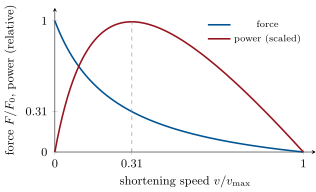
A muscle’s force falls as it shortens faster, because the faster the filaments slide, the fewer heads are attached at any instant and the more of them are dragged past their stroke before they let go. Hill’s relation describes it:
where is the isometric force (at ), the speed at no load, and , constants (). The power is zero at both ends and greatest at about a third of and a third of — which is why a cyclist changes gear and a sprinter’s stride has a preferred rate. A human muscle develops about per square centimetre of cross-section, shortens at up to ten lengths a second, and delivers some per kilogram at its best.
Proof. Hill’s curve is empirical (1938), measured on isolated frog muscle as the shortening speed against the load it lifts; the hyperbola fits because the fraction of attached heads falls with sliding speed and each attached head’s force falls as it is carried through its stroke. Power: with , is zero at and at ; differentiating gives the maximum at , which for is , where . ∎
21.3 The switch: calcium
Proposition 21.4 (Excitation–contraction coupling)
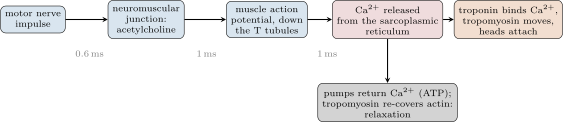
At rest the myosin heads cannot reach actin: the binding sites on the thin filament are covered by tropomyosin, a rod lying in the groove of the actin helix, held there by troponin. The switch is calcium. An action potential on the fibre’s membrane runs down the T tubules into the interior and, at the junctions where a T tubule meets the sarcoplasmic reticulum, opens the reticulum’s calcium release channels; calcium floods the myofibrils, rising from to in a millisecond, binds troponin, and troponin shifts tropomyosin off the binding sites: the heads attach, and the fibre contracts as long as the calcium stays. Pumps in the reticulum, burning ATP, take the calcium back within tens of milliseconds; tropomyosin re-covers the sites and the fibre relaxes. Relaxation is thus as active as contraction, and a muscle deprived of ATP can neither release its heads nor pump its calcium — rigor mortis. In the heart the same switch is used, but with calcium entering from outside through the membrane’s own channels to trigger the release, which is why the heart, and not skeletal muscle, is sensitive to the calcium in the blood.
21.4 Command and gradation
Definition 21.5 (The motor unit)
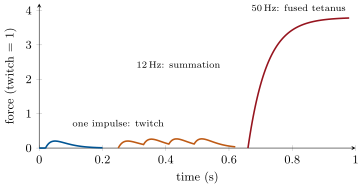
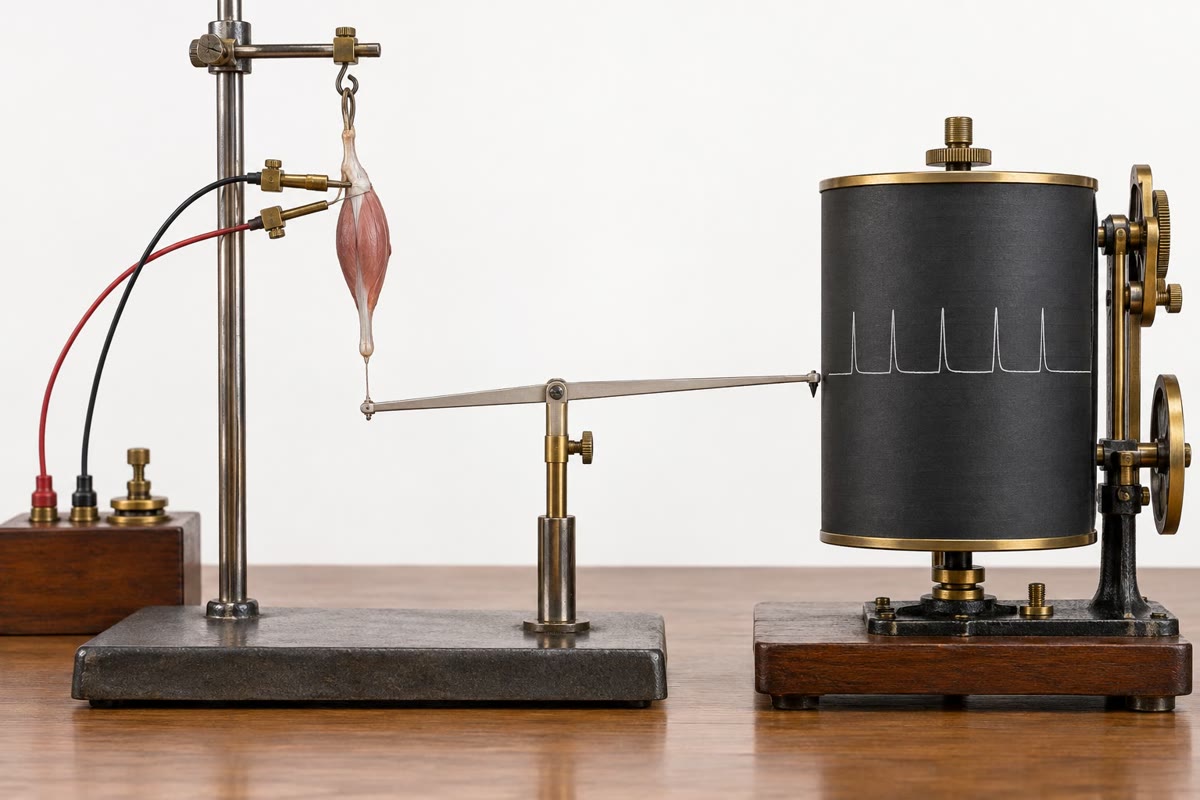
A motor neuron in the spinal cord sends its axon to a muscle and branches to innervate from a handful to a thousand fibres, scattered through the muscle; the neuron and its fibres are a motor unit, the smallest quantity of force the nervous system can command. Every impulse in the neuron makes every fibre of the unit fire once and give a twitch: a force that rises in some and decays in , because the calcium pulse is brief. Impulses in quick succession make twitches sum, since the calcium of one has not been pumped away when the next arrives; at some 30 to 50 impulses a second the force fuses into a smooth tetanus, three to five times the twitch. The nervous system grades the force of a muscle in two ways: by the rate at which each unit fires, and by the number of units it recruits — small, slow, fatigue-resistant units first (the size principle), large fast ones last, only for the greatest efforts. A muscle in ordinary use is therefore never fully on: a fraction of its units fire, in rotation, and the rest rest.
Proposition 21.6 (Reflexes and the spinal cord)
The motor neuron is the final common path: every command, from the cortex or from a reflex, ends on it. The simplest circuit is the stretch reflex of Chapter 20: sensory endings wound round special fibres inside the muscle, the muscle spindles, fire when the muscle is stretched, excite the motor neurons of the same muscle through one synapse, and inhibit those of the antagonist through an interneuron (reciprocal inhibition), so that the muscle resists the stretch — the basis of posture, since every sway is a stretch of some muscle. A second receptor, the tendon organ, fires when the muscle’s force is high and inhibits its own motor neurons: a safety valve. Withdrawal from a painful stimulus is a reflex of several synapses that flexes the limb and, on the other side, extends the other one so that you do not fall. And the brain does not command muscles but movements: the cortex sends a plan, the cerebellum corrects it against what the spindles report, the basal ganglia release it, and the spinal cord’s circuits, which can run a stepping rhythm on their own, execute it — the subject of the Year 3 volume.
21.5 Fuel and fatigue
Proposition 21.7 (Paying for the work)
A fibre holds ATP for a second or two of full effort. The first reserve is creatine phosphate, which rephosphorylates ADP within milliseconds and lasts some ten seconds — the sprinter’s fuel. The second is glycolysis of the fibre’s glycogen, without oxygen, yielding two ATP per glucose and lactate: fast, enough for a minute or two, and self-limiting as acid and phosphate accumulate. The third is oxidative metabolism of glucose and fatty acids in the mitochondria, thirty ATP per glucose, limited only by the oxygen the blood delivers (Chapter 18): the marathon. Fast glycolytic fibres rely on the first two and tire in a minute; slow oxidative fibres, red with myoglobin and packed with mitochondria, run for hours. Fatigue in a short effort is not the exhaustion of ATP — which would leave the muscle in rigor — but the accumulation of phosphate and protons, which weaken the cross-bridges and the calcium release; in a long effort it is the exhaustion of glycogen and, in the end, of the will. After the effort the muscle repays its oxygen debt: it restores creatine phosphate, converts the lactate back (in the liver) and refills its stores, breathing hard for minutes after standing still.
Example 21.8 (A hundred metres)
Ten seconds of maximal effort by of leg muscle at is of mechanical power and, at efficiency, of ATP turnover — some of ATP a second, or of ATP in the race. The muscle holds some fifty grams; creatine phosphate supplies the first five seconds, glycolysis the rest, and the sprinter finishes with lactate at in her blood and a debt she pays over the next quarter of an hour. A marathoner at for two hours burns of work, of fuel — a kilogram of glycogen and fat — with oxygen delivered at all the way, and the wall she hits at the thirtieth kilometre is the bottom of her glycogen.
21.6 Exercises
Exercise 21.1 ★
State the sliding filament mechanism and say which bands of the sarcomere change on contraction and which do not.
Solution
Solution of Exercise 21.1.
Thin filaments slide along thick ones, pulled by myosin heads; neither filament shortens. The I band and the H zone narrow and the Z discs approach; the A band (the thick filaments) keeps its length.
Exercise 21.2 ★
Give the four steps of the cross-bridge cycle and the role of ATP in each. Why does a muscle without ATP go stiff?
Solution
Solution of Exercise 21.2.
(1) ATP bound, head detached; ATP hydrolysed, head cocked. (2) Head binds actin. (3) Phosphate released, power stroke, ADP released. (4) New ATP binds and the head detaches. ATP is needed to release the head: without it every head stays bound and the muscle locks — rigor.
Exercise 21.3 ★
List the events from a motor nerve impulse to the attachment of myosin heads, with the time each takes.
Solution
Solution of Exercise 21.3.
Nerve impulse; release of acetylcholine and the end-plate potential (); muscle action potential over the fibre and down the T tubules (); calcium released from the sarcoplasmic reticulum (); calcium binds troponin, tropomyosin moves, heads attach (a few milliseconds); force rises over tens of milliseconds.
Exercise 21.4 ★
Define motor unit, twitch and tetanus, and give the two ways the nervous system grades force.
Solution
Solution of Exercise 21.4.
Motor unit: one motor neuron and all the fibres it innervates. Twitch: the brief contraction from a single impulse. Tetanus: the fused, sustained contraction from impulses arriving faster than the twitch decays. Force is graded by the firing rate of each unit and by the number of units recruited.
Exercise 21.5 ★★
A sarcomere of shortens to in . Compute the sliding speed of the thin filaments relative to the thick ones and, with a step, the number of cycles each attached head must perform per second.
Solution
Solution of Exercise 21.5.
Each half-sarcomere slides in : ; that is 20 strokes of in , 400 a second if one head were attached throughout.
Exercise 21.6 ★★
A fibre of has sarcomeres in series and shortens by in . Compute its shortening speed in lengths per second and in metres per second, and the speed of each sarcomere.
Exercise 21.7 ★★
With Hill’s relation and , lengths a second, compute the force (as a fraction of ) at 1, 3 and 6 lengths a second, and the power at each. Where is the power greatest?
Solution
Solution of Exercise 21.7.
: at 1, 3 and 6 lengths a second (, , of ): , , . Power (in lengths per second): , , — greatest near 3 lengths a second, about a third of .
Exercise 21.8 ★★
A quadriceps of cross-section at : compute its maximal isometric force. It acts from the knee joint on a lever whose foot is from the joint: what force can the foot exert?
Solution
Solution of Exercise 21.8.
; at the foot .
Exercise 21.9 ★★
A twitch’s calcium pulse lasts . Explain why impulses at give a rippling force, at a smooth tetanus, and why the tetanic force exceeds the twitch.
Solution
Solution of Exercise 21.9.
At the impulses come every , after the calcium of the previous one is gone: separate twitches, each starting from a partly relaxed state, giving a ripple. At they come every , before the calcium is pumped away: the calcium stays high and the force fuses. The tetanus exceeds the twitch because a single calcium pulse is too brief for the cross-bridges to stretch the series elastic elements and develop full force; sustained calcium lets them.
Exercise 21.10 ★★★
A sprinter’s of leg muscle delivers for at efficiency. Compute the ATP used (), the creatine phosphate needed to cover the first , and the glucose fermented to cover the rest (2 ATP per glucose). What lactate concentration does that put into of body water?
Solution
Solution of Exercise 21.10.
Work , ATP energy , mol of ATP. First : mol of creatine phosphate. Remaining mol of ATP by glycolysis: mol of glucose, mol of lactate — in , .
Exercise 21.11 ★★★
Predict the effect on contraction of: a drug that blocks the reticulum’s calcium release channel; one that blocks its pump; a mutation making troponin insensitive to calcium; the removal of calcium from the blood, for skeletal muscle and for the heart.
Solution
Solution of Exercise 21.11.
Blocked release channel: no calcium, no contraction — paralysis. Blocked pump: calcium stays up, the muscle cannot relax — a contracture. Insensitive troponin: tropomyosin never moves, no contraction. No calcium in the blood: skeletal muscle contracts normally (its calcium is internal); the heart, which needs external calcium to trigger its release, stops.
Exercise 21.12 ★★★
“A muscle is a machine that converts chemical energy into force with the efficiency of a good engine and the control of a computer.” Discuss the efficiency (a quarter to a half), what limits it, and what the nervous system’s two ways of grading force buy that a single switch would not.
Solution
Solution of Exercise 21.12.
The head converts up to half of an ATP’s free energy into work; the rest is heat, and the losses of the pumps, of the cross-bridges that attach without pulling at speed, and of the elastic elements bring the whole to a quarter — the efficiency of a good petrol engine. Two ways of grading force allow both fine control at low effort (small units added one at a time, each firing faster or slower) and a large range (a thousandfold, from one small unit at twitch rate to every unit in tetanus); a single switch would give one force or none.
21.7 Problem: The Physiology of a Jump
Problem 21.1
Weekend problem — a standing jump analysed from the sarcomere to the take-off: the sliding, the cross-bridges, the calcium switch, the force–velocity limit, the motor units and the fuel, ending on the number of cross-bridge strokes, the force at the take-off speed, and the ATP the jump costs
A person of jumps straight up, raising the body’s centre of mass by during a push of . The leg extensors ( of muscle) have a combined cross-section of at ; their fibres are long ( sarcomeres) and shorten by during the push; the joints multiply the muscle’s shortening by at the foot and divide its force by the same factor. lengths a second, . Each thick filament carries myosin heads; there are thick filaments per square centimetre of muscle; a stroke is and costs one ATP (, ); efficiency . The muscle holds of ATP and of creatine phosphate. Fibres are across. Motor units: per muscle group, from to fibres each.
Part I — The mechanics.
- Compute the take-off speed needed to rise (), and the kinetic energy at take-off.
- Compute the mean force the legs exert on the ground during the push (work over equals the kinetic energy plus the work against gravity), and compare with the weight.
- Compute the maximal isometric force of the extensors and, with the lever ratio of 10, the maximal foot force it could give.
- Compute the fibres’ shortening speed in lengths per second and as a fraction of .
- With Hill’s relation, compute the force available at that speed as a fraction of , and the foot force it gives. Can the muscle alone do the jump? Where does the rest come from?
- Compute the mean mechanical power during the push and the power per kilogram of extensor.
Part II — The cross-bridges.
- How far does each sarcomere shorten, and how many strokes must be made along each half-sarcomere to slide its filaments that far?
- Compute the sliding speed in each half-sarcomere and the number of strokes per second a head would make if it were attached continuously.
- Compute the number of myosin heads in the extensors.
- Compute the work the muscle itself does (its force at the jump’s speed times its shortening), the work per stroke at efficiency, and the number of strokes needed.
- How many strokes is that per head, against the number available from question 7? Comment on the reserve.
- Compute the ATP consumed by the jump, in moles and in grams (), and check the efficiency from the energy of that ATP.
Part III — The switch and the command.
- The push takes and the calcium pulse of one impulse . What firing rate keeps the fibres in tetanus, and how many impulses does each motor neuron send?
- The free calcium rises from to in a fibre of . How many free calcium ions is that, and how many pump cycles (two ions per ATP) does taking them back cost?
- Compute the number of fibres in the extensors and the cross-bridge ATP per fibre per impulse, and compare with the pump cost of question 14. The real cost of pumping is about a quarter of the muscle’s ATP: what does the free calcium understate?
- The nervous system recruits units by size. For the jump, which units are recruited and in what order? What fraction of the would a gentle step use?
- Explain why the force can be graded finely at low effort and only coarsely near the maximum.
- A person on a drug that blocks the neuromuscular junction half-way: predict the twitch, the tetanus and the jump.
Part IV — The fuel.
- Compute the ATP stored in the extensors and compare with the jump’s consumption.
- Compute the creatine phosphate store and the number of jumps it could pay for.
- Ten jumps in a row: which fuel takes over, and what accumulates?
- The blood can deliver of oxygen a minute to the extensors (6 ATP per ). What ATP turnover does the jump’s power require, and what oxygen supply would that take? Conclude.
- After the jumps the person breathes hard for a minute. Compute the oxygen needed to resynthesise the creatine phosphate and ATP used ( per molecule) and compare with the resting consumption of .
- Why does a jumper’s muscle not go into rigor even though ATP is turned over at such a rate?
- State the result: the strokes per half-sarcomere, the force fraction at the jump’s speed, and the ATP the jump costs.
Solution
Solution of Problem 21.1.
1. ; . 2. Work over : , twice the weight. 3. ; at the foot, . 4. in : , lengths a second, . 5. : in the muscle, at the foot — well short of the needed. Muscle shortening alone cannot make this jump. The counter-movement supplies the rest: as the jumper dips, the stretched tendons store elastic energy, and the muscle, contracting nearly isometrically at high force, loads them; the tendons then recoil faster than any fibre can shorten. 6. ; of extensor. 7. cm per sarcomere, per half: 42 strokes of . 8. in : ; 140 strokes a second if continuously attached. 9. heads. 10. ; per stroke ; strokes. 11. strokes per head, of the 42 available: about . The reserve is small — the muscle is working near its limit, as question 5 found. 12. mol, ; its energy , of which became work: . 13. Faster than one impulse per : above ; about 10 impulses in . 14. free ions; ATP. 15. Fibres: ; cross-bridge ATP per fibre per impulse , forty thousand times the pump estimate. The free calcium is a small remainder: the reticulum releases of the order of , ten times the free rise, almost all of it bound at once by troponin and the buffers — and all of it must be pumped back. 16. For a maximal jump, nearly every unit within a few tens of milliseconds, the small ones first and the large last; a gentle step recruits perhaps a tenth to a fifth of them. 17. Units are recruited in order of size: at low effort each new unit adds a small increment, at high effort the remaining units are large and each adds a big step. 18. The end-plate potential of every fibre is halved; the fibres whose potential falls below threshold do not fire, so the twitch and tetanus are smaller, and the jump falls short. 19. of ATP: six jumps’ worth. 20. of creatine phosphate: about 23 jumps. 21. Ten jumps use mol, not yet exhausting the creatine phosphate; after twenty or so, glycolysis takes over, and lactate and protons accumulate. 22. of work at is of ATP, mol a second, needing mol of oxygen a second — , , ten times what the blood can bring: the jump is anaerobic by necessity, and the oxygen comes afterward. 23. mol of ATP needs mol of oxygen, ; paid over a minute, , two and a half times the resting consumption. 24. ATP is rephosphorylated from creatine phosphate within milliseconds, so its concentration barely falls; rigor needs ATP near zero, which a living muscle with any reserve never reaches. 25. 42 strokes available per half-sarcomere, 24 needed; at the jump’s speed; mol, , of ATP.