Coach
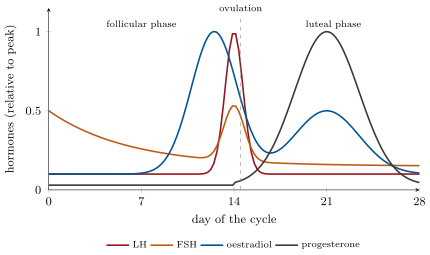
CoachThe cycle is counted from the first day of menstruation and lasts about 28 days. Follicular phase (days 1–14): FSH, freed of feedback by the previous corpus luteum’s death, recruits a cohort of follicles; they secrete oestradiol, which rises steadily; oestradiol and inhibin lower FSH, and only the follicle with the most FSH receptors survives the fall — the dominant follicle. In the uterus, oestradiol rebuilds the endometrium (the proliferative phase) and thins the cervical mucus. Ovulation (day 14): when oestradiol has stayed above about for a day and a half, its feedback on the hypothalamus and pituitary switches from negative to positive; LH rises tenfold in a day — the LH surge — and about 36 hours after its onset the follicle ruptures and releases the oocyte. Luteal phase (days 15–28): the emptied follicle becomes the corpus luteum, which under LH secretes progesterone () and oestradiol; progesterone turns the endometrium secretory, thickens the mucus, raises the basal body temperature by , and with oestradiol suppresses LH and FSH. The corpus luteum has a lifespan of about 14 days; unless hCG from an embryo rescues it, it regresses, progesterone and oestradiol fall, the endometrium is shed (menstruation), FSH rises, and the next cycle begins. The luteal phase is fixed at 14 days; variation in cycle length is variation in the follicular phase.