University Biology — Year 2 · Bachelor Year 2
9Hormonal Control of Reproduction
Every month, on a schedule kept to within a day or two for thirty years, one follicle ripens, one egg is released, the lining of the uterus is built up and then, unless an embryo has arrived, torn down. No clock in the body ticks at this rate; the rhythm emerges from a conversation between three organs — the hypothalamus, the pituitary and the ovary — in which each hormone controls the release of the next and the last controls the first. This chapter takes that conversation apart: the axis that runs both sexes, the tonic control of the testis, the cyclic control of the ovary with its remarkable switch from negative to positive feedback, and the ways the axis is overridden by pregnancy, by drugs, and by the clinic.
9.1 The axis
Definition 9.1 (The hypothalamo-pituitary-gonadal axis)
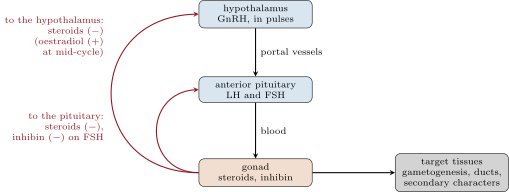
Neurons of the hypothalamus secrete GnRH (gonadotropin-releasing hormone, a peptide of ten amino acids) into the small portal vessels that run to the anterior pituitary, in brief pulses every one to two hours. GnRH makes the pituitary secrete two glycoprotein hormones into the general circulation, the gonadotropins LH (luteinising hormone) and FSH (follicle-stimulating hormone). These act on the gonads: LH on the steroid-making cells (Leydig cells, theca and luteal cells), FSH on the cells that nurse the gametes (Sertoli and granulosa cells). The gonads answer with steroids — testosterone, oestradiol, progesterone — and with the peptide inhibin, and these feed back on the hypothalamus and pituitary: the steroids on both, mostly negatively; inhibin on FSH alone. The result is a regulated loop in which the gonad’s output is held at a set point, and the same three-tier design runs the thyroid and the adrenal cortex. The mechanisms by which these hormones act on their cells are the subject of Chapter 19.
Proposition 9.2 (Why the pulses matter)
The pituitary responds to GnRH only if it arrives in pulses. A cell exposed to a hormone continuously removes the hormone’s receptors from its surface (desensitisation); if the receptor pool is replenished at a rate , removed at a basal rate and, in the presence of hormone , at an extra rate , then
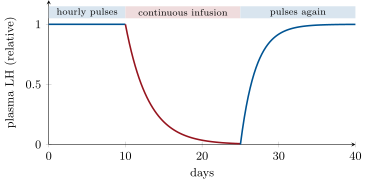
so that a continuous high drives the receptor number to a low steady state and the cell falls silent, whereas brief pulses separated by hormone-free intervals let the pool recover (time constant ) between them. A GnRH pulse every ninety minutes keeps the pituitary responsive; a constant infusion, or a long-acting GnRH agonist, shuts it down within days — the basis of the drugs that suppress the axis in prostate cancer, endometriosis and precocious puberty. Pulse frequency also encodes information: fast pulses favour LH, slow pulses favour FSH.
Evidence. Knobil (1978–1980) destroyed the GnRH neurons of rhesus monkeys, which abolished LH, FSH and the cycle, and then replaced GnRH by pump: one pulse an hour restored the gonadotropins and normal ovulatory cycles; the same daily dose given continuously restored them for a few days and then LH and FSH collapsed to zero; returning to pulses restored them again. The pattern of delivery, not the amount, is the signal. ∎
9.2 The male: tonic control
Proposition 9.3 (Control of the testis)
LH acts on the Leydig cells, which make testosterone ( in the blood of an adult man, a hundred times more inside the testis). FSH acts on the Sertoli cells, which — with the local testosterone — support spermatogenesis and secrete inhibin. Testosterone feeds back on the hypothalamus and pituitary to hold LH down; inhibin feeds back on the pituitary to hold FSH down. Both loops are negative and the system is tonic: hormone levels fluctuate with the pulses and with the day (highest in the morning) but do not cycle, and sperm are made continuously. Testosterone also builds and maintains the accessory glands and ducts, the beard, the voice, muscle and bone, red-cell production and libido, and in the fetus made the male body (Chapter 8). Castration removes it: LH and FSH rise several-fold for want of feedback, and the secondary characters regress; injected testosterone restores the characters — but not fertility, because it also suppresses LH and so the intratesticular testosterone that spermatogenesis requires. This is why anabolic steroids make men infertile.
Evidence. Berthold (1849) castrated cockerels: their combs shrank and they neither crowed nor fought. A testis grafted into the abdomen of a castrate, where it grew a new blood supply but no nerves, restored comb, crowing and fighting: the testis acted through the blood — the first demonstration of an internal secretion, fifty years before the word hormone. Testosterone was isolated and synthesised in 1935. ∎
9.3 The female: a cycle with a switch
Definition 9.4 (The ovarian and uterine cycles)
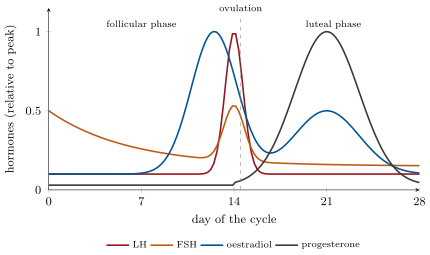
The cycle is counted from the first day of menstruation and lasts about 28 days. Follicular phase (days 1–14): FSH, freed of feedback by the previous corpus luteum’s death, recruits a cohort of follicles; they secrete oestradiol, which rises steadily; oestradiol and inhibin lower FSH, and only the follicle with the most FSH receptors survives the fall — the dominant follicle. In the uterus, oestradiol rebuilds the endometrium (the proliferative phase) and thins the cervical mucus. Ovulation (day 14): when oestradiol has stayed above about for a day and a half, its feedback on the hypothalamus and pituitary switches from negative to positive; LH rises tenfold in a day — the LH surge — and about 36 hours after its onset the follicle ruptures and releases the oocyte. Luteal phase (days 15–28): the emptied follicle becomes the corpus luteum, which under LH secretes progesterone () and oestradiol; progesterone turns the endometrium secretory, thickens the mucus, raises the basal body temperature by , and with oestradiol suppresses LH and FSH. The corpus luteum has a lifespan of about 14 days; unless hCG from an embryo rescues it, it regresses, progesterone and oestradiol fall, the endometrium is shed (menstruation), FSH rises, and the next cycle begins. The luteal phase is fixed at 14 days; variation in cycle length is variation in the follicular phase.

Theorem 9.5 (The switch from negative to positive feedback)
Oestradiol at the low levels of the early follicular phase inhibits LH and FSH; oestradiol above about , held for more than about , does the opposite: it makes the hypothalamus release a burst of GnRH and the pituitary respond to it with a tenfold rise of LH. The mechanism is a change of sign, not of magnitude: a high, sustained dose induces in the pituitary a large store of LH and a heightened sensitivity to GnRH, and in the hypothalamus (through kisspeptin neurons) a switch of the GnRH pulse generator into a surge mode. The switch converts a graded signal — how much oestradiol the follicle makes — into an all-or-none event timed to the day, which is what ovulation requires; and because only a large, mature follicle can sustain , the surge fires only when there is an egg ready to release. Once ovulation has occurred, the corpus luteum’s progesterone restores the negative feedback and no second surge follows.
Evidence. In women and monkeys with the axis suppressed, an infusion of oestradiol that raises the plasma level above for two days is followed by an LH surge; the same amount given for one day, or a lower level for three, is not. Progesterone given before the infusion blocks the surge; given at the same time it advances and amplifies it. The threshold in dose and duration reproduces the timing of the natural surge from the natural oestradiol rise. ∎
9.4 Overriding the cycle
Proposition 9.6 (Pregnancy, lactation, menopause)
An implanting embryo secretes hCG, an LH-like hormone that binds the LH receptor and keeps the corpus luteum alive and secreting past its fourteen days; by week ten the placenta itself makes enough progesterone and oestrogens to maintain the pregnancy and the corpus luteum is dispensable. Throughout pregnancy the high steroids hold LH and FSH at zero: no follicle grows, no ovulation occurs. After birth, suckling raises prolactin and slows the GnRH pulses, and ovulation stays suppressed for months. At the menopause the stock of follicles is exhausted: oestradiol and inhibin fall, and, with nothing to feed back, LH and FSH rise to ten times their earlier level and stay there — the signature of a gland that has stopped answering.
Proposition 9.7 (Contraception and assisted reproduction)
The combined pill delivers a synthetic oestrogen and a progestin every day: the constant steroid level keeps FSH and LH low, no follicle is recruited, no oestradiol rise occurs, and the surge never fires; the progestin also thickens the cervical mucus. The seven-day break lets the endometrium bleed; missing pills for more than two days in a row lets FSH escape and a follicle may grow. Emergency contraception delays the surge for a few days with a large progestin dose. In in vitro fertilisation the axis is driven the other way: daily FSH for ten days overrides the selection of a single dominant follicle and matures ten or more; a GnRH antagonist prevents a premature spontaneous surge; an injection of hCG substitutes for the surge, and the oocytes are collected 34 to 36 hours later, just before they would have been released; they are fertilised in the dish and one or two embryos are transferred, the rest frozen. In men, exogenous testosterone or a GnRH analogue suppresses spermatogenesis by suppressing LH — the principle of a male hormonal contraceptive, still not marketed. All of this is the axis of the first section, read backwards.
9.5 Exercises
Exercise 9.1 ★
Draw the axis for the male: the three tiers, the four hormones, the two feedback loops, and the cells each hormone acts on.
Solution
Solution of Exercise 9.1.
Hypothalamus (GnRH, pulses) anterior pituitary (LH, FSH) testis: LH on Leydig cells (testosterone), FSH on Sertoli cells (spermatogenesis, inhibin). Feedback: testosterone inhibits GnRH and LH; inhibin inhibits FSH.
Exercise 9.2 ★
Give the phases of the ovarian and uterine cycles with their days and the hormone that dominates each.
Solution
Solution of Exercise 9.2.
Ovary: follicular phase, days 1–14, oestradiol from the growing follicle; ovulation, day 14, LH surge; luteal phase, days 15–28, progesterone from the corpus luteum. Uterus: menstruation, days 1–5 (steroid withdrawal); proliferative phase, days 6–14 (oestradiol); secretory phase, days 15–28 (progesterone).
Exercise 9.3 ★
Explain how the combined pill prevents ovulation, and why bleeding occurs in the pill-free week.
Solution
Solution of Exercise 9.3.
The daily oestrogen and progestin hold LH and FSH low by negative feedback, so no follicle is recruited, no oestradiol rise occurs and the surge never fires; the progestin also thickens the mucus. In the pill-free week the steroids fall and the endometrium, built under them, is shed — a withdrawal bleed, not a menstruation after an ovulation.
Exercise 9.4 ★
What happens to LH, FSH and the secondary sexual characters of a castrated adult male? Which of these does injected testosterone reverse, and which not?
Solution
Solution of Exercise 9.4.
LH and FSH rise several-fold (no testosterone or inhibin feedback); muscle, libido, the accessory glands regress. Testosterone restores the characters and brings LH back down, but not fertility: the testes are gone, and even in a man with testes exogenous testosterone suppresses LH and so the intratesticular testosterone that spermatogenesis needs.
Exercise 9.5 ★★
GnRH pulses come every in the follicular phase and every in the luteal phase. How many pulses a day in each? The pituitary favours LH at fast pulses and FSH at slow ones: which gonadotropin should rise first when the corpus luteum dies, and why is that the right one?
Solution
Solution of Exercise 9.5.
pulses a day; . When the corpus luteum dies the pulses are still slow, favouring FSH: FSH rises first — the right hormone, since it is FSH that recruits the next cohort of follicles.
Exercise 9.6 ★★
Convert of oestradiol (molar mass ) into , and of progesterone () into . How many molecules of oestradiol are there in one microlitre of plasma at the surge threshold?
Solution
Solution of Exercise 9.6.
: . : . In one microlitre: mol molecules.
Exercise 9.7 ★★
A woman’s cycles last 35 days. Given that the luteal phase is fixed, on what day does she ovulate, and which days are fertile if sperm survive three days and the egg one? Why does the calendar method fail for irregular cycles?
Solution
Solution of Exercise 9.7.
Ovulation on day ; fertile from day 18 to day 22. With irregular cycles the follicular phase, and so the ovulation day, cannot be predicted from past cycles, and the window is missed or misplaced.
Exercise 9.8 ★★
An embryo implants on day 21 of a 28-day cycle and its hCG, starting at , doubles every two days. The corpus luteum needs a few IU/L of hCG by day 26 to survive. Is the embryo in time? What would happen if implantation were delayed to day 25?
Solution
Solution of Exercise 9.8.
From day 21 to 26 is 2.5 doublings: IU/L — enough. Implanting on day 25 gives IU/L on day 26; the corpus luteum, already regressing, is not rescued, progesterone falls and the embryo is lost with the period. Late implantation is a common cause of early loss.
Exercise 9.9 ★★
State what Knobil’s experiment showed and what it ruled out, and predict the effect of giving a woman a long-acting GnRH agonist for a month: on LH, on oestradiol, on the endometrium.
Solution
Solution of Exercise 9.9.
The pituitary responds to the pattern of GnRH, not its amount: hourly pulses sustain LH and FSH, the same daily dose infused continuously abolishes them. It ruled out a simple dose–response. A month of long-acting agonist: after a few days’ flare, LH falls to near zero (receptor desensitisation), oestradiol to postmenopausal levels, the endometrium atrophies and no cycle occurs — a reversible medical menopause.
Exercise 9.10 ★★★
In the receptor model, take receptors per hour, and while hormone is present. Compute the steady-state receptor number with no hormone and with continuous hormone. With a two-minute pulse every hour, compute the number lost per pulse and the fraction of the deficit recovered before the next pulse, and deduce the level around which the pool settles.
Solution
Solution of Exercise 9.10.
No hormone: . Continuous: . A two-minute pulse removes receptors (); in the following hour the deficit shrinks by a factor , i.e. of it is recovered. The pool settles where the loss per pulse equals the recovery per hour: about 150 receptors before each pulse, three quarters of the maximum — ten times the continuous level.
Exercise 9.11 ★★★
A postmenopausal woman has LH and FSH ten times the level of a young woman and very low oestradiol; a woman with a pituitary tumour secreting prolactin has low LH, low oestradiol and no cycles; a woman with a granulosa-cell tumour has high oestradiol, low LH and no cycles. Explain each profile from the axis.
Solution
Solution of Exercise 9.11.
Menopause: no follicles, so no oestradiol or inhibin, so no feedback: LH and FSH run high. Prolactinoma: prolactin slows the GnRH pulse generator, so LH is low, the follicles are not driven, oestradiol is low and there is no cycle. Granulosa-cell tumour: constant high oestradiol suppresses LH by negative feedback (and without a maturing follicle there is nothing to ovulate), so the cycle stops with high oestradiol — and the endometrium overgrows.
Exercise 9.12 ★★★
“The same hormone inhibits and then triggers the LH surge.” Explain how oestradiol can have both effects, why ovulation needs a switch rather than a dial, and what would go wrong with a dial.
Solution
Solution of Exercise 9.12.
Low or brief oestradiol reduces GnRH and LH; high, sustained oestradiol (above for more than 36 hours) changes the response of the kisspeptin–GnRH system and of the pituitary, which has meanwhile stocked LH, so that the same hormone now provokes a burst. Ovulation must be all-or-none and timed: the egg must be released once, on one day, when a follicle is ripe. A dial (LH proportional to oestradiol) would give a gradual, partial luteinisation, follicles ovulating half-ripe or several at once, and no defined fertile day.
9.6 Problem: A Cycle Measured
Problem 9.1
Weekend problem — daily hormone measurements of one cycle are read for their phases, the ovulation day and the fertile window; the surge threshold, the corpus luteum’s clock and the hCG rescue are computed; the receptor model explains Knobil; and the axis is driven backwards in the clinic, ending on the ovulation day, the luteal length, the fertile window and the surge threshold
Blood was sampled on selected days of a woman’s cycle:
| day | 1 | 5 | 8 | 11 | 12 | 13 | 14 | 15 | 21 | 27 |
|---|---|---|---|---|---|---|---|---|---|---|
| oestradiol () | 40 | 60 | 110 | 210 | 260 | 310 | 220 | 150 | 160 | 50 |
| LH () | 5 | 5 | 6 | 7 | 8 | 20 | 65 | 15 | 4 | 4 |
| progesterone () | 0.5 | 0.5 | 0.6 | 0.7 | 0.8 | 1.0 | 1.5 | 3 | 16 | 2 |
| temperature () | 36.4 | 36.4 | 36.4 | 36.4 | 36.4 | 36.4 | 36.4 | 36.5 | 36.8 | 36.7 |
Menstruation began on day 1 and again on day 29.
Part I — Reading the cycle.
- Identify the follicular and luteal phases from the table, with the hormone that marks each.
- On what day did the LH surge peak? When did ovulation occur?
- How long was the luteal phase? Is it consistent with the lifespan of the corpus luteum?
- Explain the temperature shift and why it confirms, but cannot predict, ovulation.
- On which days was oestradiol above ? Relate the duration to the surge.
- Give the fertile window of this cycle (sperm three days, egg one day).
Part II — Numbers.
- Convert the day-13 oestradiol to , and the day-21 progesterone to .
- By what factor did LH rise from day 12 to day 14? Why does it fall so fast afterwards (the half-life of LH is about )?
- If this woman’s next cycle had a 21-day follicular phase, on what day would she ovulate and what would the cycle length be?
- An embryo implants 7 days after ovulation. On what day of this cycle would hCG appear, and, doubling every two days from , what level would it reach by day 27?
- Explain why the day-27 progesterone of shows that no embryo implanted.
- What would the day-27 values of progesterone and oestradiol have been if one had?
Part III — Feedback and pulses.
- Explain, with the feedback signs, why FSH is highest at the start of the cycle and why only one follicle usually survives.
- In the receptor model with per hour, , , compute without hormone and under continuous hormone.
- A pulse lasts . Starting from the unstimulated , how many receptors does one pulse remove (use the linear approximation )? What fraction of the deficit is recovered in the hour before the next pulse (time constant ), and around what level does the pool settle?
- Use these numbers to explain Knobil’s result.
- A man is given a GnRH agonist continuously for prostate cancer. Predict his LH and testosterone after one day and after one month, and explain the difference.
- A woman’s granulosa cells fail to make inhibin. Predict her FSH and LH, and the consequence for follicle recruitment.
Part IV — The clinic.
- For in vitro fertilisation this woman receives FSH daily from day 2. Explain why ten follicles mature instead of one.
- Why is a GnRH antagonist added from day 6, and what would happen without it?
- hCG is injected when the follicles are ripe; the oocytes are collected 35 hours later. Justify the timing from the table.
- Ten oocytes are collected; fertilise, of embryos reach the blastocyst stage, and each transferred blastocyst implants with probability . Expected number of blastocysts? Probability of at least one pregnancy if two are transferred?
- Explain why the combined pill, taken by this woman, would have produced a table with no LH surge and no progesterone rise.
- A male contraceptive based on a GnRH antagonist would also abolish testosterone. What must be given with it, and why does giving it not restore sperm production?
- State the result: ovulation day, luteal length, fertile window, and the oestradiol threshold and duration that triggered the surge.
Solution
Solution of Problem 9.1.
1. Follicular, days 1–14: oestradiol rising, progesterone low. Luteal, days 15–28: progesterone high. 2. The surge peaked on day 14 (started on day 13); ovulation about 36 hours after the onset, on day 15. 3. Days 15 to 28: 14 days, the lifespan of the corpus luteum. 4. Progesterone raises the thermoregulatory set point by to ; the rise appears a day or two after ovulation, so it confirms that ovulation has happened but cannot announce it. 5. Days 11 to 14 (210, 260, 310, 220): three to four days, more than the 36 hours the switch requires. 6. Days 12 to 16. 7. ; . 8. . With a one-hour half-life, LH halves every hour once secretion stops, so a day later it is back near baseline. 9. Ovulation around day 22, cycle of about 36 days. 10. Implantation on day 22; by day 27 (five days, 2.5 doublings) about . 11. Progesterone falling to on day 27 means the corpus luteum is regressing on schedule: nothing rescued it. 12. Progesterone around and rising, oestradiol around . 13. At the end of the cycle oestradiol, progesterone and inhibin fall together and FSH escapes its feedback; as the cohort grows, oestradiol and inhibin rise and FSH falls, and only the follicle with the most FSH receptors (the most granulosa cells) keeps growing on the falling FSH — the rest die. 14. without hormone; under continuous hormone. 15. receptors, ; time constant , so of the deficit is recovered in an hour; the pool settles around 150 receptors, three quarters of the maximum. 16. Pulses keep the pituitary at about 150 receptors and it answers each pulse with LH; a continuous infusion drives the pool to 15 and the same cells fall silent, whatever the dose; pulses restore the pool and the response. 17. Day one: LH and testosterone rise (the agonist stimulates receptors that are still there — the flare). One month: receptors desensitised, LH near zero, testosterone at castrate levels, which is the therapeutic aim. 18. FSH rises (no inhibin), LH stays normal; more follicles survive selection each cycle, with multiple ovulations and dizygotic twins. 19. In a natural cycle the fall of FSH kills all but the dominant follicle; a constant supply of FSH keeps the whole cohort growing to maturity. 20. Ten follicles make far more than of oestradiol early, which would trigger a premature LH surge and ovulation before collection; the antagonist blocks GnRH and no surge can occur. 21. In the table the surge peaked on day 14 and ovulation followed about 36 hours after its onset; hCG substitutes for the surge, and collection at 35 hours catches the oocytes mature but still in the follicle. 22. embryos, blastocysts; . 23. Constant oestrogen and progestin keep FSH and LH low: no follicle grows, oestradiol never rises to the threshold, no surge, no corpus luteum, no progesterone rise. 24. Testosterone must be given for the secondary characters and libido; but it does not restore the high intratesticular concentration that Leydig cells provided, so spermatogenesis stays suppressed — which is the point. 25. Ovulation on day 15; luteal phase 14 days; fertile window days 12–16; surge triggered by oestradiol above for more than 36 hours, met on days 11–14.