 Coach
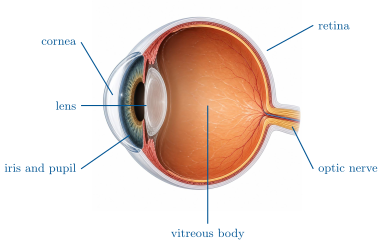
CoachThe eye is a globe about across. Light enters through the transparent cornea, passes the pupil — the opening in the coloured iris, which widens in the dark and narrows in bright light — and the lens, crosses the clear jelly of the vitreous body, and reaches the retina, the light-sensitive layer lining the back of the globe. Cornea and lens together form, on the retina, a small inverted image of the scene; the lens, whose curvature muscles can change, adjusts the focus from distant to near objects (accommodation). The optic nerve leaves the back of the eye carrying the retina’s signals to the brain.
Examples
Example 21.2 (Focus, and its faults)
A relaxed eye focuses distant objects on the retina; to read at the lens must bulge. An eye slightly too long focuses distant objects in front of the retina — short sight, corrected by a diverging spectacle lens; an eye too short, or a lens that has stiffened with age, cannot bring near objects to focus — long sight, corrected by a converging lens. In each case the retina is intact: the fault is optical, and glasses put the image back where the receptors are.
Example 21.10 (What one duplication changed)
A monkey with two cone types sees the forest in two dimensions of colour, and ripe fruit is hard to pick out of foliage. After the L/M duplication, one copy could mutate towards longer wavelengths while the other kept the original — a third cone, and ripe red against green. The mutation that later breaks one copy in 8% of men simply returns the eye to the ancestral two-cone state.