 Coach
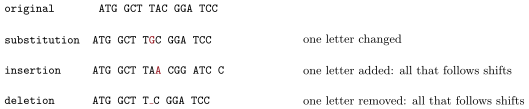
CoachA mutation is a change in the sequence of nucleotides of a DNA molecule, transmitted to the descendants of the cell in which it occurs. The commonest are point mutations, affecting one or a few nucleotides:
- a substitution: one nucleotide replaced by another;
- an insertion: one or more nucleotides added;
- a deletion: one or more nucleotides removed.
Larger changes — a segment duplicated, inverted, moved, or a whole chromosome gained or lost — are mutations too.
Examples
Example 13.3 (The frequency of mutation)
Replication leaves about one error per nucleotides (Chapter 11). A gene of base pairs is therefore miscopied about once in every replications; a human, whose genome is copied some times in a lifetime, accumulates mutations in every gene in many cells. Each child is born with some 60 new mutations that neither parent carried — almost all in the 98% of the genome that is not genes.
Example 13.9 (Pigment lost, pigment kept)
The pigment melanin is made by an enzyme. Dozens of different mutations of its gene are known, each producing a non-working enzyme and, in a person carrying two such alleles, the pigmentless condition of the chapter’s opening. Every one of them arose at random, once, in a germ cell; the visible condition appears only when two carriers pass their silent alleles to the same child. The same gene, in another allele, makes a slightly less active enzyme — and lighter skin, common in populations that lived for millennia at high latitudes, where a little less pigment lets the skin make more vitamin D from a weak sun.